


























Views
Downloads



HSG-CO.A.1 Worksheet: Line Segments — Grade 9-10 Aligned
Paste this activity's link or code into your existing LMS (Google Classroom, Canvas, Teams, Schoology, Moodle, etc.).
Students can open and work on the activity right away, with no student login required.
You'll still be able to track student progress and results from your teacher account.
Mastering the Building Blocks of Geometry
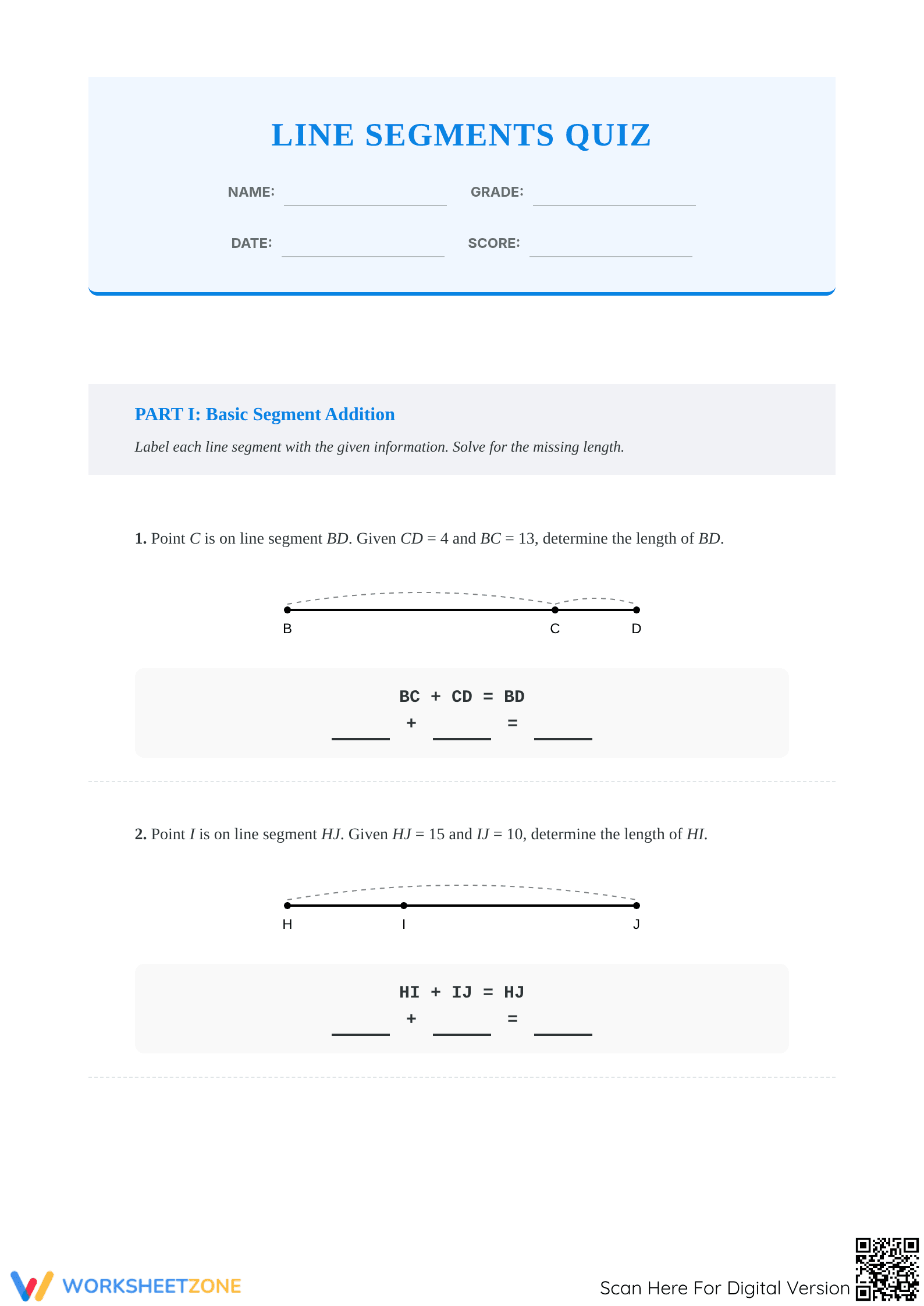
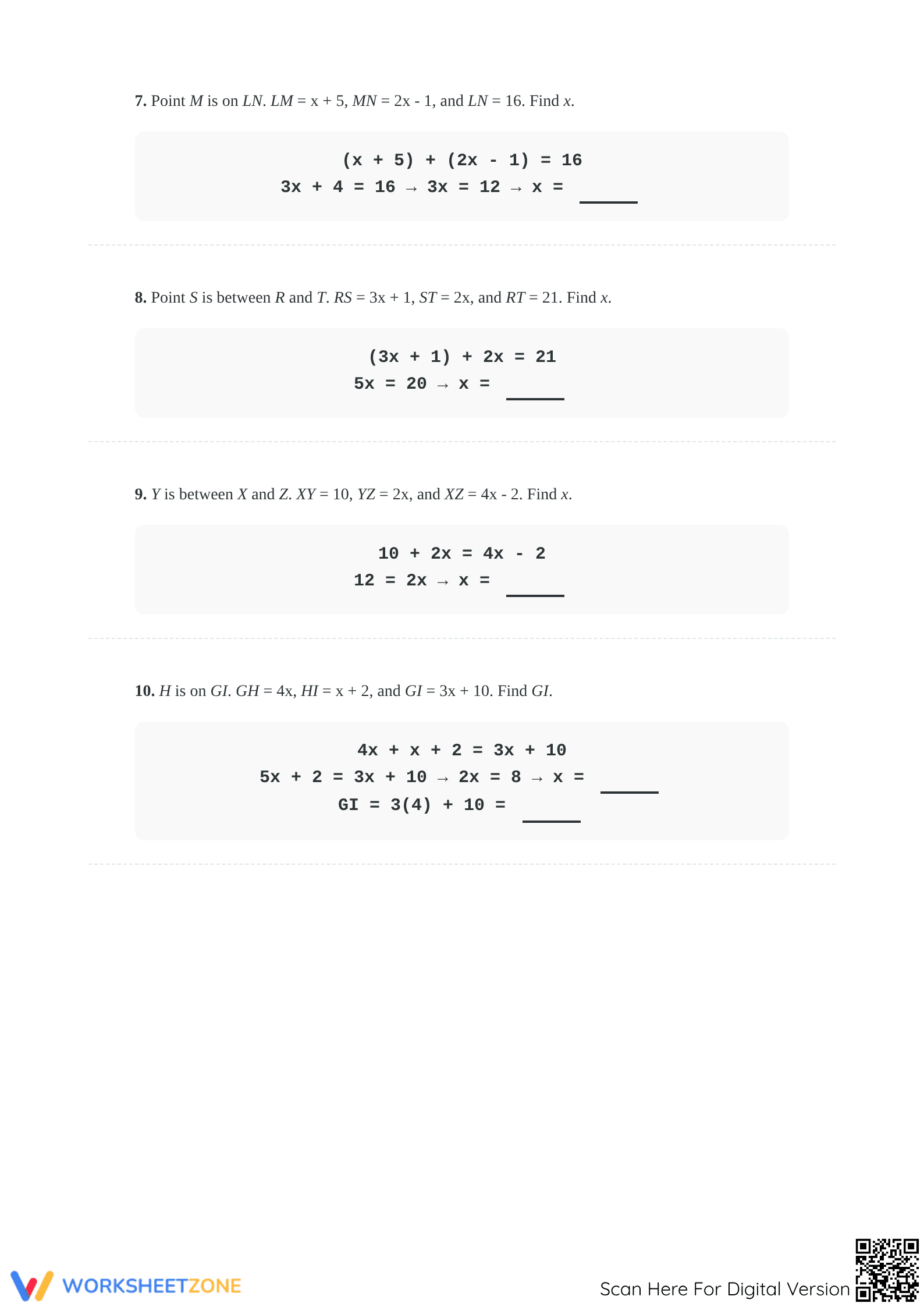
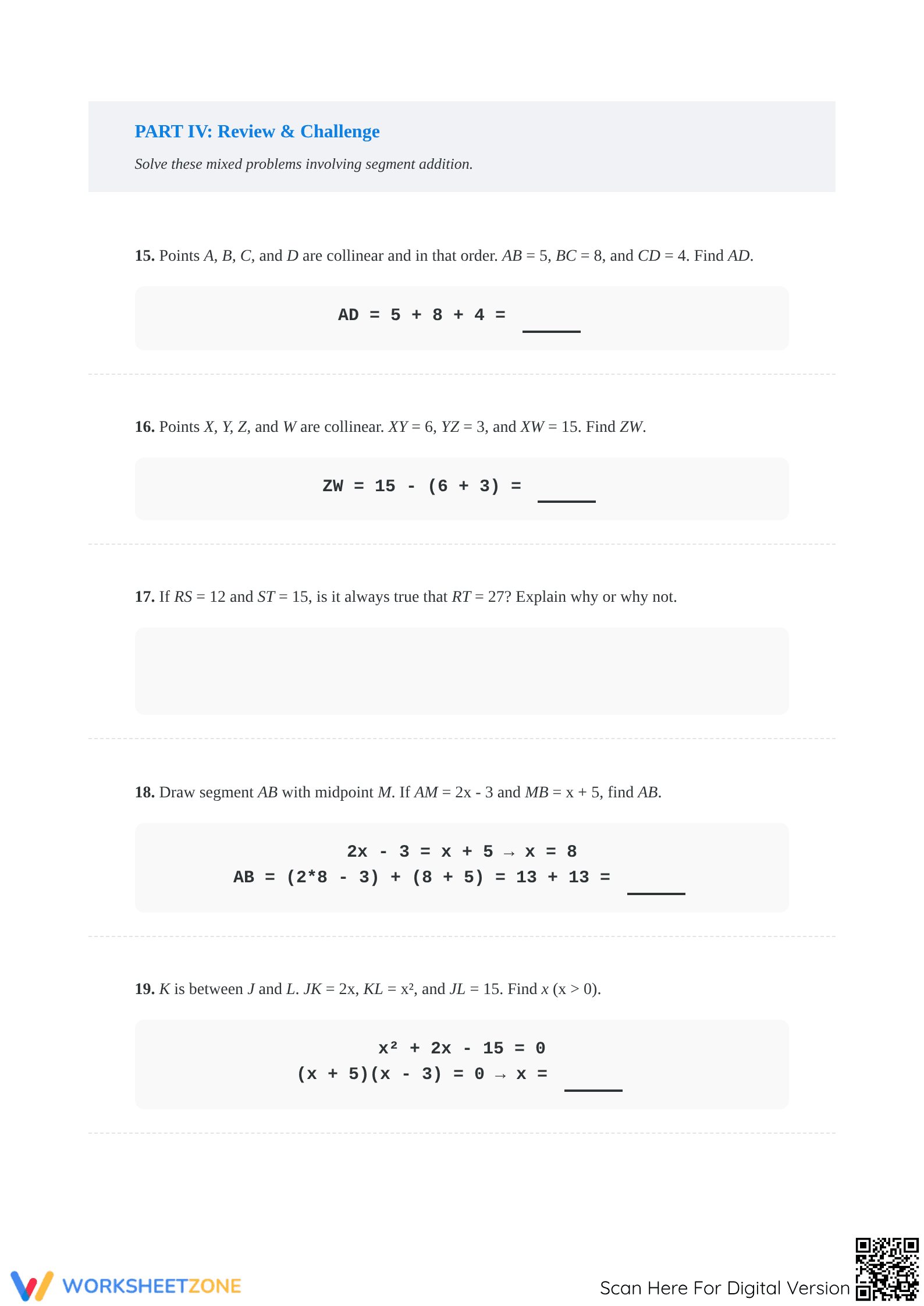
This comprehensive geometry quiz provides high school students with focused practice on the foundational concepts of points, lines, planes, and line segments. Through 20 carefully structured questions, learners will demonstrate their understanding of precise geometric definitions and their application, a critical first step for success in Geometry. This printable resource is designed for assessment or review in a Grade 9 or 10 classroom.
At a Glance
- Grade: 9–10 · Subject: Geometry
- Standard:
CCSS.MATH.CONTENT.HSG.CO.A.1— Know precise definitions of angle, circle, perpendicular line, parallel line, and line segment.- Skill Focus: Geometric Definitions (Points, Lines, Planes)
- Format: 5 pages · 20 problems · Answer key included · PDF
- Best For: Chapter quiz, unit review, or assessment
- Time: 20–30 minutes
What's Inside
This five-page download contains a 20-question quiz on geometry's foundational definitions. Problems include multiple-choice and short-answer formats testing terms like point, line, ray, and segment with correct notation. A full five-page answer key is provided for efficient grading and review.
Evidence of Mastery
This quiz serves as a direct assessment for CCSS.MATH.CONTENT.HSG.CO.A.1, providing evidence of a student's ability with precise geometric definitions. Its 20 questions isolate concepts, allowing teachers to pinpoint misunderstandings, such as the difference between a line and a segment. A high score indicates a student has internalized the fundamental vocabulary and notation required for subsequent geometry topics. Scores can be used as a formative data point or a summative grade.
Standards Alignment
This worksheet directly aligns with the Common Core State Standard CCSS.MATH.CONTENT.HSG.CO.A.1, which requires students to know precise definitions of key geometric terms including the line segment. This quiz targets the foundational elements of this standard, focusing on points, lines, and segments. The standard code can be copied directly into lesson plans, IEP goals, or district curriculum mapping tools.
How to Use This Resource
This resource is ideal as a quiz at the end of an introductory geometry unit, with an expected completion time of 20-30 minutes. Administer it after direct instruction on points, lines, and planes. For formative assessment, observe which questions cause the most difficulty. For example, if students confuse a 'ray' and a 'segment,' it signals a need for re-teaching before moving on.
Who It's For
Designed for students in Grade 9 or 10 Geometry, this resource establishes a baseline understanding of core vocabulary. For students needing support, pair this quiz with a visual anchor chart of the key terms. Its straightforward format is accessible for a wide range of learners in a general education classroom.
This standards-based quiz provides a reliable measure of student understanding of essential geometric vocabulary as defined in CCSS.MATH.CONTENT.HSG.CO.A.1. By requiring students to know precise definitions of foundational concepts like the line segment, the worksheet supports a key predictor of success in higher-level mathematics. Research consistently shows that a firm grasp of domain-specific academic language is critical for accessing complex texts and problems. A RAND AIRS 2024 report on instructional materials emphasizes the importance of resources that explicitly teach and assess the vocabulary of a discipline. This quiz aligns with that principle, offering a focused tool for ensuring students have the necessary linguistic foundation before tackling more complex geometric proofs and constructions. Its 20 questions provide targeted practice that helps solidify these non-negotiable building blocks of mathematical reasoning.


