


























Views
Downloads



Line of Symmetry Worksheet: Essential Grade 4-7 Geometry
Paste this activity's link or code into your existing LMS (Google Classroom, Canvas, Teams, Schoology, Moodle, etc.).
Students can open and work on the activity right away, with no student login required.
You'll still be able to track student progress and results from your teacher account.
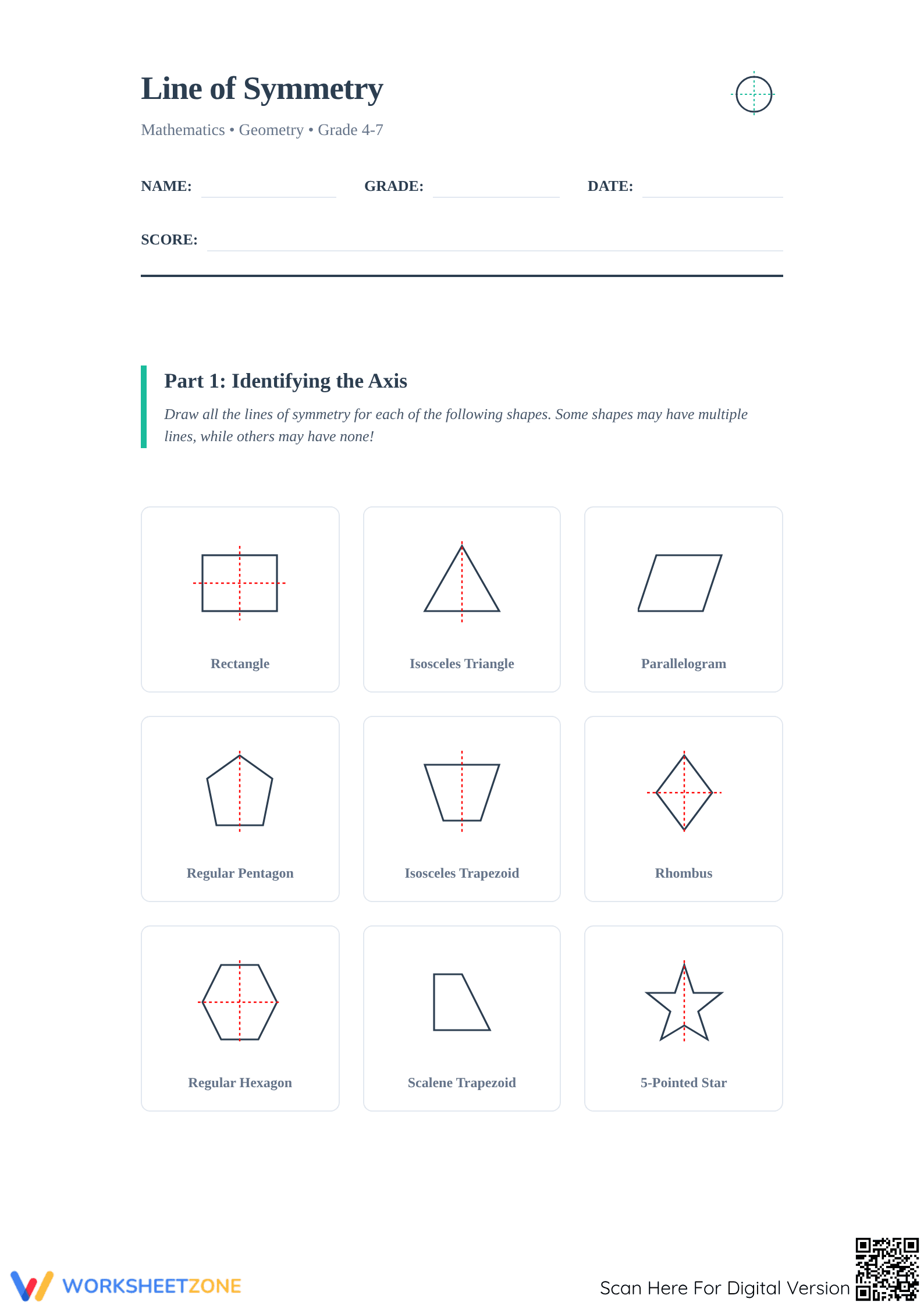
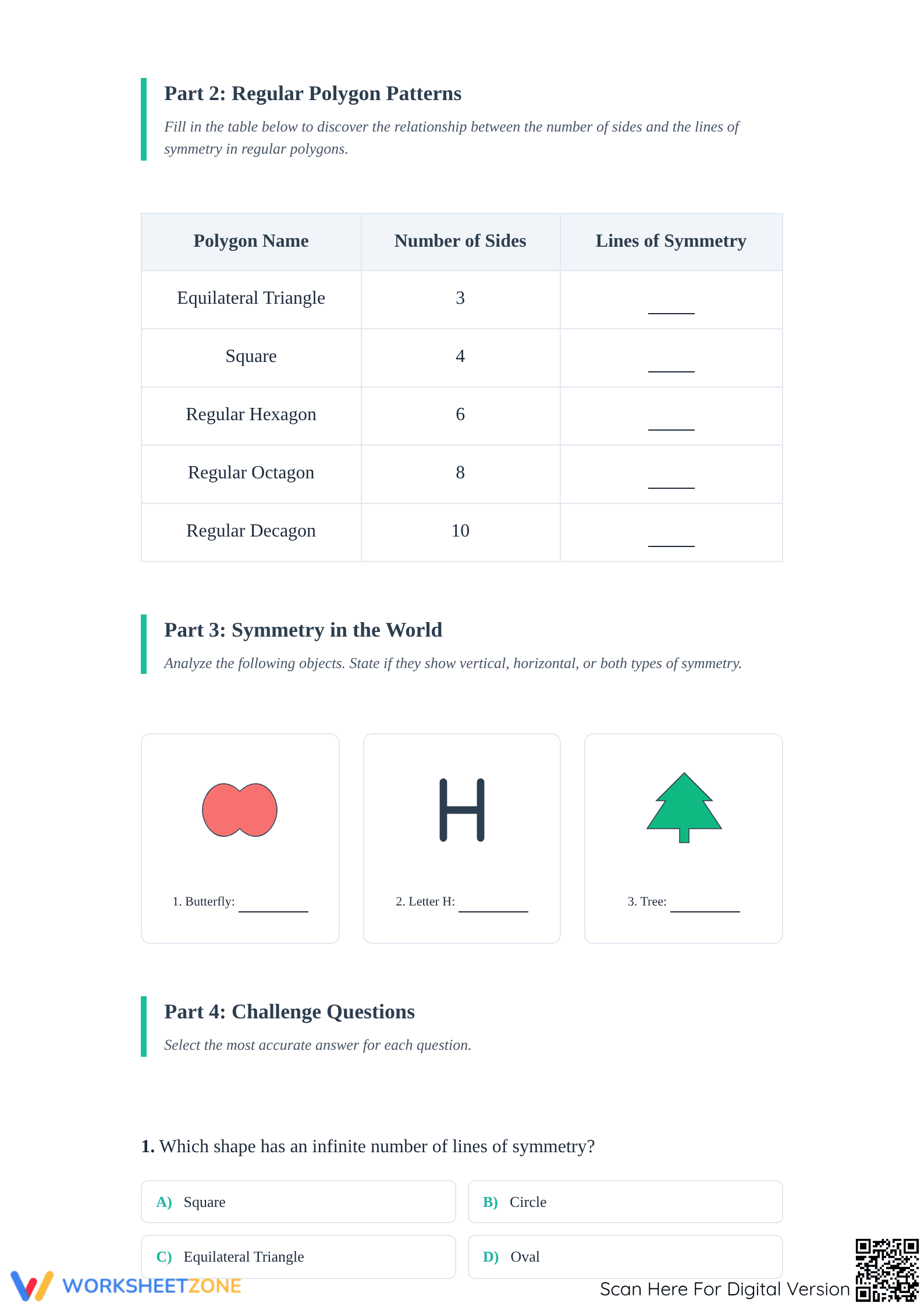
This comprehensive Line of Symmetry worksheet provides Grade 4-7 students with twenty-seven structured tasks designed to master geometric symmetry. Students will identify axes of symmetry in complex polygons, analyze real-world objects, and explore reflection mapping on coordinate planes. This resource ensures students can accurately recognize and draw lines that divide shapes into identical mirror images.
At a Glance
- Grade: 4-7 · Subject: Math (Geometry)
- Standard:
CCSS.MATH.CONTENT.4.G.A.3— Identify and draw lines of symmetry for two-dimensional figures accurately.- Skill Focus: Axis identification and reflection mapping
- Format: 4 pages · 27 problems · Answer key included · PDF
- Best For: Geometry unit practice or sub plans
- Time: 40–60 minutes
Inside this four-page printable packet, you will find five distinct parts ranging from basic axis identification to coordinate plane reflections. The worksheet includes a variety of shapes such as scalene trapezoids, regular decagons, and real-world icons like butterflies. A complete answer key is provided for all multiple-choice, table-based, and drawing tasks, making grading immediate and effortless for busy educators.
Zero-Prep Workflow
- Print: Spend less than one minute sending the four-page PDF packet to the copier for your entire class.
- Distribute: Hand out the pre-organized packets to students; the clear instructions require no additional teacher setup or lecture time.
- Review: Utilize the included full-color answer key for rapid grading or allow students to self-correct their work during a final review phase.
Total teacher preparation time is under two minutes, making this an ideal resource for emergency sub plans or last-minute geometry reinforcement.
This resource is fully aligned to CCSS.MATH.CONTENT.4.G.A.3, which requires students to recognize a line of symmetry for a two-dimensional figure and draw lines of symmetry. It also supports higher-grade standards involving transformation geometry by introducing reflection across the x and y axes. This standard code can be copied directly into lesson plans, IEP goals, or district curriculum mapping tools.
Use this worksheet as an independent practice activity following a direct instruction lesson on symmetry properties. It serves as an excellent formative assessment; observe students as they attempt Part 1 to see if they can distinguish between diagonal and orthogonal axes. Students typically complete the entire packet within 45 to 60 minutes depending on their familiarity with coordinate mapping.
This resource is ideal for upper elementary and middle school students working on geometry fundamentals. It provides natural differentiation for visual learners who benefit from drawing lines directly on shapes. Pair this worksheet with a set of Miras or handheld mirrors to allow students to physically verify their drawn lines of symmetry before final submission.
According to the RAND AIRS 2024 report on mathematics education, spatial reasoning skills such as identifying lines of symmetry are foundational for advanced geometric understanding and algebraic thinking in middle school. This worksheet directly addresses CCSS.MATH.CONTENT.4.G.A.3 by requiring students to recognize and draw lines of symmetry across a diverse set of two-dimensional figures, including regular polygons and real-world objects. The inclusion of coordinate reflection mapping extends the utility of this resource, bridging the gap between basic visual symmetry and the transformation geometry required in higher grades. Research from Fisher & Frey (2014) emphasizes that scaffolded practice with visual manipulatives—like folding or drawing axes—enhances the retention of geometric properties. By providing twenty-seven structured tasks across four comprehensive pages, this resource offers the repetitive but varied exposure necessary for student mastery. Teachers can utilize this printable PDF to ensure students can accurately define a line of symmetry as a fold line that creates matching parts.


