


























Views
Downloads
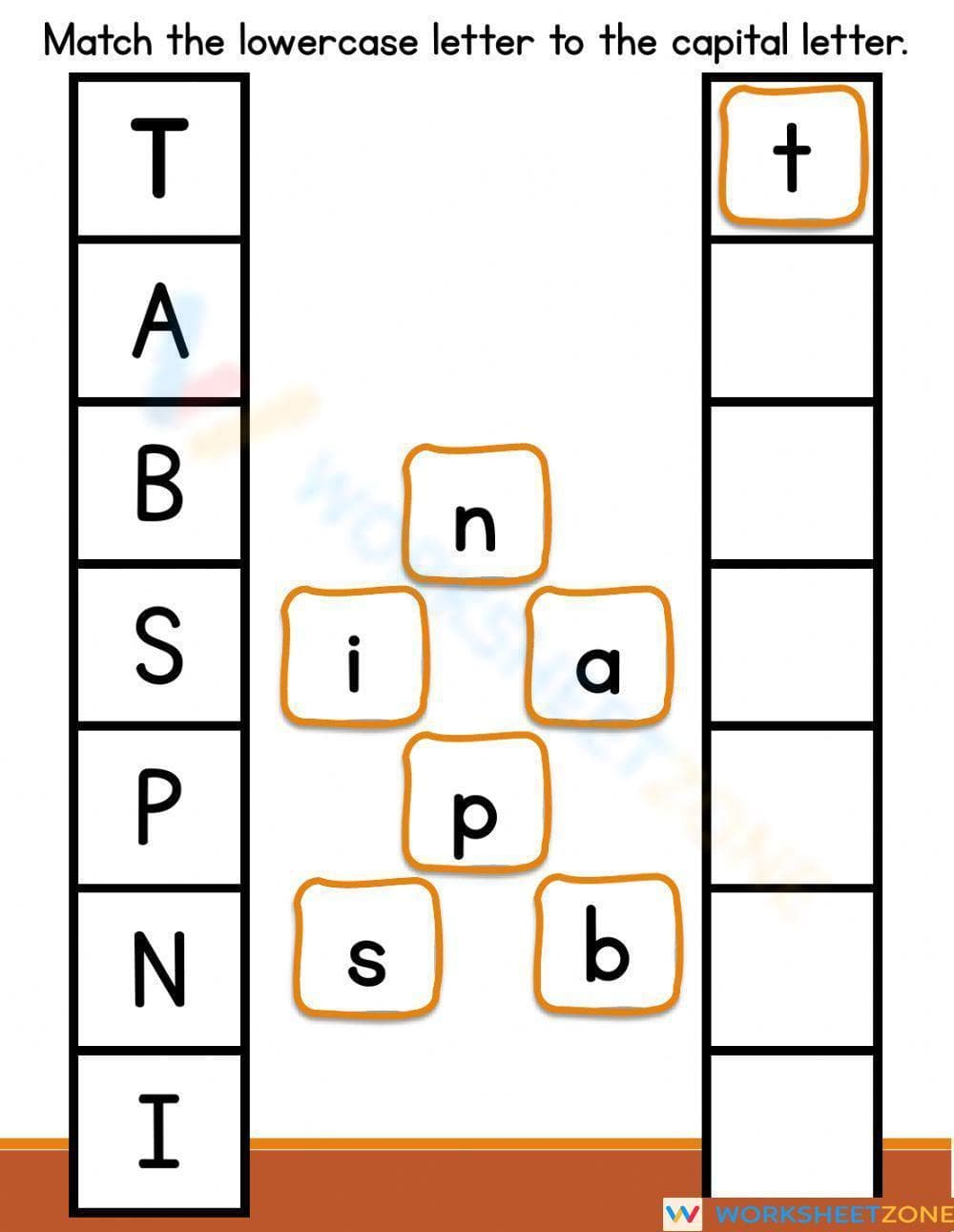

Essential Letter Recognition: Upper & Lowercase Match
Paste this activity's link or code into your existing LMS (Google Classroom, Canvas, Teams, Schoology, Moodle, etc.).
Students can open and work on the activity right away, with no student login required.
You'll still be able to track student progress and results from your teacher account.
This essential letter recognition worksheet helps Kindergarten and Preschool students master the foundational skill of matching uppercase and lowercase letters. By visually connecting capital letters to their small letter counterparts, children reinforce their alphabetical knowledge and prepare for early reading success. This targeted practice ensures students can fluently identify letters in various forms across different texts.
At a Glance
At a Glance
- Grade: Kindergarten · Subject: English Language Arts (ELA)
- Standard:
CCSS.ELA-LITERACY.RF.K.1.D— Recognize and name all upper- and lowercase letters of the alphabet- Skill Focus: Uppercase and lowercase letter matching
- Format: 1 page · 7 problems · Answer key included · PDF
- Best For: Early literacy centers and morning work
- Time: 5–10 minutes
What's Inside
This single-page PDF features a clear, vertical layout designed for young learners. On the left, students find a column of seven capital letters (T, A, B, S, P, N, I), while the corresponding lowercase letters are arranged in a playful cluster in the center. Students are tasked with drawing lines or placing the correct lowercase letter in the empty boxes on the right. A worked example for the letter "T" provides immediate clarity for students working independently.
Zero-Prep Workflow
Print this single-page worksheet in seconds. Distribute during literacy blocks or as a quick transition activity. Review with the included answer key or a classroom alphabet chart. Total prep time is under two minutes, making it ideal for last-minute lessons or sub-plans.
Standards Alignment
The primary alignment for this resource is CCSS.ELA-LITERACY.RF.K.1.D, which requires students to "Recognize and name all upper- and lowercase letters of the alphabet." By isolating the matching task, this worksheet focuses on the visual discrimination required to transition between different letter cases. This standard code can be copied directly into lesson plans, IEP goals, or district curriculum mapping tools to ensure instructional consistency across the grade level.
How to Use It
Use this worksheet as a quick formative assessment during small-group literacy. Observe students' ability to identify lowercase forms without hesitation, providing insight into visual processing speed. This focused activity takes 5-10 minutes, offering a clear data point for tracking letter recognition progress.
Who It's For
This worksheet is primarily designed for Kindergarten students and advanced Preschoolers who are beginning to explore the relationship between uppercase and lowercase letters. It is also an excellent tool for English Language Learners (ELLs) or students in RTI (Response to Intervention) tiers who need extra practice with alphabetical visual discrimination. The clear layout supports learners who benefit from minimal visual distractions on the page.
Citation Capsule
Letter recognition is a critical predictor of reading achievement, foundational for phonological awareness and decoding. Research shows students with strong alphabet fluency are more likely to meet literacy benchmarks. This worksheet addresses CCSS.ELA-LITERACY.RF.K.1.D by providing structured practice in matching upper- and lowercase letters. This focused approach reduces cognitive load for early readers, automating letter identification so they can build comprehension and fluency. By utilizing this resource, educators provide repetitive, evidence-based practice essential for mastering the English alphabet's visual forms and supporting long-term academic growth.


