


























Views
Downloads

Essential Alphabet Pattern Worksheet | Grade K Ready
Paste this activity's link or code into your existing LMS (Google Classroom, Canvas, Teams, Schoology, Moodle, etc.).
Students can open and work on the activity right away, with no student login required.
You'll still be able to track student progress and results from your teacher account.
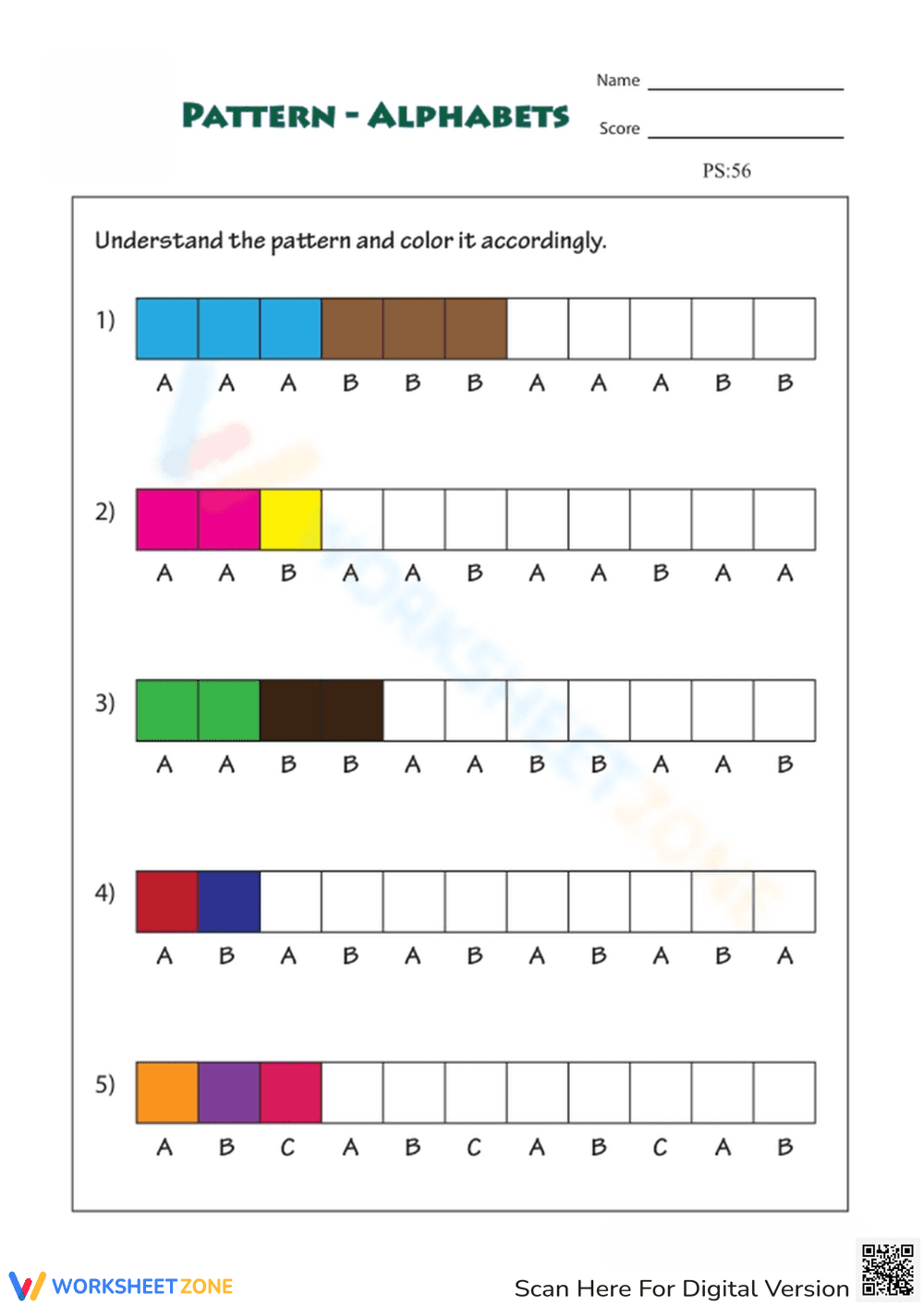
This Alphabet Pattern Coloring Worksheet helps Preschool and Kindergarten students master identifying and extending logical sequences. By combining letter recognition with fine motor coloring, students develop analytical skills necessary for early literacy. This essential printable ensures focused, engaging practice for young learners.
At a Glance
- Grade: Kindergarten · Subject: English Language Arts
- Standard:
CCSS.ELA-LITERACY.RF.K.1.D— Recognize and name all upper- and lowercase letters of the alphabet- Skill Focus: Pattern recognition and color sequencing
- Format: 1 page · 5 problems · Answer key included · PDF
- Best For: Independent literacy centers or early finishers
- Time: 10–15 minutes
What's Inside
This resource features five distinct patterning tasks progressing from simple AB sequences to ABC and AAB variants. Each task provides blocks for students to color based on the letter-coded pattern. The single-page PDF is easy to handle and includes an answer key for quick review.
Zero-Prep Workflow
First, print the single-page PDF (30 seconds). Second, distribute copies to students with crayons (1 minute). Finally, review the completed patterns using the answer key (under 1 minute). Total teacher prep time is under 3 minutes, making it perfect for sub plans or busy mornings.
Standards Alignment
Aligned to CCSS.ELA-LITERACY.RF.K.1.D, students "Recognize and name all upper- and lowercase letters of the alphabet." Using letters for patterns provides repetitive exposure to forms while developing logic. Standard codes can be copied directly into lesson plans or district curriculum mapping tools.
How to Use It
Assign this during independent practice to observe how students translate codes into visual representations. It serves as a formative-assessment tool; watch for students who struggle to maintain the sequence, indicating a need for additional scaffolding or direct instruction.
Who It's For
Designed for Preschool and Kindergarten students working on foundational ELA and fine motor skills. It is effective for English Language Learners who benefit from visual-spatial tasks. Pair this with a physical alphabet anchor chart or a tracing passage for a comprehensive experience.
Aligned to standard CCSS.ELA-LITERACY.RF.K.1.D, this worksheet leverages the cognitive benefits of pattern recognition through alphabet sequencing to build early literacy and fine motor control. According to Fisher & Frey (2014), the use of visual patterns in foundational learning provides a structured scaffolding that helps students transition from rote recognition to analytical thinking. This resource requires students to identify recurring letter sequences (AB, AAB, ABC) and translate those logic-based patterns into specific color choices, reinforcing the 'organization and basic features of print.' Research suggests that integrating fine art activities like coloring with ELA standards increases student engagement and retention of letter forms. The 5 tasks included are designed to facilitate independent practice with minimal teacher intervention, making it an ideal choice for literacy centers or early finisher activities. Educators can confidently use this printable as a high-quality formative assessment tool within a comprehensive Kindergarten curriculum.


