


























Views
Downloads



Essential Multi-Digit Addition Worksheet Packet | Grade 6-7
Paste this activity's link or code into your existing LMS (Google Classroom, Canvas, Teams, Schoology, Moodle, etc.).
Students can open and work on the activity right away, with no student login required.
You'll still be able to track student progress and results from your teacher account.
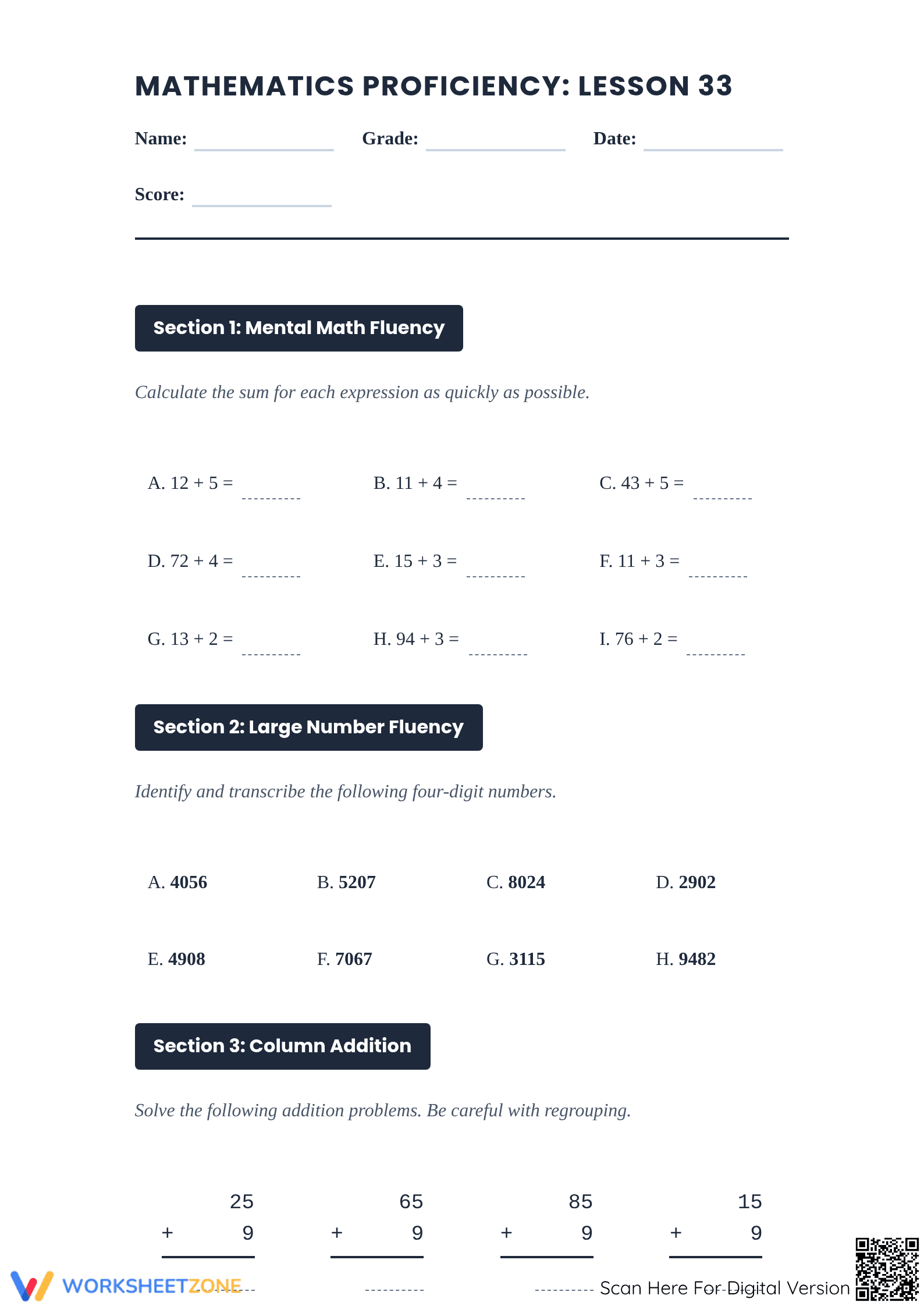
This comprehensive 4-page mathematics proficiency packet is designed to build fluency in multi-digit addition and complex problem-solving. Students progress through mental math exercises to advanced multi-step challenges and real-world word problems. By mastering these operations, learners develop the computational accuracy required for higher-level algebra and statistics.
At a Glance
- Grade: 6–7 · Subject: Math Addition
- Standard:
CCSS.MATH.CONTENT.6.NS.B.3— Fluently add multi-digit decimals using the standard algorithm- Skill Focus: Multi-digit addition with regrouping
- Format: 4 pages · 37 problems · Answer key included · PDF
- Best For: Computational fluency review and sub plans
- Time: 45–60 minutes
This extensive lesson packet contains five distinct sections spread across four printable pages. It includes 9 mental math fluency expressions, 8 number transcription tasks, 8 column addition problems ranging from two to three digits with regrouping, and 6 complex word problems. The final section features 6 advanced multi-step addition challenges. A complete answer key ensures easy grading.
Zero-Prep Workflow
Implementing this resource is designed for maximum teacher efficiency. First, print the four-page packet, which takes less than 30 seconds for a standard class set. Second, distribute the materials directly to students for independent or guided work. Finally, review the completed tasks using the provided answer key, requiring under two minutes of total teacher preparation time. This streamlined workflow makes the packet an ideal emergency sub-plan for busy classrooms.
Standards Alignment
This worksheet is strictly aligned to CCSS.MATH.CONTENT.6.NS.B.3, which requires students to fluently add multi-digit numbers using the standard algorithm. It also supports CCSS.MATH.PRACTICE.MP1 as students must make sense of word problems and persevere in solving multi-step addition challenges. Both standard codes can be copied directly into lesson plans, IEP goals, or district curriculum mapping tools.
How to Use It
Use this packet during the "Independent Practice" phase of a lesson to reinforce addition algorithms and word problem strategies. Alternatively, assign it as a comprehensive sub plan that keeps students engaged for a full class period. A key formative assessment tip is to observe students during Section 3 to ensure they are correctly carrying values during regrouping.
Who It's For
This resource is ideal for Grade 6 and 7 students who need to solidify their arithmetic foundations or as a remediation tool for middle schoolers struggling with multi-step operations. It pairs naturally with instructional videos on regrouping or classroom anchor charts that break down the steps of the standard addition algorithm.
According to the RAND AIRS 2024 report, sustained practice with the standard algorithm is a critical predictor of success in middle school mathematics. This worksheet facilitates that development by moving students through a scaffolded progression of complexity. Research from Fisher & Frey (2014) emphasizes that effective computational fluency is not merely about speed but about the flexible application of strategies to both abstract and contextualized problems. This 4-page resource bridges that gap by integrating mental math with multi-digit word problems involving up to five digits. By requiring students to transcribe large numbers and solve multi-step equations, the worksheet targets cognitive endurance and attention to detail. Aligned to CCSS.MATH.CONTENT.6.NS.B.3, this tool ensures that students achieve the procedural fluency necessary for more advanced Grade 6 and 7 standards. It can be easily integrated into Tier 1 instruction or used as a targeted intervention for specific arithmetic gaps.


