


























Views
Downloads

Essential Geometrical Shapes Worksheet | Grade 7 Math
Paste this activity's link or code into your existing LMS (Google Classroom, Canvas, Teams, Schoology, Moodle, etc.).
Students can open and work on the activity right away, with no student login required.
You'll still be able to track student progress and results from your teacher account.
Students explore the anatomy of circles and squares to master geometric properties. This 4-page guide bridges the gap between visual identification and mathematical calculation. By the end of this session, learners will confidently define radius, diameter, and circumference while applying area formulas to quadrilaterals.
At a Glance
- Grade: 7 · Subject: Geometry
- Standard:
CCSS.MATH.CONTENT.7.G.B.4— Use formulas for area and circumference of a circle to solve problems- Skill Focus: 2D Shape Properties
- Format: 4 pages · 16 problems · Answer key included · PDF
- Best For: Middle school geometry introduction and reinforcement
- Time: 35–50 minutes
What's Inside
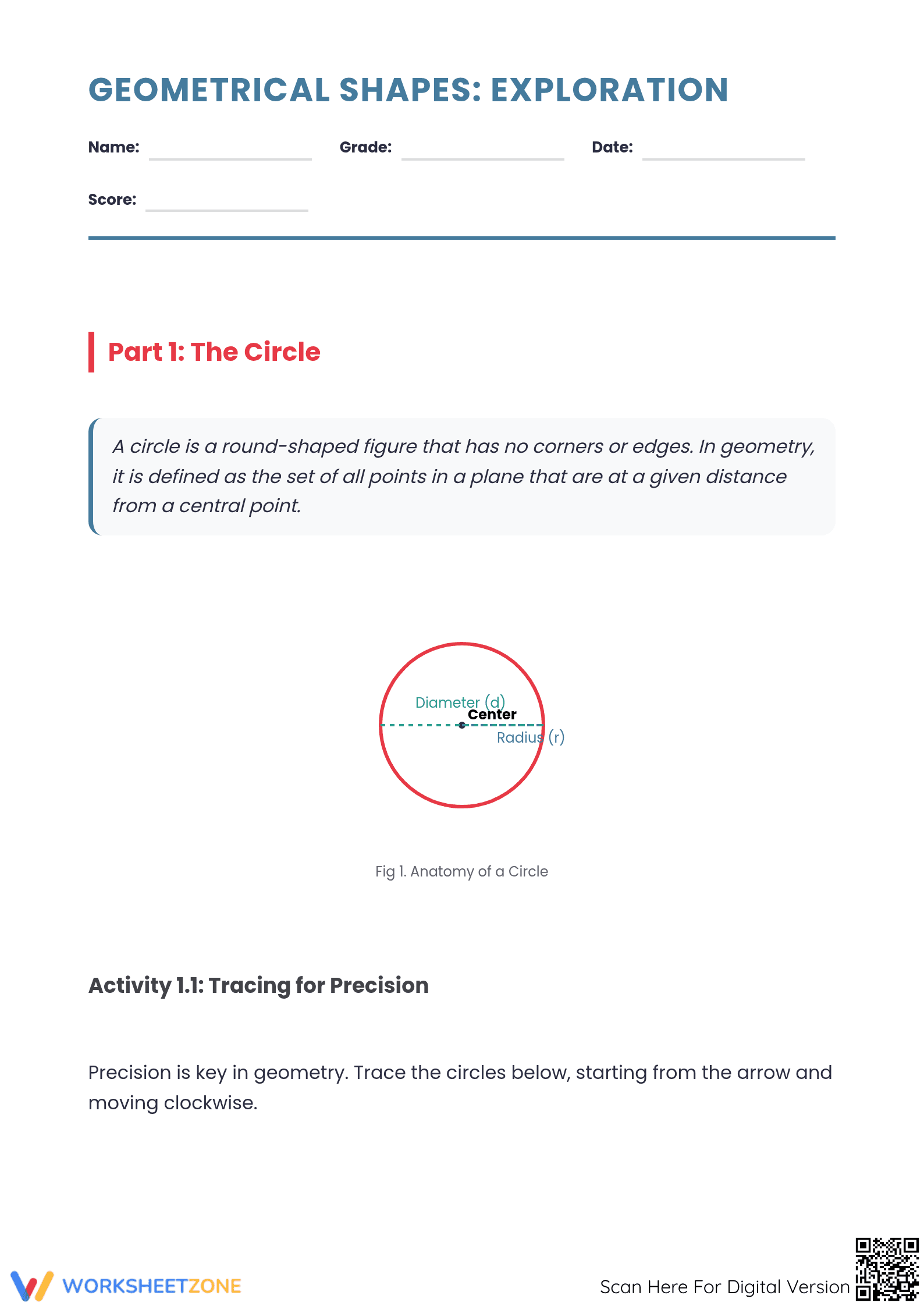
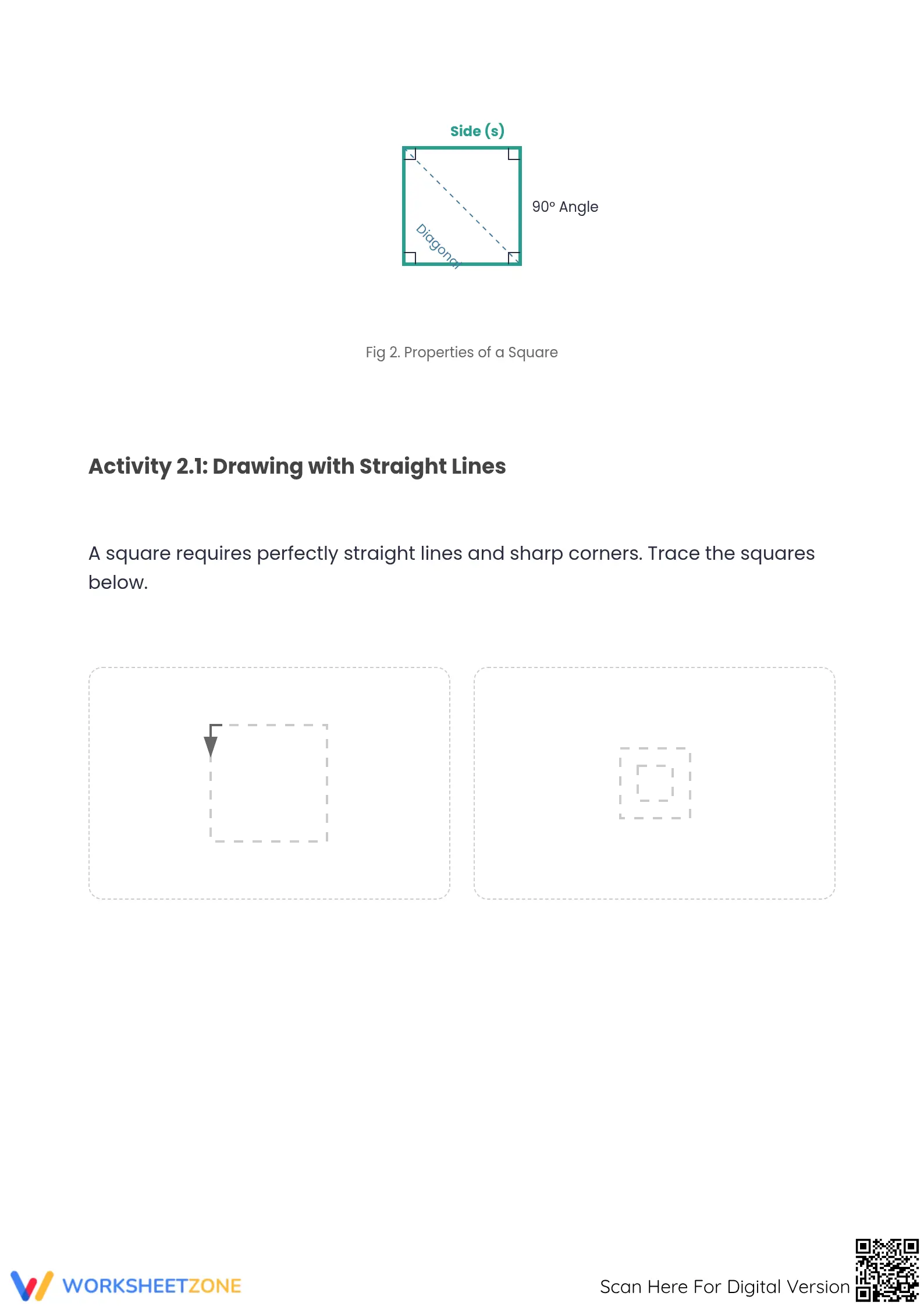
This comprehensive 4-page PDF contains dedicated sections for both circular and square geometries. It features visual diagrams labeling anatomy (like radius and diameter), guided tracing activities for precision, property-based fill-in-the-blank questions, and a critical thinking section with 3 word problems. A full answer key is provided for immediate feedback.
Skill Progression
- Guided practice: Students begin with Activity 1.1 and 2.1, using tracing exercises to build motor memory for geometric forms.
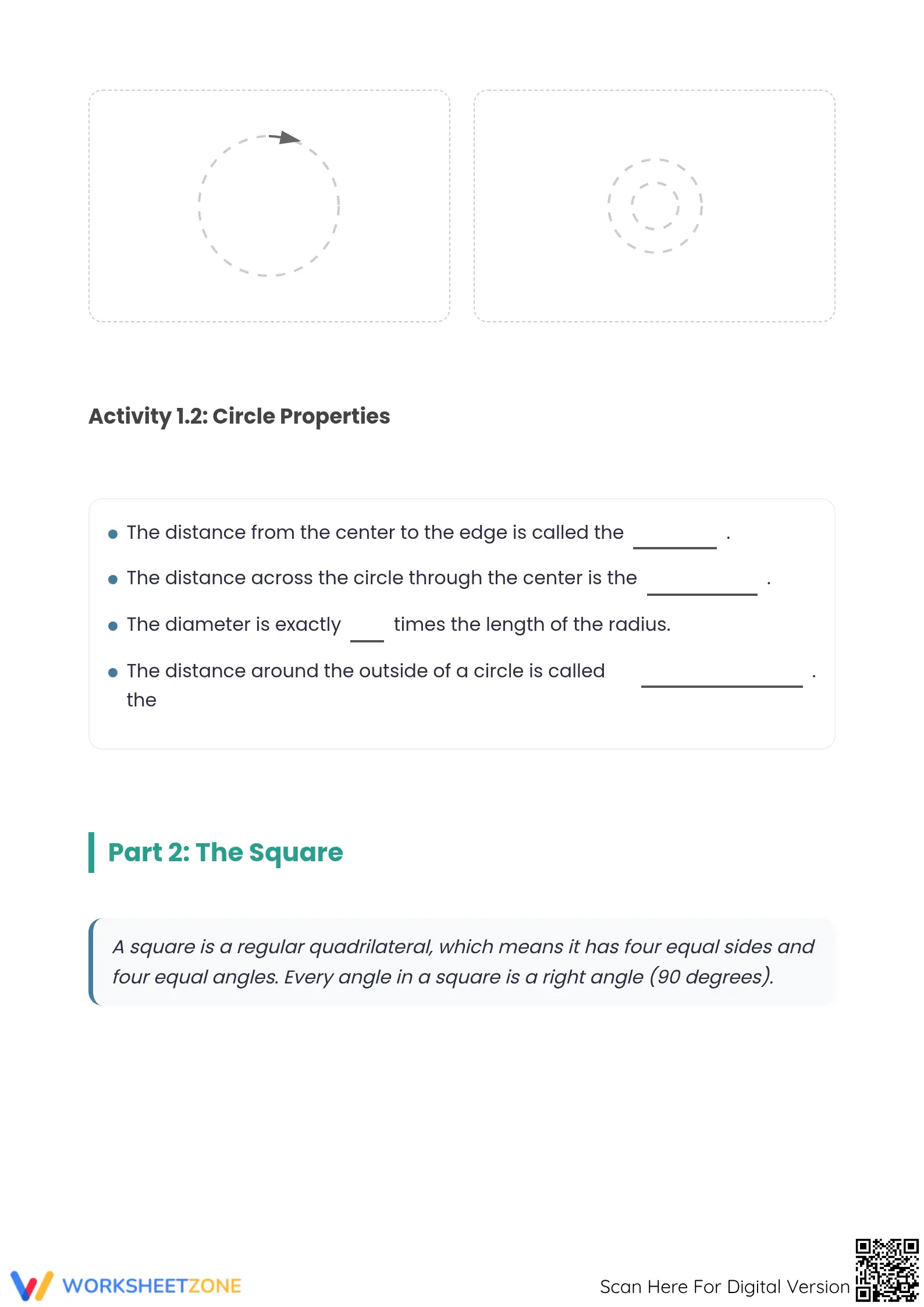
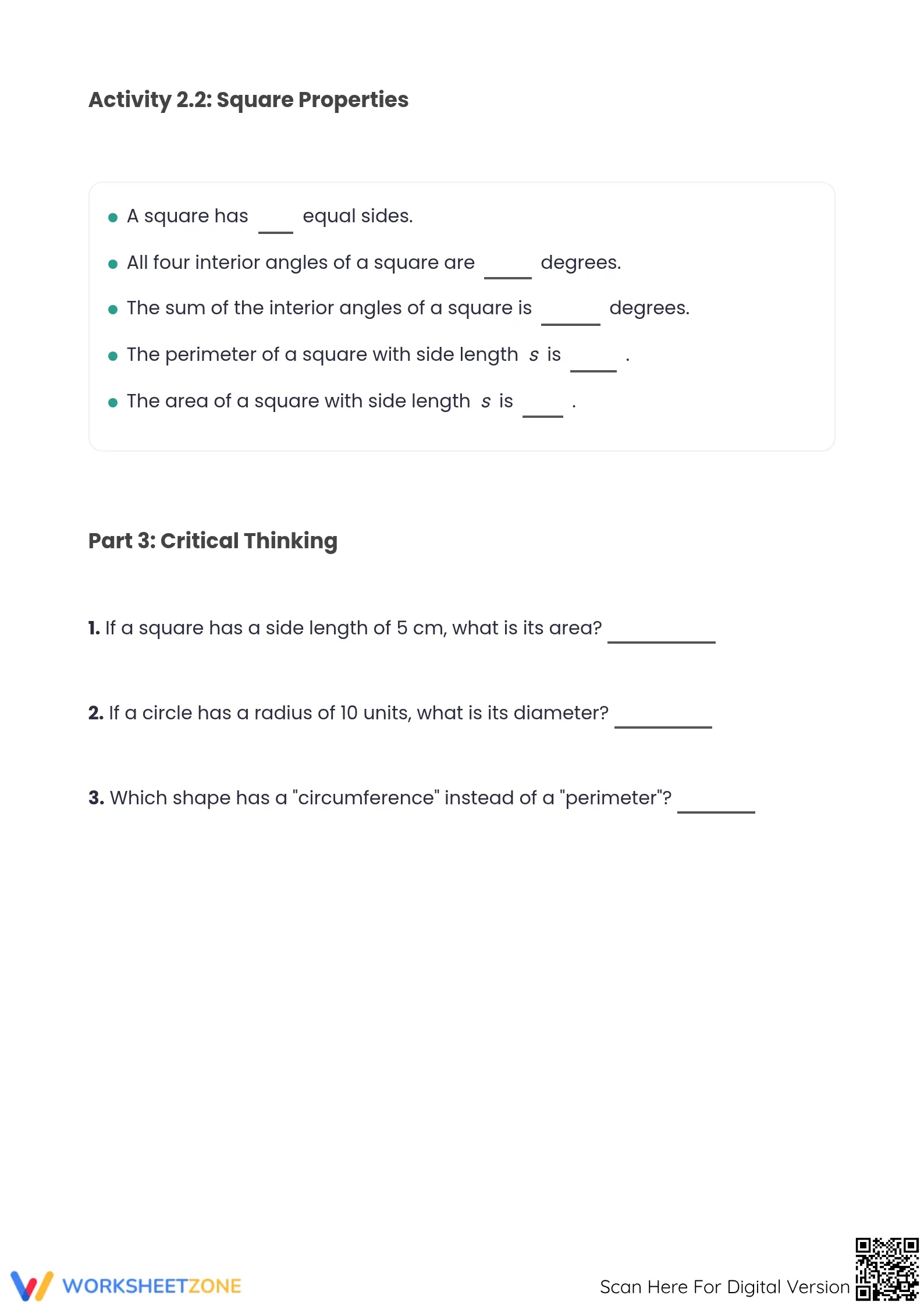
- Supported practice: The middle activities (1.2 and 2.2) use 9 specific property questions to reinforce vocabulary like "diagonal," "interior angle," and "circumference."
- Independent practice: The final "Critical Thinking" section presents 3 multi-step word problems requiring students to apply formulas without visual scaffolds.
This structure follows the gradual-release model to ensure high-stakes mastery.
Standards Alignment
The primary focus is CCSS.MATH.CONTENT.7.G.B.4, which requires students to "know the formulas for the area and circumference of a circle and use them to solve problems." It also supports CCSS.MATH.CONTENT.6.G.A.1 by introducing area calculations for squares. Both standard codes can be copied directly into lesson plans, IEP goals, or district curriculum mapping tools.
How to Use It
Assign this as a "Bridge" activity during the transition from basic identification to formal calculation. It works perfectly as a guided exploration after an anchor chart presentation on circle anatomy. Teachers should observe students during the "Circle Properties" section to check for the common misconception between radius and diameter. Total completion time ranges from 35 to 50 minutes.
Who It's For
This resource is designed for Grade 7 students but is appropriate for Grade 6 enrichment or High School remedial review. It pairs naturally with a unit on plane geometry or a "real-world measurements" lesson. For differentiation, provide a formula sheet to students who struggle with memory recall while allowing advanced learners to skip the tracing sections.
The integration of motor-skills activities like tracing with high-level conceptual property identification aligns with the "Gradual Release of Responsibility" framework. According to Fisher & Frey (2014), instructional materials that explicitly move from teacher-modeled scaffolds to independent critical thinking significantly improve retention of abstract mathematical definitions. By anchoring vocabulary (diameter, circumference, radius) within visual diagrams and then removing those scaffolds for final word problems, this worksheet ensures that the CCSS.MATH.CONTENT.7.G.B.4 standard is not just memorized but deeply understood. Research from NAEP suggests that students who can articulate the relationship between a circle’s parts perform 20% better on later volume-based geometry assessments. This resource provides the necessary foundational drill required for high-school-level coordinate geometry.


