


























Views
Downloads

Letter L Tracing Worksheet | Essential Kindergarten ELA
Paste this activity's link or code into your existing LMS (Google Classroom, Canvas, Teams, Schoology, Moodle, etc.).
Students can open and work on the activity right away, with no student login required.
You'll still be able to track student progress and results from your teacher account.
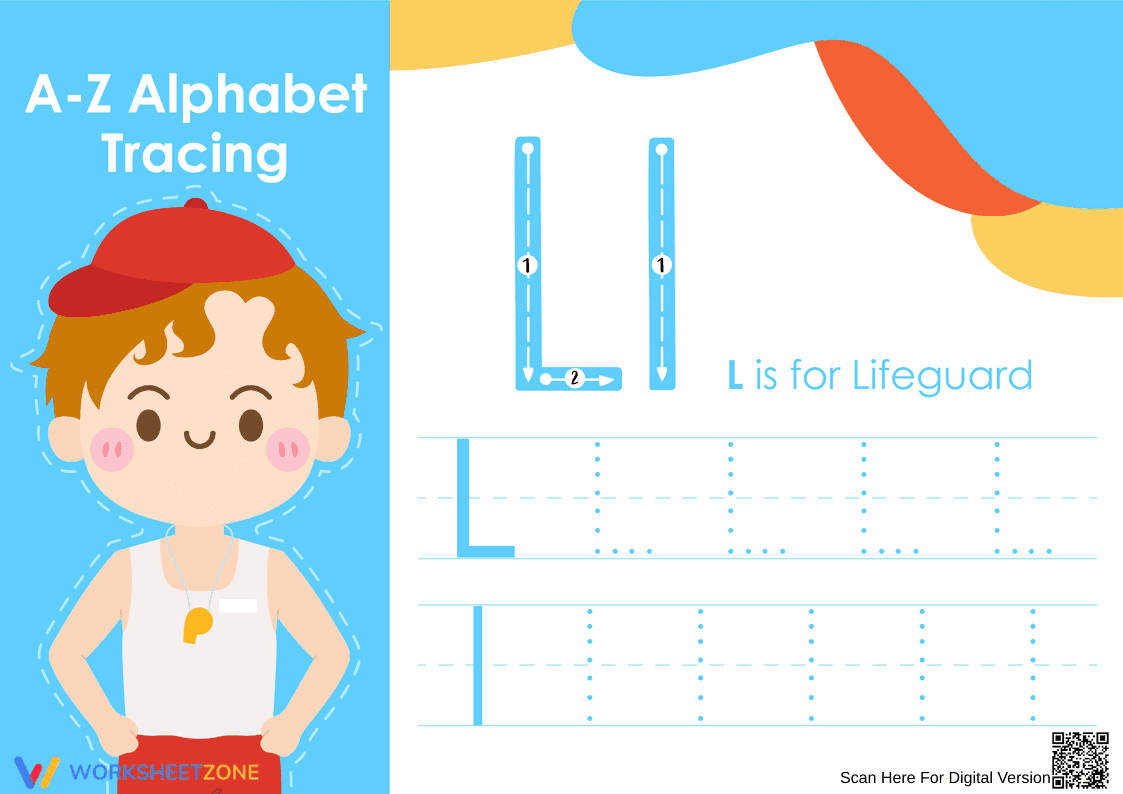
This Letter L tracing worksheet helps early learners master uppercase and lowercase letter formation through guided penmanship practice. By connecting the letter "L" to the "Lifeguard" visual cue, students strengthen phonemic awareness while developing the fine motor control necessary for legible writing. It provides a structured foundation for literacy.
At a Glance
- Grade: Kindergarten · Subject: ELA
- Standard:
CCSS.ELA-LITERACY.RF.K.1.D— Recognize and name all upper- and lowercase letters of the alphabet- Skill Focus: Letter L formation and identification
- Format: 1 page · 10 tasks · No-prep · PDF
- Best For: Morning work or literacy centers
- Time: 10–15 minutes
A large instructional graphic shows the numbered stroke order for both capital "L" and lowercase "l". Below the visual guide, a grid contains 10 specific tracing opportunities. The layout includes a "Lifeguard" illustration to anchor the letter sound, providing a multi-sensory approach to alphabet recognition and handwriting.
Skill Progression
- Guided practice: Students follow numbered arrows on large-scale models to understand the vertical and horizontal strokes required for the letter L.
- Supported practice: Dotted-line templates provide a clear path for students to trace 4 uppercase and 6 lowercase letters with decreasing visual prompts.
- Independent practice: The final row allows students to attempt the letter form with minimal guidance, reinforcing muscle memory.
This worksheet follows a gradual-release model, moving from heavy scaffolding to independent stroke execution.
Standards Alignment
This resource aligns with `CCSS.ELA-LITERACY.RF.K.1.D`, which requires students to recognize and name all upper- and lowercase letters of the alphabet. It also supports foundational writing standards by focusing on print concepts and letter-sound correspondence. Both standard codes can be copied directly into lesson plans, IEP goals, or district curriculum mapping tools.
How to Use It
Use this worksheet during the "You Do" phase of a direct instruction lesson on the letter L. It serves as an excellent formative assessment tool; teachers can observe grip strength and stroke directionality as students work. This activity is ideal for transition periods or as a quiet morning activity.
Who It's For
This resource is designed for preschool and kindergarten students who are transitioning from basic line drawing to formal letter construction. It is particularly effective for English Language Learners (ELLs) who benefit from the visual "Lifeguard" association. Pair this with a physical alphabet anchor chart for a comprehensive literacy experience.
According to the RAND AIRS 2024 report on early literacy, consistent exposure to letter-sound correspondence and tactile tracing activities is a primary predictor of future reading fluency. This worksheet addresses the critical need for fine motor development alongside phonemic awareness by isolating the letter "L" for focused practice. By utilizing the CCSS.ELA-LITERACY.RF.K.1.D standard, the resource ensures that students are meeting national benchmarks for kindergarten readiness. Research from Fisher & Frey (2014) emphasizes that the gradual release of responsibility—moving from the numbered stroke guides to independent tracing—allows students to internalize the spatial requirements of letter formation. This structured approach reduces cognitive load, allowing young learners to focus on the physical mechanics of writing while reinforcing the linguistic connection between the character and its phonetic value in a classroom setting.


