


























Views
Downloads

Preschool Unscramble Words Printable Worksheet | Ready
Paste this activity's link or code into your existing LMS (Google Classroom, Canvas, Teams, Schoology, Moodle, etc.).
Students can open and work on the activity right away, with no student login required.
You'll still be able to track student progress and results from your teacher account.
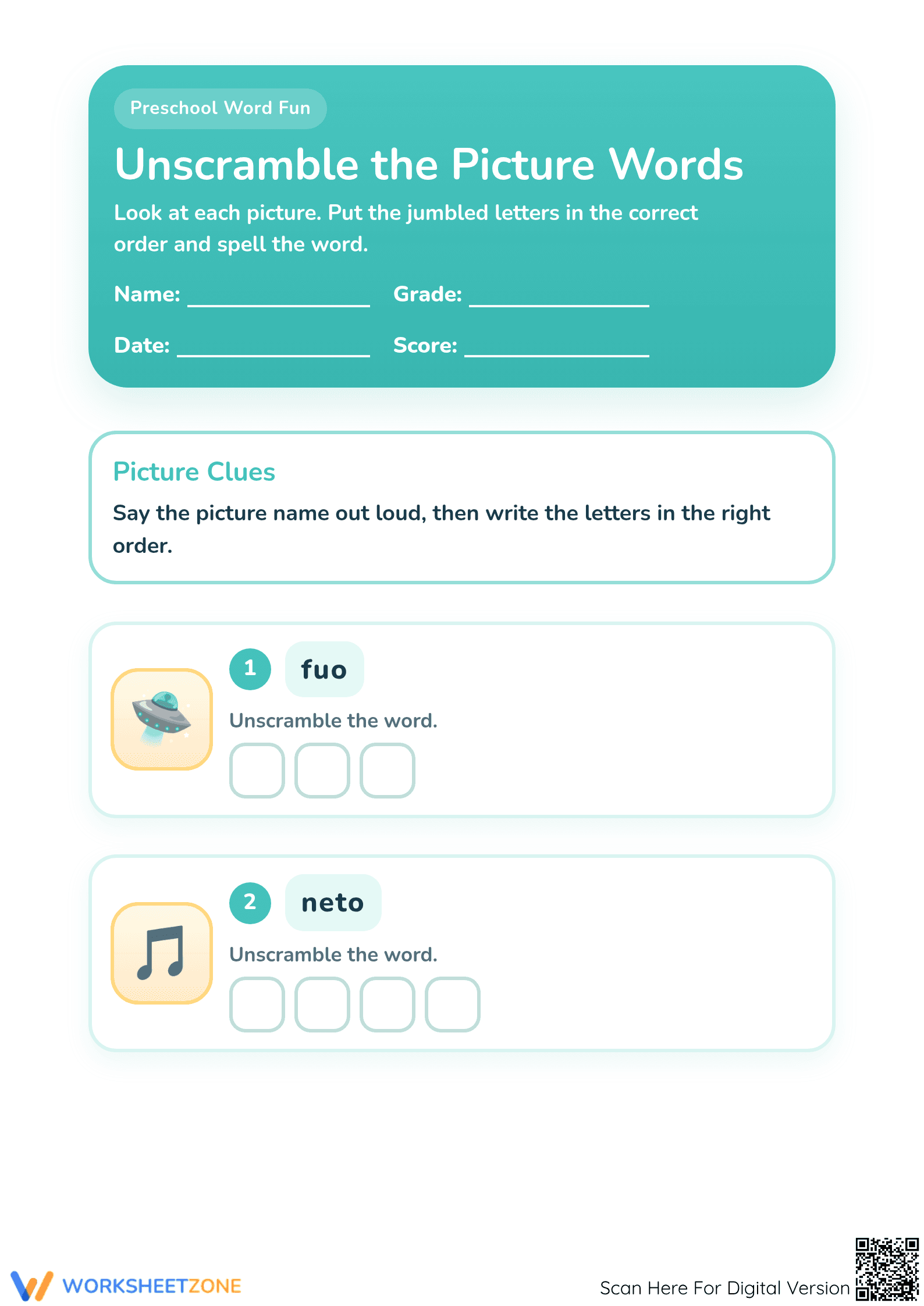
This Preschool Unscramble the Picture Words worksheet provides a fun, tactile way for early learners to practice letter order and phonemic awareness. By manipulating jumbled letters to match visual cues, students strengthen their spelling foundations and word recognition. This engaging activity ensures young learners develop the confidence needed for successful independent reading and writing.
At a Glance
- Grade: Preschool · Subject: ELA
- Standard:
CCSS.ELA-LITERACY.L.K.2.D— Spell simple words phonetically, drawing on knowledge of sound-letter relationships- Skill Focus: Word unscrambling and spelling
- Format: 2 pages · 5 problems · Answer key included · PDF
- Best For: Early literacy centers and homework
- Time: 10–15 minutes
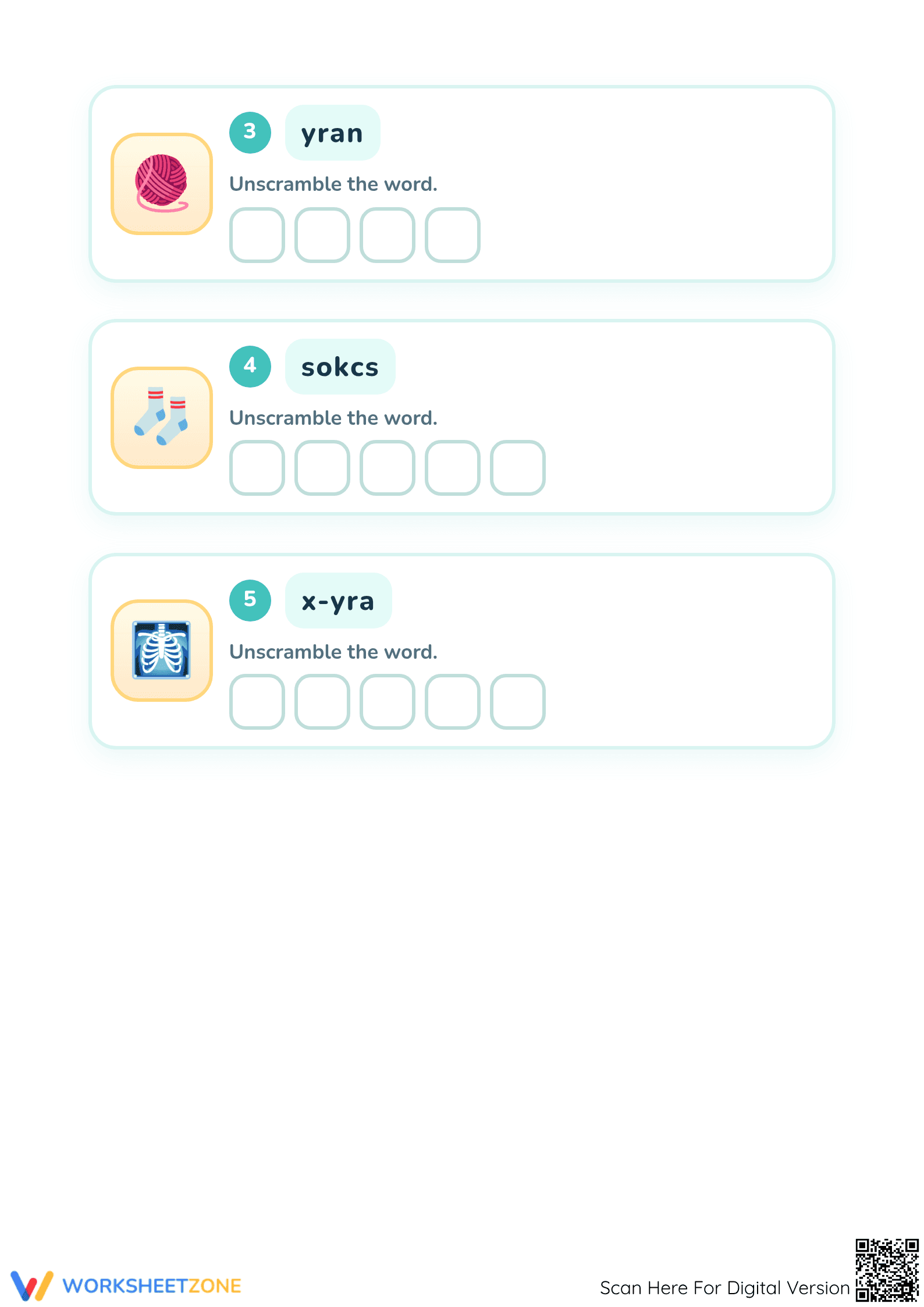
This two-page resource features five distinct word unscrambling tasks, each paired with a vibrant picture clue such as a UFO, musical note, and yarn. Students are provided with the jumbled letters and clear boxes for writing the correct sequence. The inclusion of a full answer key allows for immediate feedback or easy grading, while the clean layout minimizes visual distractions for young children.
Our zero-prep workflow is designed for busy educators and parents. First, print the two PDF pages (30 seconds). Second, distribute the worksheets along with pencils (1 minute). Third, review the answers using the provided key (30 seconds). Total teacher preparation time is under two minutes, making this an ideal choice for emergency sub plans or quick morning work.
This worksheet aligns with CCSS.ELA-LITERACY.L.K.2.D, focusing on spelling simple words phonetically. By requiring students to reorder letters, the activity reinforces the understanding that specific letter sequences represent specific sounds and meanings. This standard code can be copied directly into lesson plans, IEP goals, or district curriculum mapping tools to document foundational literacy progress.
Use this worksheet during small-group literacy instruction to observe how students approach letter sequencing and phonemic blending. It also serves as an excellent formative assessment tool; watch for students who correctly identify the initial sound but struggle with the middle vowels. The estimated completion time is 10 to 15 minutes, allowing it to fit perfectly into a rotation schedule.
Designed for preschool and early kindergarten students, this resource is perfect for children beginning their journey with letter sounds. Differentiation is naturally supported through the visual picture clues, which provide a scaffold for students who may not yet recognize the word by letters alone. It pairs naturally with an alphabet anchor chart or a direct instruction lesson on beginning sounds.
The use of scrambled word tasks paired with pictorial support is a validated method for enhancing early orthographic processing. According to Fisher & Frey (2014), providing visual scaffolds during phonemic tasks allows young learners to bridge the gap between abstract letter symbols and concrete objects. This worksheet specifically addresses CCSS.ELA-LITERACY.L.K.2.D by requiring students to apply sound-letter relationships to reconstruct familiar terms like socks and yarn. By engaging in this structured spelling practice, preschoolers build the cognitive pathways necessary for fluent word recognition and phonetic spelling. Research from EdReports (2024) emphasizes that such focused, printable activities are essential for developing the foundational literacy skill of mapping sounds to letters accurately and consistently. As a self-contained instructional tool, this worksheet provides the repetition required for mastery while maintaining high student engagement through its clear, interactive design and immediate visual reinforcement.


