


























Views
Downloads

Printable Jumbled Words Worksheet | Preschool ELA
Paste this activity's link or code into your existing LMS (Google Classroom, Canvas, Teams, Schoology, Moodle, etc.).
Students can open and work on the activity right away, with no student login required.
You'll still be able to track student progress and results from your teacher account.
Mastering letter order is a foundational step in early literacy development. This printable Jumbled Words Adventure worksheet helps preschool students bridge the gap between recognizing objects and spelling their names. By unscrambling letters with visual cues, young learners develop phonological awareness and fine motor writing skills through engaging, structured practice.
At a Glance
- Grade: Preschool · Subject: ELA
- Standard:
CCSS.ELA-LITERACY.L.PK.2— Demonstrate emerging command of conventions of standard English spelling when writing- Skill Focus: Phonemic Unscrambling
- Format: 2 pages · 5 problems · Answer key included · PDF
- Best For: Early literacy center activity
- Time: 15–20 minutes
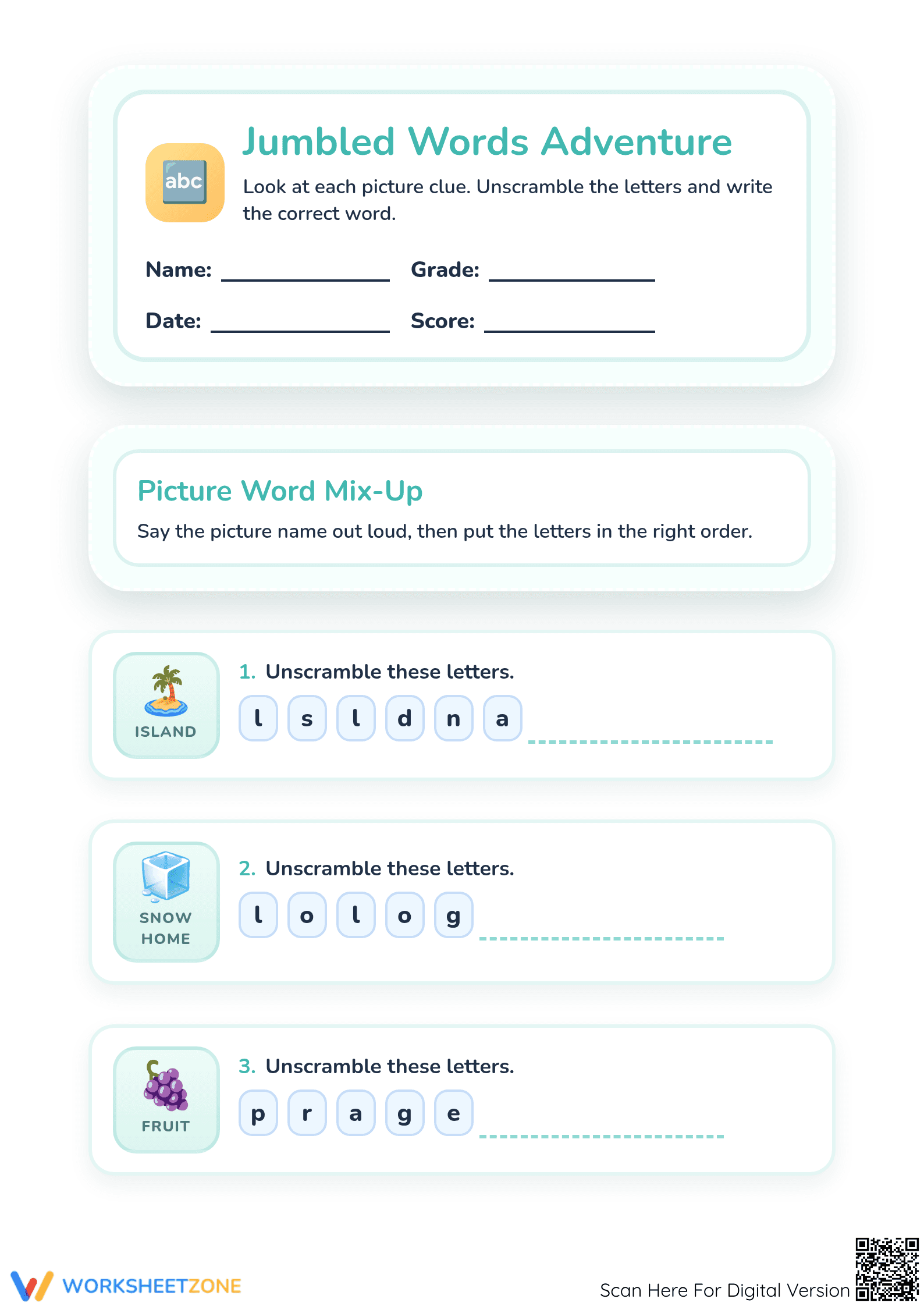
This comprehensive 2-page PDF features five distinct vocabulary challenges, each paired with a vibrant illustration to scaffold student success. Learners are presented with a jumbled set of letters and must reorder them to match the image, such as an island or an igloo. The worksheet includes dedicated name and score fields, making it easy for educators to track individual student progress.
- Guided Practice: The first task provides high-frequency vocabulary words like "island," allowing teachers to model the process of identifying the picture and isolating the initial consonant sound.
- Supported Practice: Tasks two and three introduce multi-syllabic concepts like "igloo" and "grape," where students use the provided letter bank as a self-correction tool.
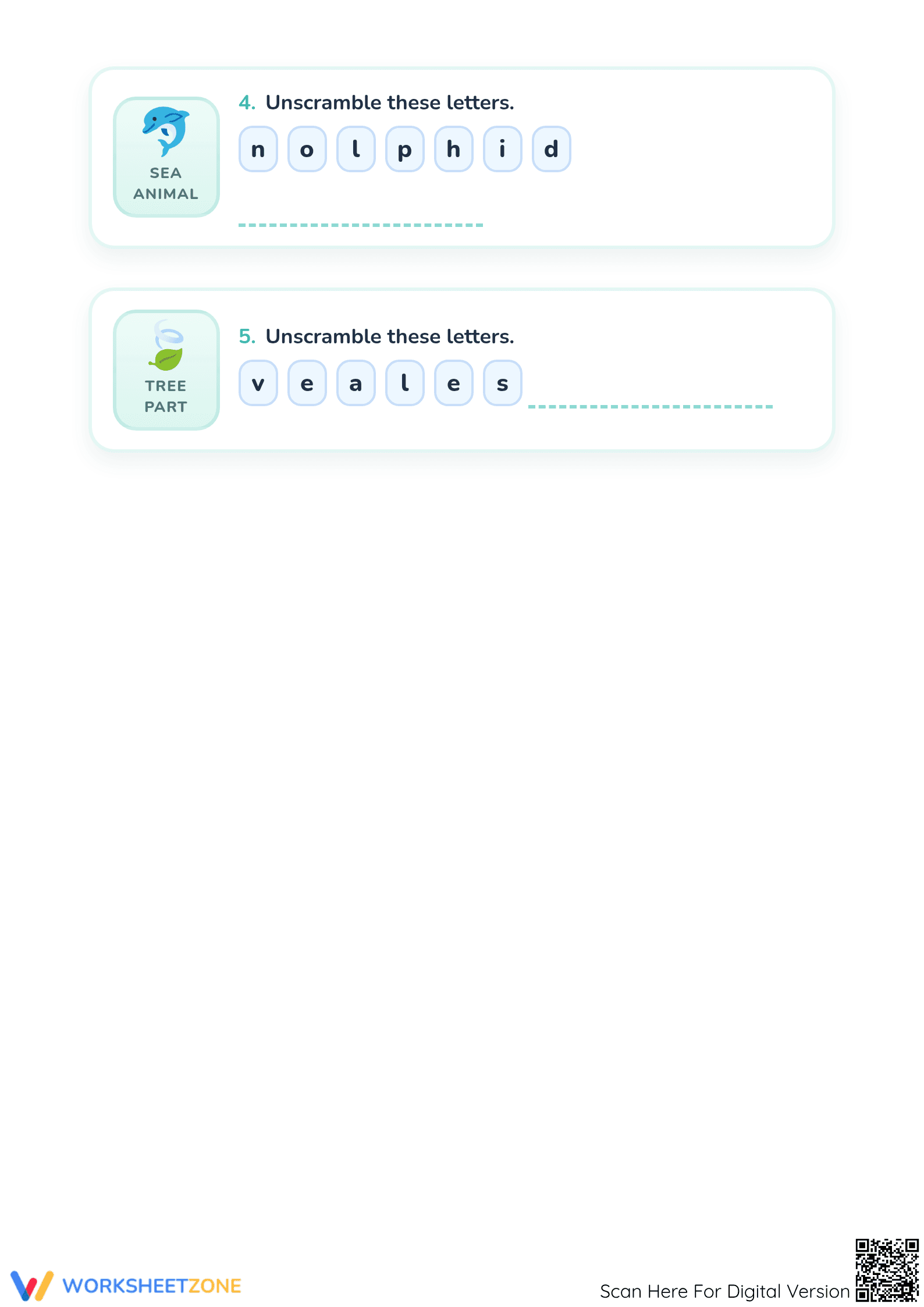
- Independent Practice: The final two challenges on page two require students to apply their developed decoding strategies to more complex words like "dolphin" and "leaves," promoting phonemic mastery.
This "I Do, We Do, You Do" approach ensures that young learners feel supported as they transition from simple letter recognition to independent word construction.
Standards Alignment
This resource aligns directly with CCSS.ELA-LITERACY.L.PK.2, focusing on the student's ability to use letter-sound relationships to spell simple words phonetically. It also supports phonological awareness by requiring active recognition and manipulation of lowercase alphabet letters. Both standard codes can be copied directly into lesson plans or curriculum mapping tools.
How to Use It
Use this worksheet during small-group literacy rotations after a direct instruction lesson on phonics. To maximize learning, observe if students are sounding out the picture names before writing; this helps identify those who may need additional support with phonemic segmentation. This activity typically takes 15 to 20 minutes.
Who It's For
Designed for preschool and early kindergarten students, this worksheet is ideal for learners beginning to explore the alphabetic principle. It serves as an excellent differentiation tool for students who benefit from visual scaffolding. Pair this resource with a picture book or alphabet magnetic letters for a multi-sensory learning experience.
Effective spelling instruction in early childhood requires a balance between phonological awareness and visual word recognition. According to the RAND AIRS 2024 literacy review, visual cues combined with letter manipulation activities significantly improve a preschool student's ability to grasp the alphabetic principle. This worksheet, aligned with standard CCSS.ELA-LITERACY.L.PK.2, provides five targeted tasks that require students to engage in phonemic unscrambling, a high-impact strategy for developing early orthographic mapping skills. By providing a structured framework for reordering letters based on observable picture clues, the resource promotes the orthographic mapping process, a critical predictor of later reading fluency. Educators can confidently integrate this zero-prep printable to meet foundational ELA requirements, providing students with essential cognitive scaffolding for word production.


