


























Views
Downloads

Essential Quotation Marks Worksheet | Grade 3 English
Paste this activity's link or code into your existing LMS (Google Classroom, Canvas, Teams, Schoology, Moodle, etc.).
Students can open and work on the activity right away, with no student login required.
You'll still be able to track student progress and results from your teacher account.
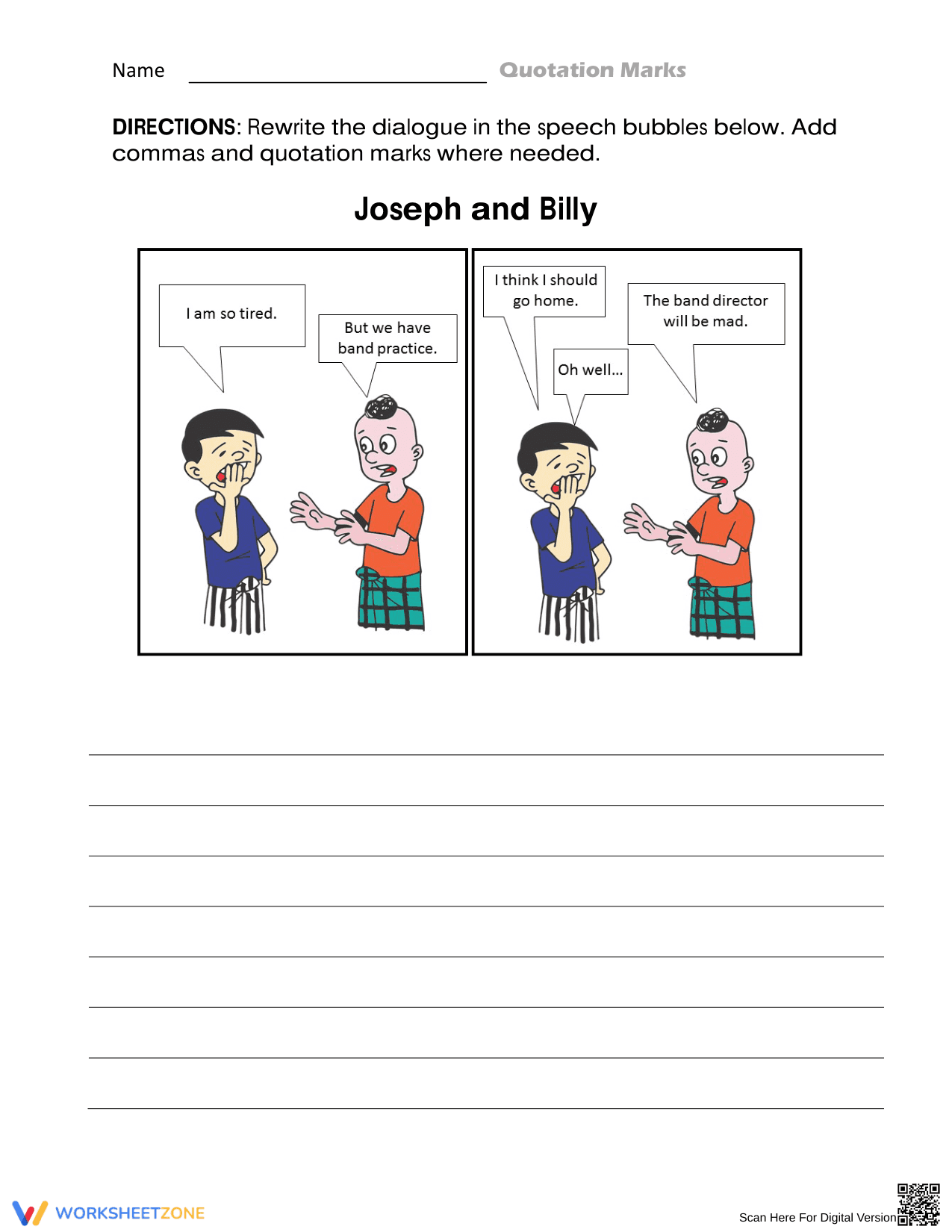
This Grade 3 English Language Arts worksheet focuses on correctly punctuating dialogue. Students practice identifying spoken text within speech bubbles and rewriting it using standard quotation mark conventions. By adding necessary commas and quotation marks, learners strengthen their narrative writing skills and improve their overall grammatical accuracy in written communication.
At a Glance
- Grade: 3 · Subject: ELA
- Standard:
CCSS.ELA-LITERACY.L.3.2.C— Use commas and quotation marks in dialogue to convey character speech accurately- Skill Focus: Punctuating Dialogue and Quotation Mark Mechanics
- Format: 1 comprehensive page · 5 interactive problems · Full answer key included · PDF
- Best For: Grammar centers, daily warm-ups, and targeted independent practice
- Time: 15–20 minutes of focused classroom engagement
What's Inside
This resource contains a one-page activity featuring a comic-style layout with two character panels. Joseph and Billy interact through five distinct speech bubbles containing informal dialogue. Students are provided with ample lined space below the illustrations to rewrite each sentence with formal punctuation. A comprehensive answer key is included to facilitate quick grading or student self-correction.
Zero-Prep Workflow
The zero-prep workflow for this resource is designed for maximum efficiency in busy classrooms. Teachers can simply print the single-page PDF in under 30 seconds, distribute the worksheets for a morning warm-up or grammar center in about 1 minute, and review the five punctuated sentences using the included answer key in another 30 seconds. This streamlined process makes it an ideal choice for emergency sub plans or quick formative assessments.
Standards Alignment
The primary alignment is `CCSS.ELA-LITERACY.L.3.2.C`, which requires students to use commas and quotation marks in dialogue. This worksheet specifically addresses the transition from visual speech bubbles to written prose, a critical step in mastering narrative punctuation. Both standard codes can be copied directly into lesson plans, IEP goals, or district curriculum mapping tools.
How to Use It
Introduce this worksheet during a mini-lesson on narrative writing to demonstrate how characters speak on the page. Use it as a formative assessment after teaching the comma-quotation-capital rule to observe if students correctly place commas before closing quotation marks. Completion usually takes 15 to 20 minutes, making it perfect for independent seatwork.
Who It's For
This resource is tailored for third-grade students mastering basic grammar conventions and fourth-grade students requiring a refresher on dialogue rules. It serves as an excellent companion to mentor texts featuring heavy dialogue. For struggling writers, the visual cues of the speech bubbles provide a helpful bridge to understanding where punctuation belongs.
According to RAND AIRS 2024, structured grammar practice that utilizes visual aids, such as speech bubbles, significantly improves the retention of punctuation rules among elementary learners. This worksheet addresses the CCSS.ELA-LITERACY.L.3.2.C standard by requiring students to manually apply commas and quotation marks to dialogue. By engaging with the 5 specific tasks, students move from recognizing spoken text to applying formal writing conventions. Fisher & Frey (2014) emphasize that such guided practice is essential for the gradual release of responsibility in literacy instruction. This focused resource provides the necessary scaffolding to ensure students can independently produce accurately punctuated dialogue in their own narrative compositions. The inclusion of an answer key further supports immediate feedback, which is a key component of effective formative assessment strategies in modern ELA classrooms. This approach aligns with NAEP findings suggesting that frequent writing practice with focused feedback leads to higher proficiency levels across all student demographics.


