


























Views
Downloads


Algebraic Expressions Worksheet | Grade 6-7 Printable
Paste this activity's link or code into your existing LMS (Google Classroom, Canvas, Teams, Schoology, Moodle, etc.).
Students can open and work on the activity right away, with no student login required.
You'll still be able to track student progress and results from your teacher account.
Algebraic expressions represent the fundamental bridge between basic arithmetic and higher-level mathematics. This comprehensive worksheet set provides students with the structured practice necessary to manipulate variables, simplify complex terms, and solve multi-step equations. By engaging with these exercises, learners develop the procedural fluency required for success in middle school algebra and beyond.
At a Glance
- Grade: 6–7 · Subject: Math / Algebra
- Standard:
CCSS.MATH.CONTENT.6.EE.A.3— Apply properties of operations to generate equivalent expressions and solve problems- Skill Focus: Expression simplification and substitution
- Format: 4 pages · 17 problems · Answer key included · PDF
- Best For: Independent practice and skill reinforcement
- Time: 30–45 minutes
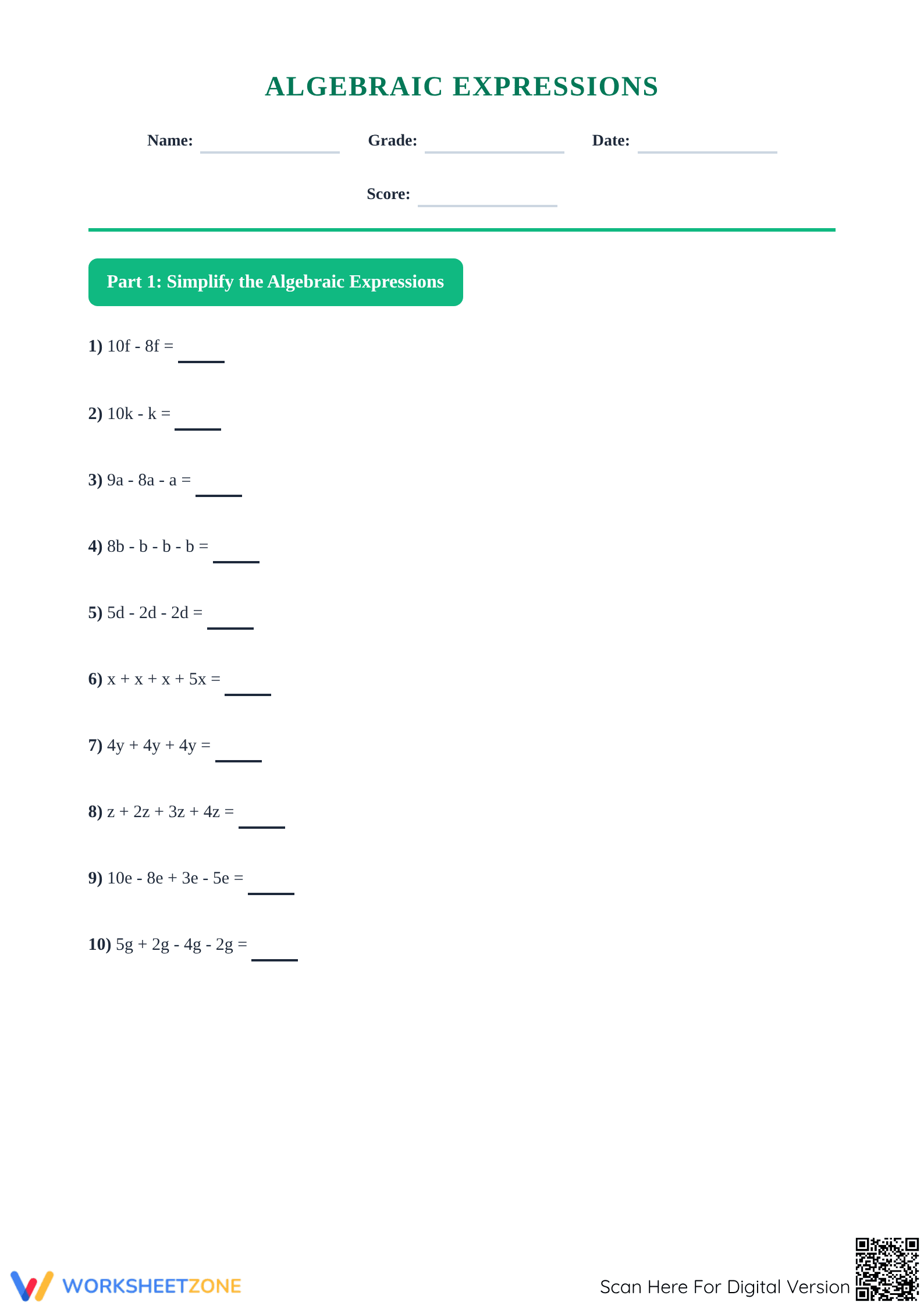
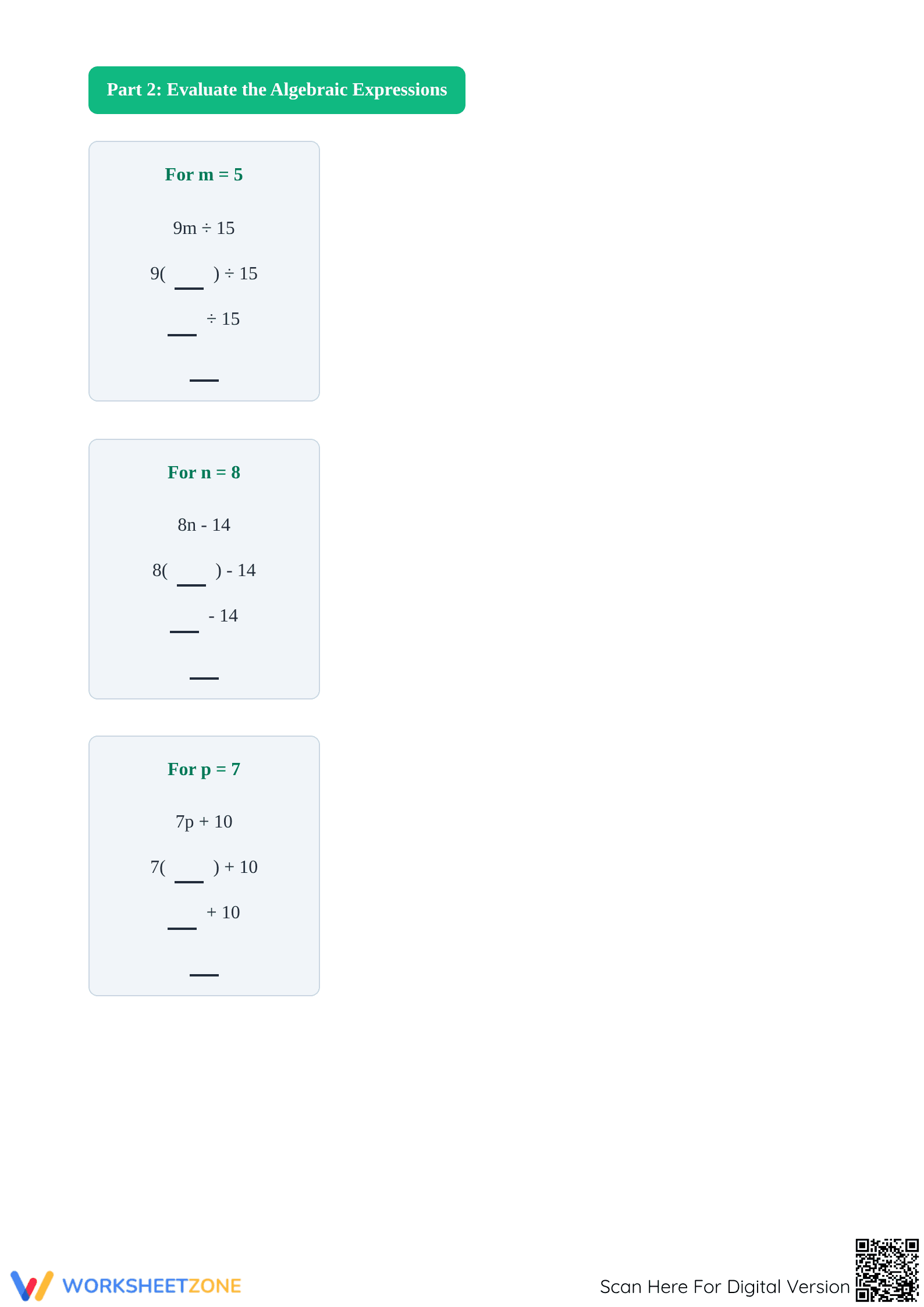
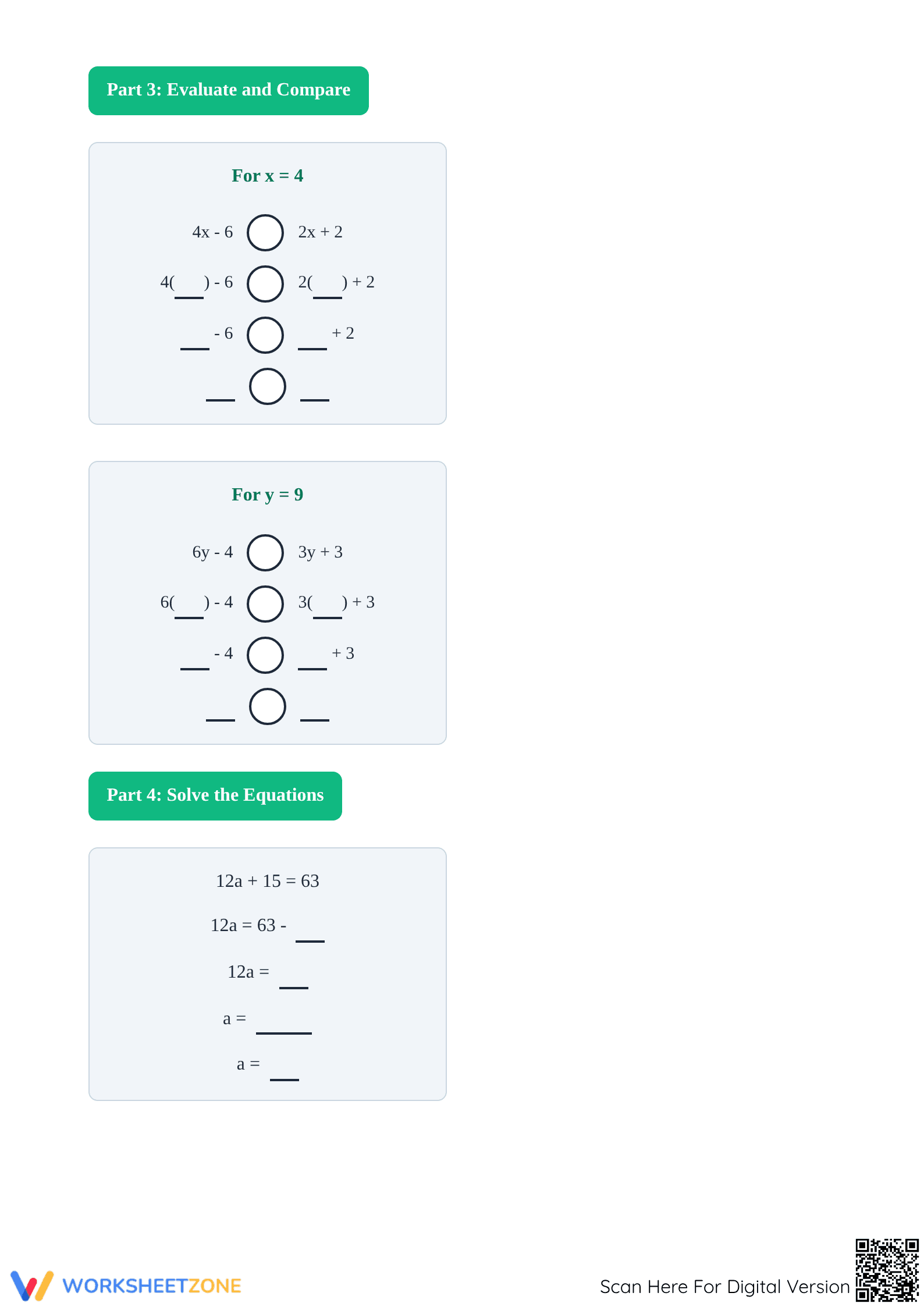
What's Inside: This 4-page PDF resource contains 17 distinct mathematical tasks organized into four logical parts. The worksheet features clear headings, dedicated workspace for substitution, and comparison circles for evaluating expressions. A full answer key is provided, allowing for quick grading or student self-correction during independent study sessions or homework assignments.
Skill Progression
- Guided Practice: Part 1 focuses on 10 simplification problems where students combine like terms using addition and subtraction of variables.
- Supported Practice: Parts 2 and 3 introduce substitution, providing scaffolded boxes for students to plug in numerical values and evaluate the resulting expressions.
- Independent Practice: Part 4 challenges students to solve multi-step equations by isolating variables, requiring them to apply inverse operations without visual prompts.
This structure follows a gradual-release model, moving from basic term manipulation to complex problem-solving.
Standards Alignment
This resource is primarily aligned with `CCSS.MATH.CONTENT.6.EE.A.3`, which requires students to apply properties of operations to generate equivalent expressions. It also supports `CCSS.MATH.CONTENT.6.EE.B.7` by asking students to solve real-world and mathematical problems by writing and solving equations. Both standard codes can be copied directly into lesson plans, IEP goals, or district curriculum mapping tools.
How to Use It
This worksheet is ideal for use during the independent practice phase of a lesson on algebraic properties. Teachers can assign the first two pages as a mid-lesson check to ensure students understand substitution before moving to equation solving. For formative assessment, observe how students handle the comparison tasks in Part 3; errors here often indicate a misunderstanding of the order of operations. Completion typically takes 35 minutes.
Who It's For
This resource is designed for Grade 6 and Grade 7 students beginning their algebra journey. It is also highly effective for Grade 8 students requiring intervention or as a review tool before introducing quadratic functions. Pair this worksheet with a variable anchor chart or a direct instruction lesson on combining like terms.
According to research by Fisher & Frey (2014), the gradual release of responsibility is essential for mathematical mastery, particularly when transitioning from concrete arithmetic to abstract algebraic reasoning. This worksheet facilitates that transition by providing 17 scaffolded tasks that move from simple variable combination to independent equation solving. By isolating the skill of simplification before requiring full equation mastery, the resource reduces cognitive load and allows students to build a durable mental model of variable manipulation. The inclusion of the CCSS.MATH.CONTENT.6.EE.A.3 standard ensures that the practice remains focused on high-leverage skills identified by national frameworks as critical for college and career readiness. Educators can utilize the structured substitution boxes to identify exactly where a student's calculation might fail, making this an excellent tool for targeted intervention. This systematic approach to algebra instruction is supported by the NAEP as a proven method for increasing student proficiency in middle school mathematics.


