


























Views
Downloads
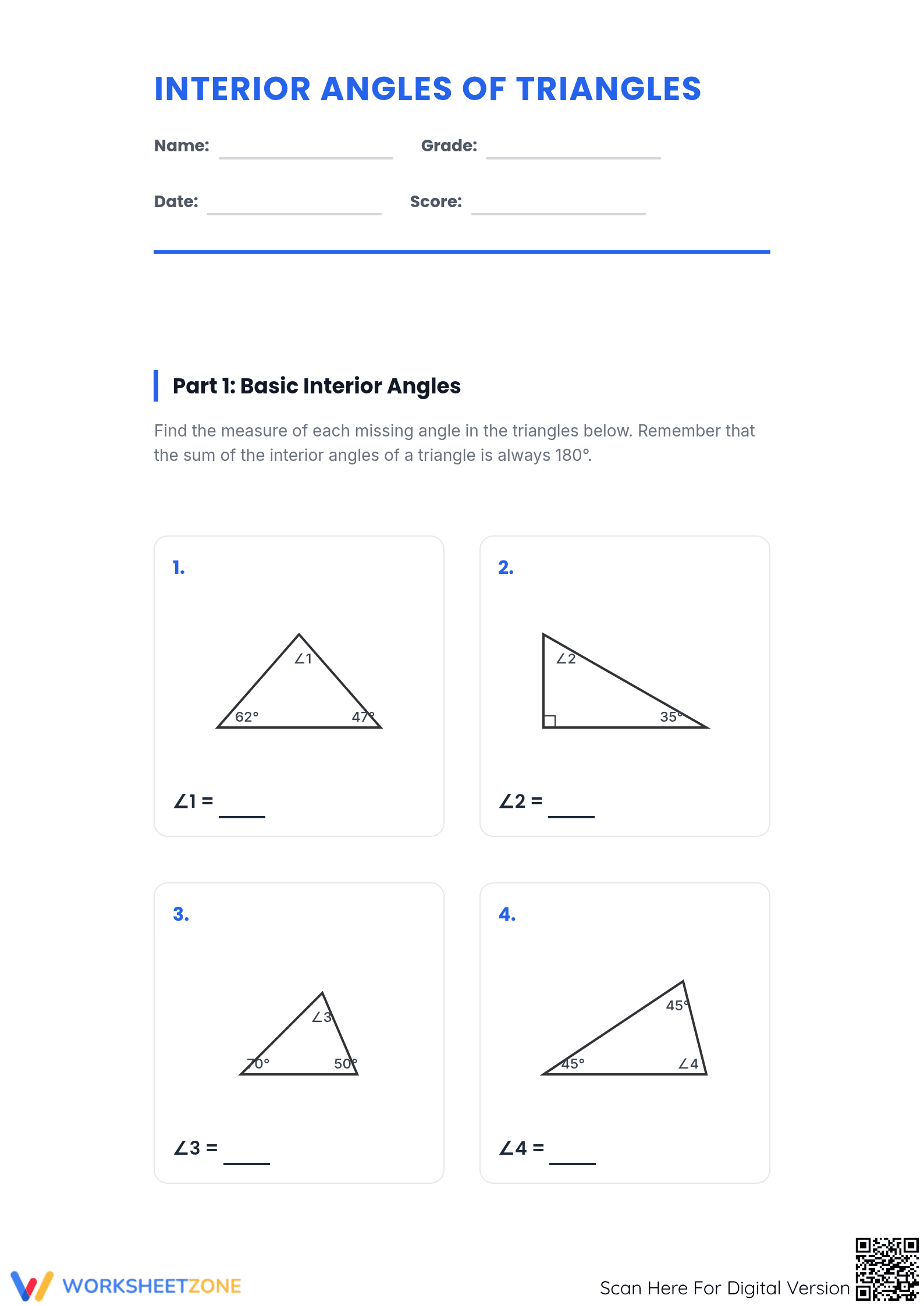



Interior Angles of Triangles Worksheet | Essential 8th Grade Math
Paste this activity's link or code into your existing LMS (Google Classroom, Canvas, Teams, Schoology, Moodle, etc.).
Students can open and work on the activity right away, with no student login required.
You'll still be able to track student progress and results from your teacher account.
This comprehensive worksheet helps students master the interior angles of triangles through 17 structured problems. By applying the triangle angle sum theorem, learners progress from basic identification to complex algebraic equations and real-world application. This resource ensures students gain the confidence needed to solve for unknown variables in various geometric figures.
At a Glance
- Grade: 8 · Subject: Math · Topic: Geometry
- Standard:
CCSS.MATH.CONTENT.8.G.A.5— Use informal arguments to establish facts about the interior angle sum of triangles and missing angles- Skill Focus: Triangle Angle Sum Theorem and Algebraic Equation Modeling
- Format: 5 printable pages · 17 targeted problems · Full answer key included · PDF
- Best For: Independent classroom practice, standardized test prep, or homework
- Time: 40–50 minutes of instructional time
The packet contains five meticulously designed pages organized into four distinct instructional blocks. Page one and two focus on basic visual identification, while page three introduces complex figures with overlapping lines. Page four transitions into solving for "x" using linear equations, and the final page provides challenging word problems and reasoning tasks. A complete answer key is provided for immediate grading.
- Guided Practice: Students solve basic triangles to reinforce the 180-degree rule using clear visual models.
- Supported Practice: Learners set up algebraic equations to find missing measures in complex and composite figures.
- Independent Practice: Students apply their knowledge to real-world word problems and reasoning challenges.
This gradual-release model moves students from rote calculation to higher-order geometric reasoning through a structured instructional sequence.
Standards Alignment
This resource is explicitly aligned with CCSS.MATH.CONTENT.8.G.A.5, focusing on the proof that the sum of interior angles is 180 degrees. It also supports algebraic standards by requiring students to solve multi-step linear equations for an unknown measure within a geometric context. Both standard codes can be copied directly into lesson plans or district curriculum mapping tools.
How to Use It
Use this worksheet as a practice tool after direct instruction. It serves as an excellent formative assessment; observe students during Part 3 to check their equation-solving skills and variable manipulation. The 45-minute completion time makes it ideal for a full class period or a comprehensive homework assignment that bridges geometry and algebra.
Who It's For
This packet is designed for Grade 8 students but is highly effective for Grade 7 enrichment or Grade 9 remediation. It provides necessary scaffolding for students with IEPs through the visual section while offering extension opportunities in the word problem section. Pair this resource with a protractor exploration or an anchor chart showing the triangle sum proof for maximum instructional impact.
The CCSS.MATH.CONTENT.8.G.A.5 standard requires students to leverage the triangle angle sum theorem to calculate unknown measures. Research from RAND AIRS 2024 emphasizes that geometric reasoning is most effective when paired with algebraic manipulation, as it helps middle schoolers build pathways for high school trigonometry. By moving from visual triangles to equations involving variables, this worksheet aligns with the Fisher & Frey (2014) scaffolded model. This approach ensures that learners do not merely memorize the 180-degree rule but can apply it to solve for unknown variables in non-standard figures. ScienceDirect 2024 analysis suggests that worksheets featuring a mix of numerical and algebraic tasks significantly improve long-term retention. This 17-task resource provides the high-frequency practice necessary for students to achieve procedural fluency in angle calculations and algebraic modeling.


