


























Views
Downloads


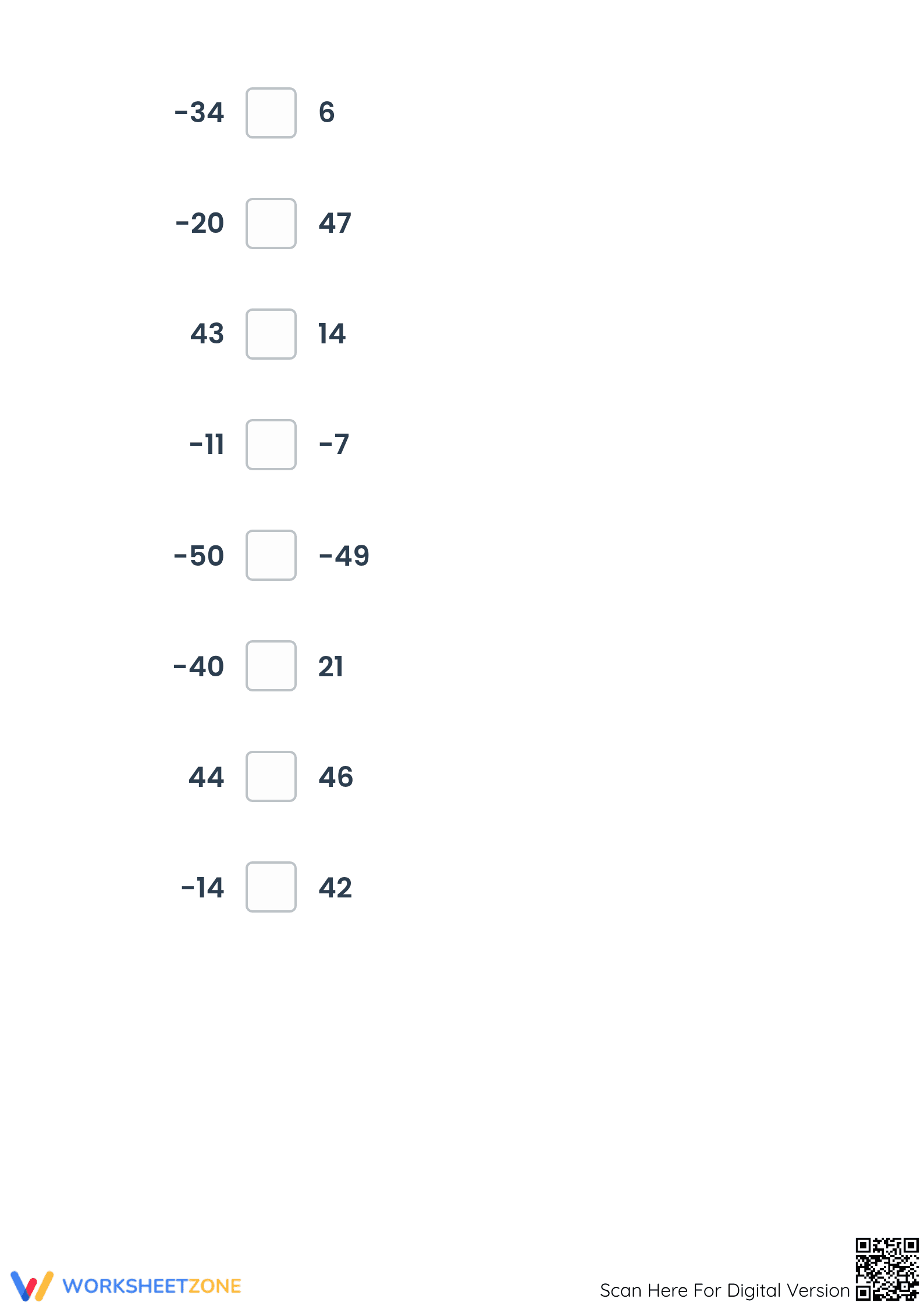

Grade 5 Comparing Integers — Printable No-Prep Worksheet
Paste this activity's link or code into your existing LMS (Google Classroom, Canvas, Teams, Schoology, Moodle, etc.).
Students can open and work on the activity right away, with no student login required.
You'll still be able to track student progress and results from your teacher account.
Mastering the relationship between positive and negative values is a critical milestone for middle-grade mathematicians. This comprehensive worksheet provides extensive practice in comparing integers within the range of -50 to 50. By using inequality symbols, learners solidify their understanding of relative value and position on the horizontal number line for consistent mathematical success.
At a Glance
- Grade: 5 · Subject: Math
- Standard:
CCSS.MATH.CONTENT.6.NS.C.7— Interpret statements of inequality as relative positions on a number line diagram- Skill Focus: Integer comparison and ordering (-50 to 50)
- Format: 5 pages · 40 problems · Answer key included · PDF
- Best For: Independent practice and fluency building
- Time: 25–40 minutes
This robust 5-page packet features 40 comparison tasks designed to eliminate common misconceptions about absolute value. Each page begins with a clear horizontal number line ranging from -50 to 50, providing a constant visual reference. Students must insert the correct greater than, less than, or equal to symbol into formatted boxes between integer pairs. A complete 5-page answer key is provided for immediate grading.
Zero-Prep Workflow
Implementing this resource into your daily routine requires minimal effort. First, print the desired pages for your class size, which takes less than one minute. Second, distribute the worksheets along with pencils; the clear instructions mean students can begin immediately without teacher-led modeling. Finally, review the work using the included keys, allowing for a total teacher preparation time of under two minutes from start to finish.
Standards Alignment
The primary alignment is CCSS.MATH.CONTENT.6.NS.C.7: "Interpret statements of inequality as statements about the relative position of two numbers on a number line diagram." While supporting early introduction in Grade 5, it directly addresses middle-grade number system requirements. These standard codes can be copied directly into lesson plans, IEP goals, or district curriculum mapping tools.
How to Use It
Deploy this resource during the "Independent Practice" phase of a lesson on the number system. It serves as an excellent formative assessment tool; observe if students struggle when comparing two negative numbers (e.g., -47 vs -6). Alternatively, use it as a reliable sub-plan activity. Most students will complete the entire 40-problem set within 30 minutes, making it a perfect filler for transition blocks.
Who It's For
This worksheet is ideal for fifth and sixth-grade students beginning their journey with rational numbers. The visual support of the number line benefits English Language Learners and students with processing needs. It pairs naturally with a digital number line interactive or a direct instruction lesson on real-world negative values like temperature or elevation changes.
Effective integer instruction requires moving beyond rote memorization to conceptual understanding of number magnitude. According to research by Fisher & Frey (2014), the use of visual scaffolds like the horizontal number lines featured in this resource is essential for the gradual release of responsibility. This Grade 5 math packet directly supports the standard code CCSS.MATH.CONTENT.6.NS.C.7 by requiring students to determine the relative positions of integers from -50 to 50. By engaging with 40 structured comparison tasks, learners build the fluency needed for complex operations with rational numbers. This evidence-based approach ensures students understand that -50 is "less" than -10 because it lies further left on the mathematical continuum. Educators can rely on this systematic practice to bridge the gap between elementary arithmetic and algebraic reasoning, providing a proven path toward middle school mathematics mastery.


