


























Students' comprehension of an informational text's primary premise and important elements is expanded upon in this session. At the end of the lesson, students are able to:
- Determine the informational text's key theme.
- Using important details to summarize the material.
- How do knowledgeable readers interpret literary and factual texts?
- In what ways can read aloud from a text prompt reflection and action?
- What exactly does this paragraph cover?
- Main Idea: The topic or big idea that an informational text is written about.
- Key Details: Important pieces of information that support the main idea of a text.
- Hayward, L. (2001). Day in the life of a police officer. DK Children.
- Alternative:
- Hayward, L. (2001b). A day in the life of a builder. DK Children.
- Lock, D., & Dk. (2007). Animals at home. DK Children.
Teachers may substitute other books to provide a range of reading and level of text complexity.
- “The Squirrel” by Arijit Mandal. www.poemhunter.com/poem/the-squirrel-6 (Cover the title of the poem before displaying it to students.)
- Highlighter tape
- A four-page flip book for each student (see model in lesson plan)
- Informational texts at students’ reading levels (one for each student)
- Chart paper
Aim to ensure that every student can correctly identify an informational text's primary theme and can effectively recount important details.
- When moving around the classroom, annotate what students are saying about important details and the primary theme. To evaluate students' progress toward the lesson's objectives, use the checklist that follows:
- Students are able to define terminology and articulate their major ideas.
- Students are able to organize an informational text's essential facts into a list.
- Students are able to identify the primary idea by using the details.
- Students are able to reiterate the most important information.
Explicit instruction, modeling, scaffolding, and active engagement
W: Help pupils learn how to recognize and define important features in a text. Ask them to identify the primary theme and summarize the text using the most important details.
H: Involve pupils by asking them to pinpoint specific features in a poem and to make educated guesses about its theme or central idea.
E: Show pupils how to recognize crucial words and elements that bolster the main concept. Show off your ability to restate the main points of the text.
R: Assign pupils to work independently on a flip book that documents details and main concepts from a new informative text. After that, ask students to participate in a share-share-switch exercise with classmates to impart knowledge and show that they comprehend the ideas.
E: Students' understanding of the idea and need for revision will be revealed by their classmates' feedback during the share-share-switch activity.
T: Students will acquire critical detail identification skills through modeling, guided practice, and individual practice. Students will discuss how they identify a text's core concept with their peers through conversation.
O: Students identify major ideas and important details through teacher modeling, whole-group exercises, partner and alone practice, and more. Via group discussion, students confirm their understanding.
Topic: How can we summarize an informative document using its essential features and main idea?
Show the poem "The Squirrel" to every pupil, but hide the title. Speak like this: "As I read the poem, please help us identify the main idea by pointing out any important details."
Reread the poem, pausing at critical points to help students understand how they relate to the primary topic. As students select important elements, list them on the board or chart paper.
Then, collectively, examine the important aspects. Show the pupils how to use the important facts to retell the poem. "This animal runs up and down the tree," you say. It scampers across the surface. It consumes food contained in shells and has a large, curly, furry tail. What kind of animal is this? (A squirrel). Retells the poem's essential aspects, aiding our understanding of its theme. We're going to use an informative text to achieve the same objective now."
Part 1
Open Linda Hayward's book, "A Day in the Life of a Police Officer," After reading the title, what do you think the book will be about? (about the daily tasks performed by police personnel) "Why do you think so?" After reading the book aloud, take note of the students' comments.
"Let's read the text together and identify important details." You keep going. "The important information will be listed on the chart paper. We shall examine the specifics and ascertain the text's major point at the conclusion."
Start by going through pages 4–5. Think aloud and demonstrate how to recognize important details. Say, "I see the word 'police' twice." Underline "police" and "police officer" with highlighter tape. Say, "A writer will occasionally use the same word twice in a piece." The writer directs the reader's attention to the details surrounding that term. "What important detail can we make out in the illustrations?" (A woman with a badge and a police uniform.) Notably, a police officer is required to wear a uniform and a badge.
Turn to pages 6-7. Talk to the pupils about the important information contained on these pages. (For instance, the sergeant oversees the other officers). Invite pupils to point out any specifics that they believe are crucial. Ask them to justify the significance they place on these particular elements. Show us how to underline any terms that are repeated on the pages or that relate to the main concept. (Examples: police officer; job; protection of the public)
Read the material again, ponder aloud, and talk about the important points that need to be noted. Emphasize terms that are integral to the primary concept. (A few important facts are that police officers ride patrol cars; police manage traffic when traffic lights are out; police ride motorcycles, bikes, and horses; police are assisted by police dogs; and the police patrol the neighborhood to keep us secure.)
Once you've read the material, go over the important elements with the class. "Take a look at the words that are highlighted. What word appears repeatedly?" (A policeman). Show how to evaluate the details to ascertain the text's core theme. Prompt: "I believe this text discusses how police officers monitor neighborhoods to ensure our safety." Concisely state the major idea at the top of the chart paper, above the list of the important details. For instance, write " Police officers keep us safe in many different ways". Demonstrate how to consult the text again to ensure that the details corroborate the primary notion. Say aloud, "The information we provided explains the duties of a police officer. They describe how police officers behave to secure people".
Encourage your kids to distinguish between a topic and a main theme. Suggest: "We are revealing the topic when we state, 'This book is about police officers.' By stating, "This book is about how police officers keep us safe," we are revealing the work's primary theme.
Ask pupils to check their theories about the book's plot at the end. Talk about whether or not their forecasts came true. After that, ask students to recite the most important details from the book to summarize it.
Part 2
Make sure every student has a flip book ready for this portion of the lecture. Each of the four paper pages that make up a flip book is longer than the previous one. At the top, staple the sheets together (see figure). The pages can be labeled as displayed, or you can help the pupils label them.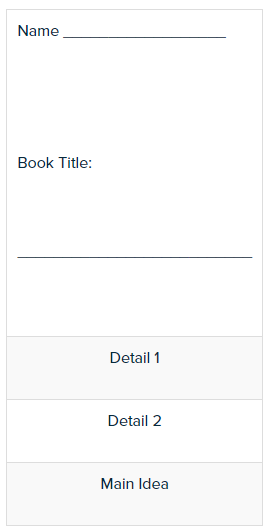
Show how to write the flip book's title on the first page by using the example from A Day in the Life of a Police Officer. Then inquire, "What is one crucial element in this book?" On the page marked "Detail 1," write the detail. Ask pupils to locate and record another crucial detail on the flip book's Detail 2 page. "What is the basic premise of this work?" you ask. On the flip book's final page, write the primary theme.
Give every kid a flip book that is blank and contains informative text appropriate for their reading ability. Students should be told to sign their names and the book's title on the first page. Let them read their book after that. Tell them to keep an eye out for further information and repeated words. Instruct them to jot down a crucial item on every flip-book page within.
Visit each student's classroom and assist those who are struggling to identify key components.
Prompt: "Use the two details you wrote in your flip book to identify the main idea. On the flip book's final page, write the primary theme." As needed, offer support. Instruct pupils to illustrate each detail and the major theme in their flipbooks.
After finishing their flipbooks, assign pupils to a share-share-switch task. Assign them to locate a companion, explain to them the contents of their flip book, and have them estimate what the primary point is. They should then tell their companion the true core concept. Next, partners should trade places, with one partner sharing details, the other letting their partner guess the major idea, and finally sharing the primary idea. Each student could repeat the exercise with a new partner if further practice is required.
Walk around the classroom while the share-share-switch activity is going on to make sure that students understand the importance of key information, how to use key details to summarize a text, and how to use key details to identify the primary idea of the text.
Gather flip books for grading or adding to a portfolio.
Extension:
Give pupils who require more practice or guidance a tangible example by drawing comparisons between the primary idea, specifics, and a recipe. The final product is the recipe's core idea. The final product requires the ingredients listed in the details. After that, employ a straightforward text to assist pupils in locating information that supports the main argument. Make a note of the specifics. After going over the detail list with the pupils, find out what the main points of the specifics are. Once they have stated the primary idea, write it above the list in full sentences.
When they are prepared to go beyond the curriculum, students can examine one or more chapters of a chapter book using the techniques they have learned in this lesson. (For recommended book titles, see Related Resources at the lesson's conclusion.) Kids can make use of a
Use a flip book or a T-chart to list the main idea, important information, and topic of one or more chapters. Next, talk about how each chapter advances the book's central thesis.

Identifying Main Idea and Details in Informational Text (L-1-1-3)
Students' comprehension of an informational text's primary premise and important elements is expanded upon in this session. At the end of the lesson, students are able to:
- Determine the informational text's key theme.
- Using important details to summarize the material.


