


























Views
Downloads
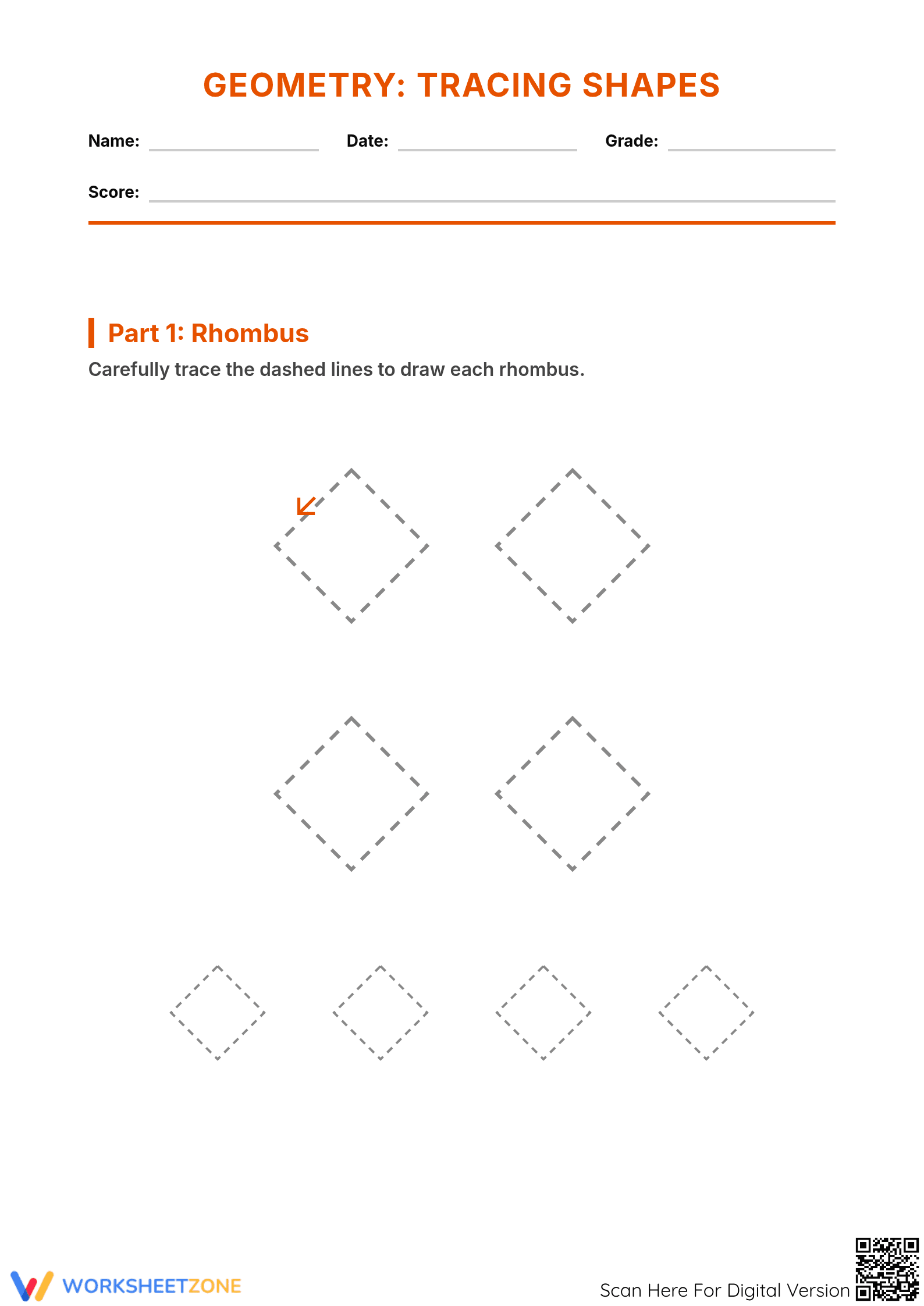


Printable 2D Shape Tracing Worksheet: Rhombus & Trapezoid
Paste this activity's link or code into your existing LMS (Google Classroom, Canvas, Teams, Schoology, Moodle, etc.).
Students can open and work on the activity right away, with no student login required.
You'll still be able to track student progress and results from your teacher account.
This 2D shape tracing worksheet provides foundational geometry practice by focusing on rhombuses and trapezoids. Students develop fine motor control and spatial awareness while correctly identifying and drawing geometric figures. This resource ensures early learners master shape recognition through repetitive, guided practice that leads to independent mastery of complex polygons and coordinate geometry basics.
At a Glance
- Grade: K-2 · Subject: Geometry
- Standard:
CCSS.MATH.CONTENT.K.G.A.2— Correct-ly name shapes regardless of their orientations or overall size- Skill Focus: Tracing and identifying rhombuses and trapezoids
- Format: 2 pages · 18 problems · Answer key included · PDF
- Best For: Fine motor skill development and shape recognition
- Time: 15–20 minutes
What's Inside
This comprehensive 2-page PDF features 18 distinct tracing tasks. Page one focuses on the rhombus, providing 8 dashed-line figures. Page two introduces the trapezoid with 10 additional tracing exercises. The worksheet includes clear instructional headers, space for student metrics, and a professional layout suitable for immediate classroom distribution or homework assignments.
Zero-Prep Workflow
- Print: Select the 2-page PDF and print copies for your class in under 30 seconds.
- Distribute: Pass out the sheets with pencils; no extra setup is required.
- Review: Use the included answer key for rapid grading or student self-correction.
Total teacher prep time is under 2 minutes, making this an ideal resource for busy mornings or sub plans.
Standards Alignment
This resource is primarily aligned with `CCSS.MATH.CONTENT.K.G.A.2`, which requires students to correctly name shapes regardless of their orientations. By tracing these figures, students internalize the defining attributes of rhombuses and trapezoids. This activity also supports `CCSS.MATH.CONTENT.1.G.A.1` regarding the identification of defining versus non-defining attributes. Both standard codes can be copied directly into lesson plans or IEP goals.
How to Use It
Use this worksheet during independent practice after introducing 2D shapes. It is also effective as a formative assessment to observe pencil grip and spatial coordination. Teachers should walk around and ask students to name the shape as they trace, ensuring they connect the visual representation with the mathematical term.
Who It's For
This resource is designed for Kindergarten and first-grade students. It is also highly effective for older students requiring occupational therapy support or English Language Learners needing visual reinforcement of mathematical vocabulary. Pair this worksheet with a shape scavenger hunt around the classroom to deepen the learning experience.
According to a **ScienceDirect TpT Analysis**, structured tracing activities significantly improve the retention of geometric vocabulary in early childhood education. The use of dashed lines provides a scaffolded environment that reduces cognitive load, allowing students to focus on the specific vertex and edge properties of shapes like the rhombus and trapezoid. This worksheet aligns with best practices in the "I Do, We Do, You Do" instructional model, providing the necessary repetition for students to move toward fluent identification. By meeting `CCSS.MATH.CONTENT.K.G.A.2` requirements, this tool ensures that students build a rigorous foundation for higher-level spatial reasoning. Educators can rely on this evidence-based approach to bridge the gap between abstract shape names and concrete visual recognition. The 18 tasks provided here offer sufficient practice to ensure that students can identify these specific polygons with high accuracy across various contexts.


