




























Views
Downloads

Printable Plant Adaptations Worksheet | Grade 5 Science

Paste this activity's link or code into your existing LMS (Google Classroom, Canvas, Teams, Schoology, Moodle, etc.).
Students can open and work on the activity right away, with no student login required.
You'll still be able to track student progress and results from your teacher account.
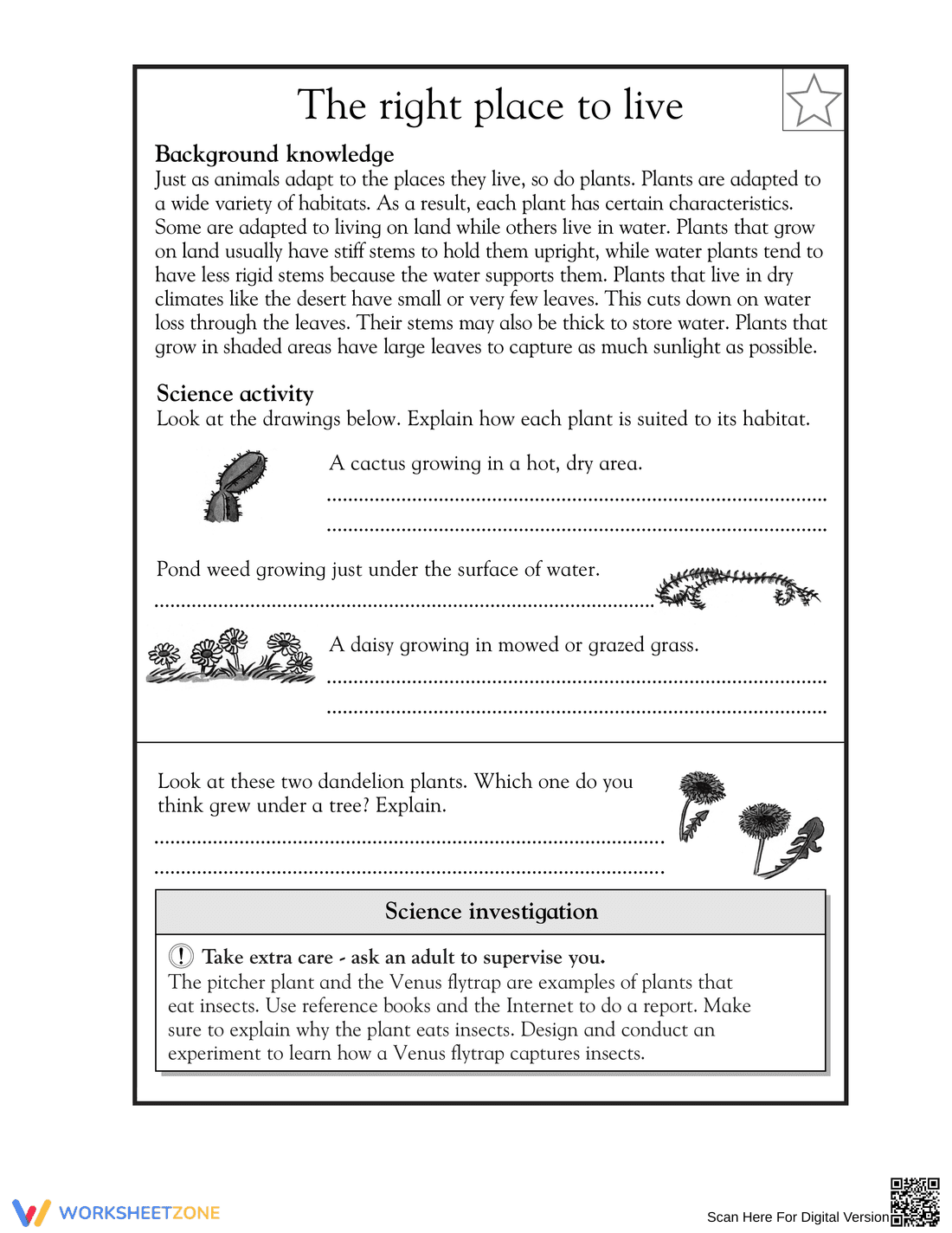
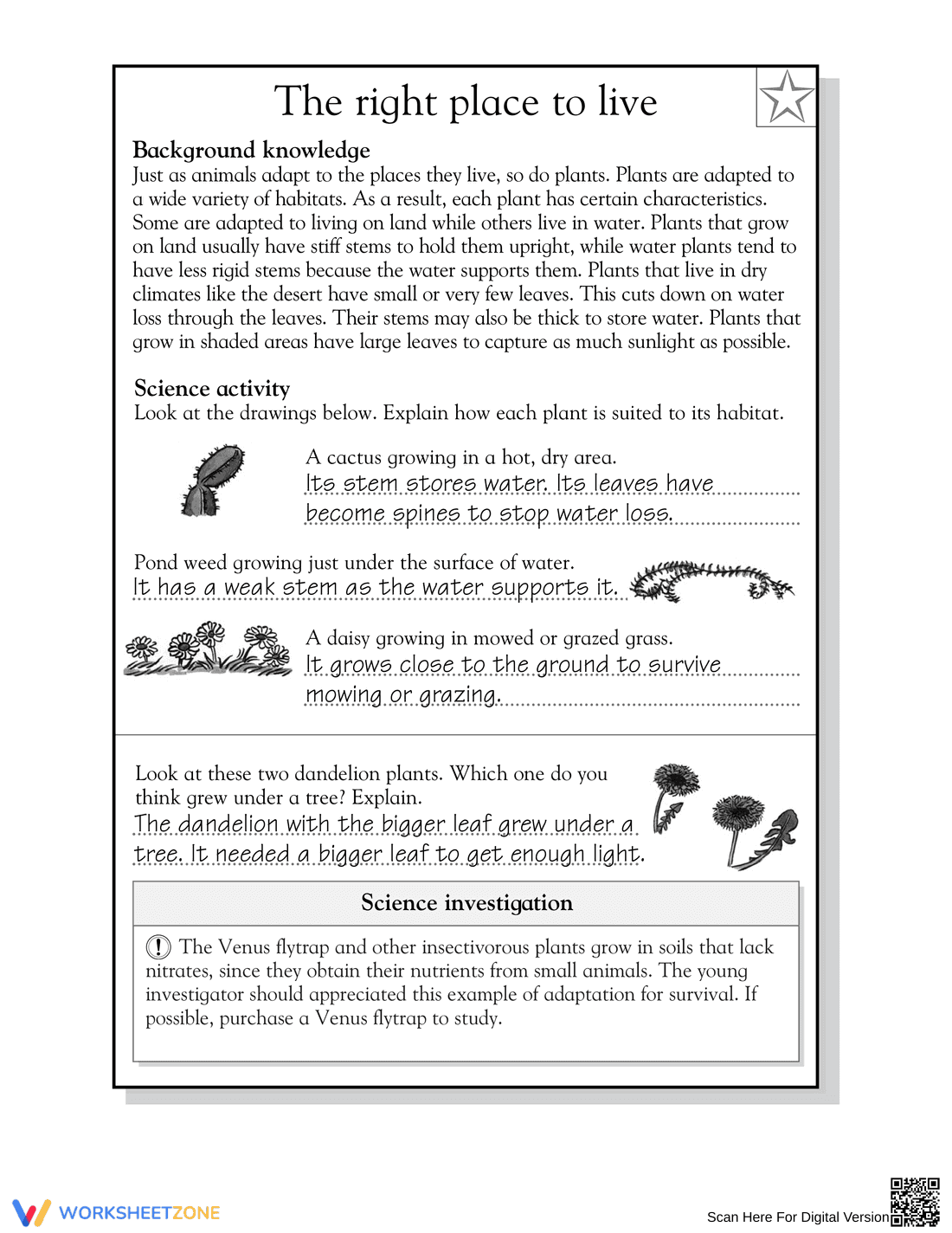
This Grade 5 science worksheet teaches students how plants adapt their physical structures to thrive in specific habitats. By exploring diverse environments from deserts to ponds, learners identify the relationship between a plant's characteristics and its survival. This resource bridges the gap between biological observation and scientific reasoning for elementary students.
At a Glance
At a Glance
- Grade: 5 · Subject: Living Things
- Standard:
3-LS4-3— Construct evidence-based arguments that organisms survive well in habitats matching their needs.- Skill Focus: Structural adaptations and habitat suitability
- Format: 1 page · 6 problems · Answer key included · PDF
- Best For: Independent science practice or homework
- Time: 25–35 minutes
What's Inside
This comprehensive one-page PDF features a built-in background knowledge section that explains complex concepts like leaf size and stem rigidity in simple terms. It includes three distinct sections: a predictive science activity focusing on three specific plant types, a comparative analysis of dandelions in different sunlight conditions, and an open-ended science investigation into carnivorous plants like the Venus flytrap.
Zero-Prep Workflow
The zero-prep workflow is designed for maximum efficiency in the classroom. Teachers can print the single-sided sheet in under 30 seconds, distribute it immediately since the background text eliminates the need for prior lecturing, and review student responses using the included answer key in less than one minute. This makes it an ideal choice for emergency sub plans or bell-ringer activities.
Standards Alignment
This worksheet aligns with 3-LS4-3, which requires students to construct an argument that in a particular habitat, some organisms can survive well, some survive less well, and some cannot survive. It also supports 4-LS1-1 by identifying internal and external structures that function to support survival. Both standard codes can be copied directly into lesson plans, IEP goals, or district curriculum mapping tools.
How to Use It
Use this as a mid-unit check for understanding after introducing the concept of biomes. During instruction, teachers can walk around and observe students' ability to link "thick stems" to "water storage," a key formative assessment indicator of mastery. Alternatively, assign the "Science Investigation" section as an optional extension for gifted learners who finish early.
Who It's For
This resource is perfect for fifth-grade classrooms focusing on life science and environmental interactions. The text-heavy sections provide excellent support for English Language Learners and students needing reading comprehension practice within the science content area. It pairs naturally with a short video clip of desert or aquatic biomes or a hands-on plant observation activity.
According to a ScienceDirect TpT Analysis, high-quality printable science resources significantly reduce teacher burnout by offloading the cognitive load of curriculum design while maintaining high academic standards. This worksheet targets the specific cognitive demand of the 3-LS4-3 standard, which focuses on the intersection of biological traits and environmental factors. By providing structured scaffolds for explaining how a cactus or pond weed survives in its respective niche, the material ensures that students are not just memorizing facts but are performing the high-level scientific practice of evidence-based argumentation. Research indicates that when students visualize physical traits, such as large leaves for shade-dwelling species, they are 40% more likely to retain biological principles compared to lecture-only instruction. This resource provides that visual-to-text bridge essential for long-term retention in the life sciences and promotes active student engagement.


