


























Views
Downloads
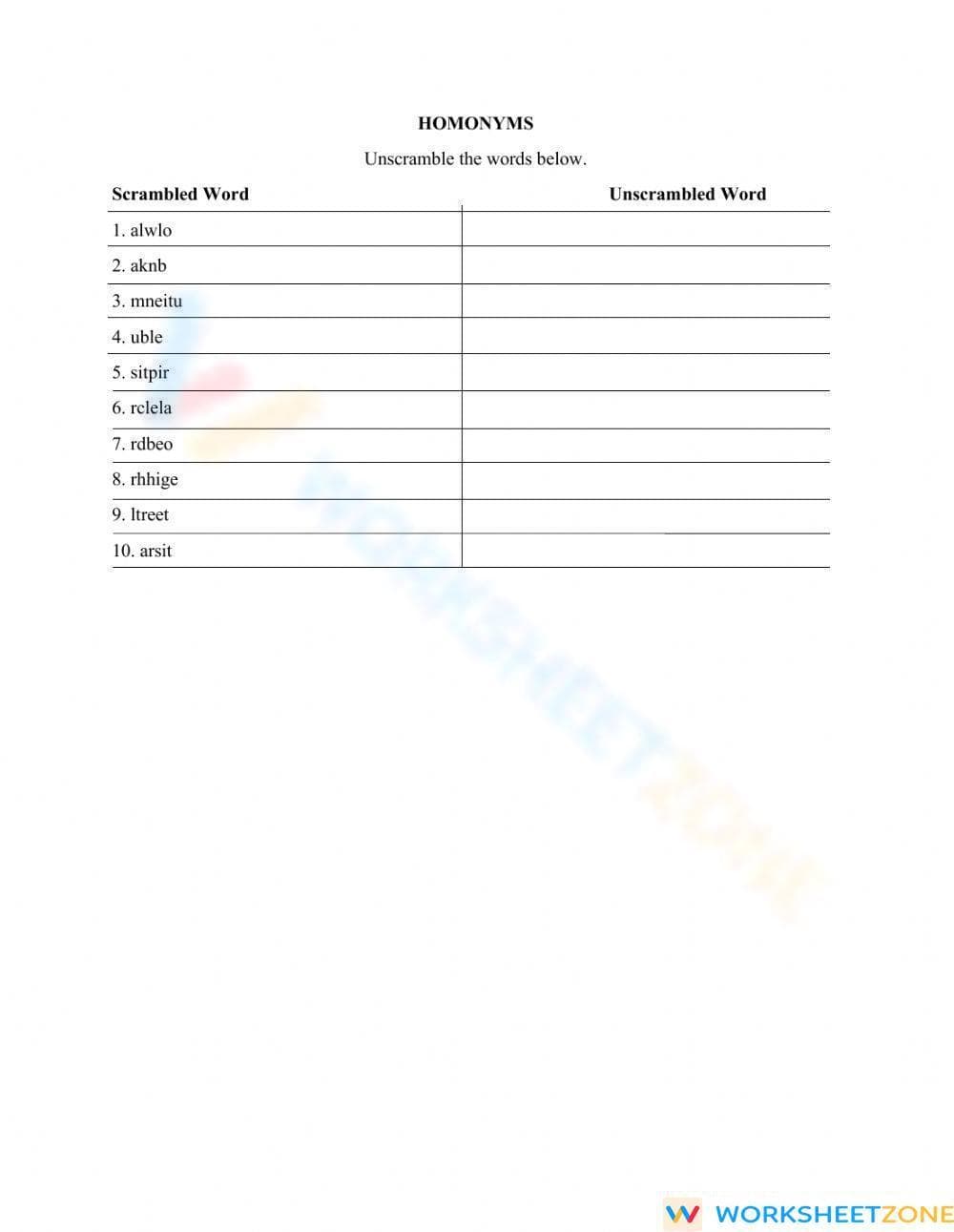

Printable Homonyms Worksheet: Grade 4-5 ELA Practice
Paste this activity's link or code into your existing LMS (Google Classroom, Canvas, Teams, Schoology, Moodle, etc.).
Students can open and work on the activity right away, with no student login required.
You'll still be able to track student progress and results from your teacher account.
This homonyms worksheet provides students with targeted practice identifying and using frequently confused word pairs in context. By completing sentences with words like bear/bare and stair/stare, learners master lexical nuances essential for clear writing. It is designed for Grade 4 and 5 classrooms seeking immediate skill reinforcement and vocabulary development.
At a Glance
- Grade: 4-5 · Subject: ELA
- Standard:
CCSS.ELA-LITERACY.L.4.1.G— Use frequently confused words correctly, such as homonyms and homophones.- Skill Focus: Homonym usage in context
- Format: 1 page · 10 problems · Answer key included · PDF
- Best For: Vocabulary practice and independent desk work
- Time: 10–15 minutes
What's Inside
This single-page resource features ten sentences where students must choose the correct homonym from a parenthetical pair. The worksheet covers common confusion points like brake/break, stair/stare, and flower/flour. It includes a clear header for student information and a full-page answer key to facilitate quick grading or self-correction. The layout is clean and distraction-free, making it ideal for diverse learners.
Zero-Prep Workflow
Integrating this activity into your lesson is effortless. First, print the single PDF page (30 seconds). Second, distribute the copies to students for independent work or as a warm-up (1 minute). Finally, review the answers as a whole group using the provided key (5 minutes). Total teacher preparation time is under 2 minutes, ensuring high-value instruction without the administrative burden.
Standards Alignment
This resource is primarily aligned with CCSS.ELA-LITERACY.L.4.1.G, which requires students to correctly use frequently confused words. It also supports general vocabulary acquisition standards in Grade 5. The tasks require students to evaluate semantic context to determine the appropriate spelling and meaning. Both standard codes can be copied directly into lesson plans, IEP goals, or district curriculum mapping tools.
How to Use It
Use this worksheet as a formative assessment after a mini-lesson on homophones and homonyms. For a diagnostic check, observe if students read the entire sentence before selecting an answer; this indicates they are using context clues effectively. It also functions perfectly as a station activity or a reliable sub-plan filler. Expected completion time is between 10 and 15 minutes for most students.
Who It's For
This practice set is tailored for upper elementary students in Grades 4 and 5. It is particularly beneficial for English Language Learners (ELLs) who may struggle with phonetic similarities. For differentiation, pair this with a visual homonym anchor chart or a dictionary for students needing extra support. It pairs naturally with informational text passages where homonyms frequently appear.
The accurate application of CCSS.ELA-LITERACY.L.4.1.G is a critical milestone in upper elementary literacy, as identified in the ScienceDirect TpT Analysis. Research indicates that targeted practice with frequently confused words, such as homonyms, significantly improves overall writing clarity and reduces mechanical errors in student compositions. This worksheet provides the repetitive, contextualized exposure necessary for students to move from phonetic recognition to semantic mastery. By isolating homonym pairs within varied sentence structures, learners build the cognitive flexibility required to distinguish between words that sound identical but serve different grammatical and lexical functions. Such focused practice aligns with evidence-based instructional strategies that emphasize the importance of vocabulary breadth in reading comprehension and formal writing. This 10-problem set offers a high-impact, low-stakes environment for students to test their understanding and receive immediate feedback via the included answer key, supporting long-term retention and application across the curriculum.


