


























1 / 2
0
Views
0
Downloads

0.0
0
Save
0 Likes
Solve Thermochemistry Problems with Hess Cycle Worksheet
0 Views
0 Downloads
Paste this activity's link or code into your existing LMS (Google Classroom, Canvas, Teams, Schoology, Moodle, etc.).
Students can open and work on the activity right away, with no student login required.
You'll still be able to track student progress and results from your teacher account.
Information
Description
What It Is:
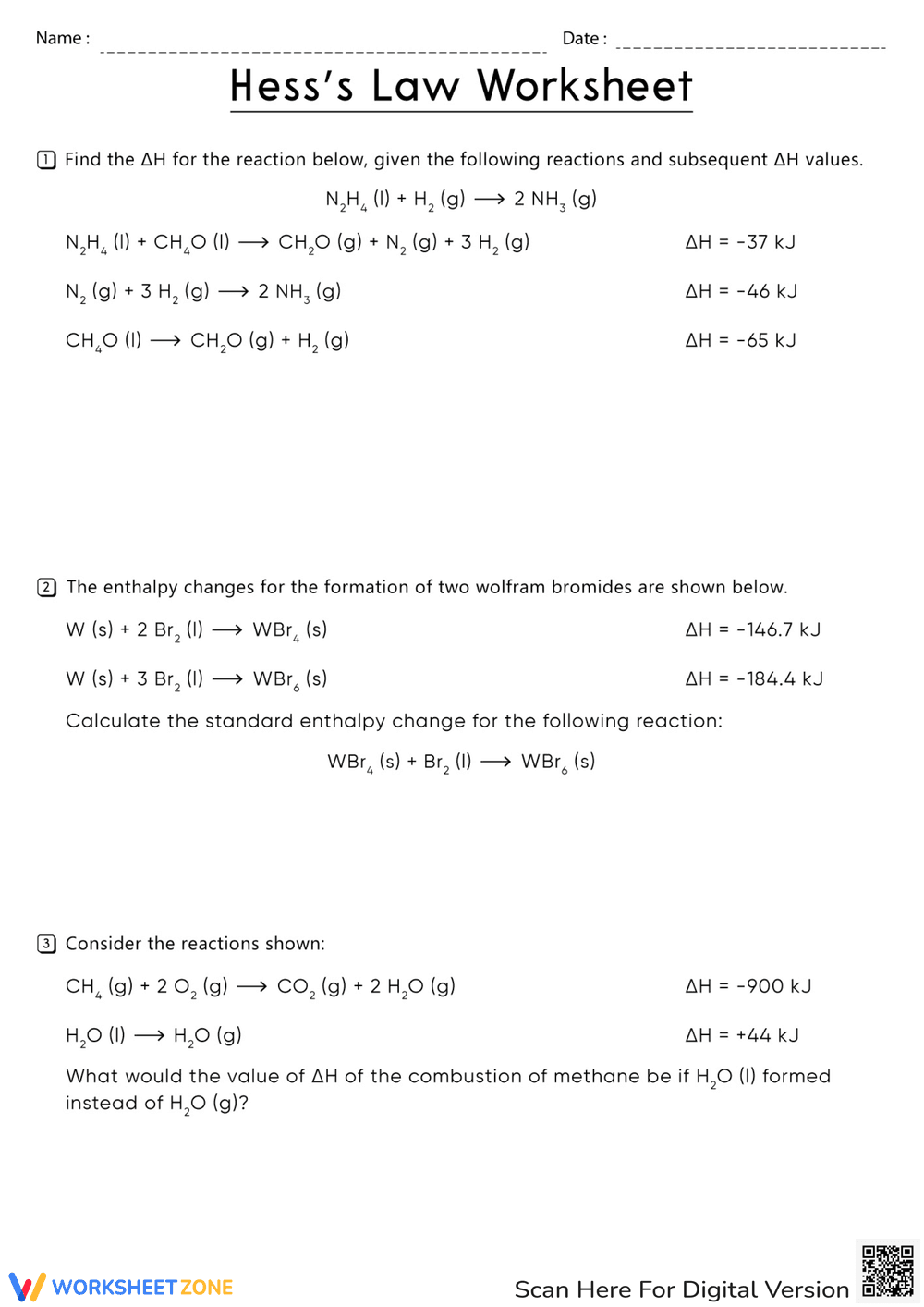
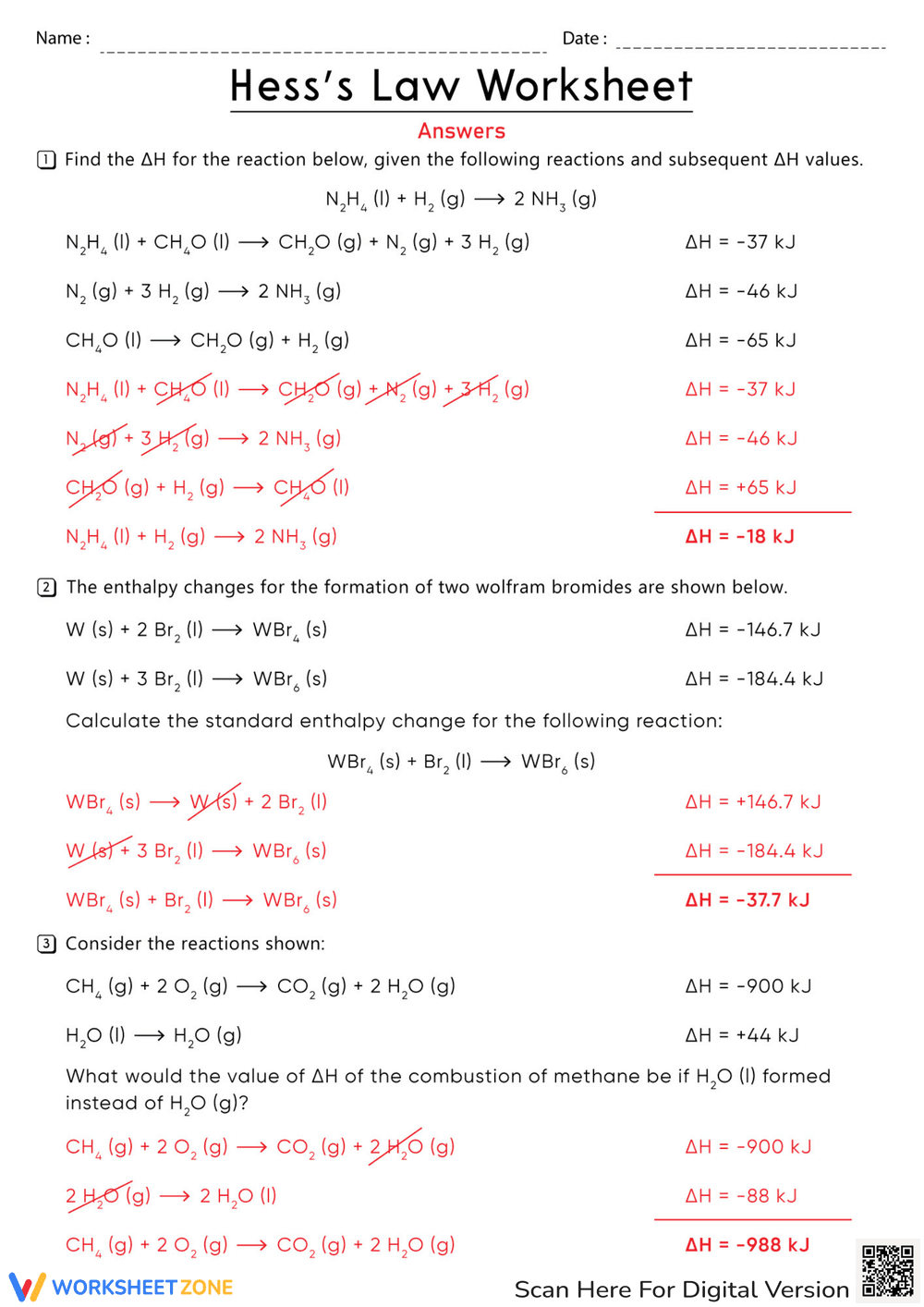
This is a Hess's Law worksheet containing three problems. The first problem asks the student to find the ΔH for a reaction given other reactions and their ΔH values. The second problem provides enthalpy changes for the formation of tungsten bromides and asks the student to calculate the standard enthalpy change for a reaction. The third problem gives reactions involving methane combustion and asks the student to determine the ΔH if liquid water is formed instead of gaseous water.
Grade Level Suitability:
This worksheet is suitable for high school chemistry, specifically grades 11-12, or introductory college chemistry. It requires an understanding of chemical reactions, enthalpy, and Hess's Law, which are typically covered in these levels.
Why Use It:
This worksheet helps students practice applying Hess's Law to calculate enthalpy changes for chemical reactions. It reinforces understanding of thermochemistry concepts and provides practice in manipulating chemical equations and enthalpy values. It also helps students understand the effect of phase changes on enthalpy.
How to Use It:
Students should use their knowledge of Hess's Law to manipulate the given chemical equations and their corresponding enthalpy changes to arrive at the desired reaction. They need to add or subtract the enthalpy values accordingly. For problem 3, they need to account for the phase change of water.
Target Users:
The target users are high school chemistry students, AP Chemistry students, or introductory college chemistry students who are learning about Hess's Law and thermochemistry.
This is a Hess's Law worksheet containing three problems. The first problem asks the student to find the ΔH for a reaction given other reactions and their ΔH values. The second problem provides enthalpy changes for the formation of tungsten bromides and asks the student to calculate the standard enthalpy change for a reaction. The third problem gives reactions involving methane combustion and asks the student to determine the ΔH if liquid water is formed instead of gaseous water.
Grade Level Suitability:
This worksheet is suitable for high school chemistry, specifically grades 11-12, or introductory college chemistry. It requires an understanding of chemical reactions, enthalpy, and Hess's Law, which are typically covered in these levels.
Why Use It:
This worksheet helps students practice applying Hess's Law to calculate enthalpy changes for chemical reactions. It reinforces understanding of thermochemistry concepts and provides practice in manipulating chemical equations and enthalpy values. It also helps students understand the effect of phase changes on enthalpy.
How to Use It:
Students should use their knowledge of Hess's Law to manipulate the given chemical equations and their corresponding enthalpy changes to arrive at the desired reaction. They need to add or subtract the enthalpy values accordingly. For problem 3, they need to account for the phase change of water.
Target Users:
The target users are high school chemistry students, AP Chemistry students, or introductory college chemistry students who are learning about Hess's Law and thermochemistry.


