


























Views
Downloads

Grade 5 Properties of Gases | Essential Science Worksheet
Paste this activity's link or code into your existing LMS (Google Classroom, Canvas, Teams, Schoology, Moodle, etc.).
Students can open and work on the activity right away, with no student login required.
You'll still be able to track student progress and results from your teacher account.
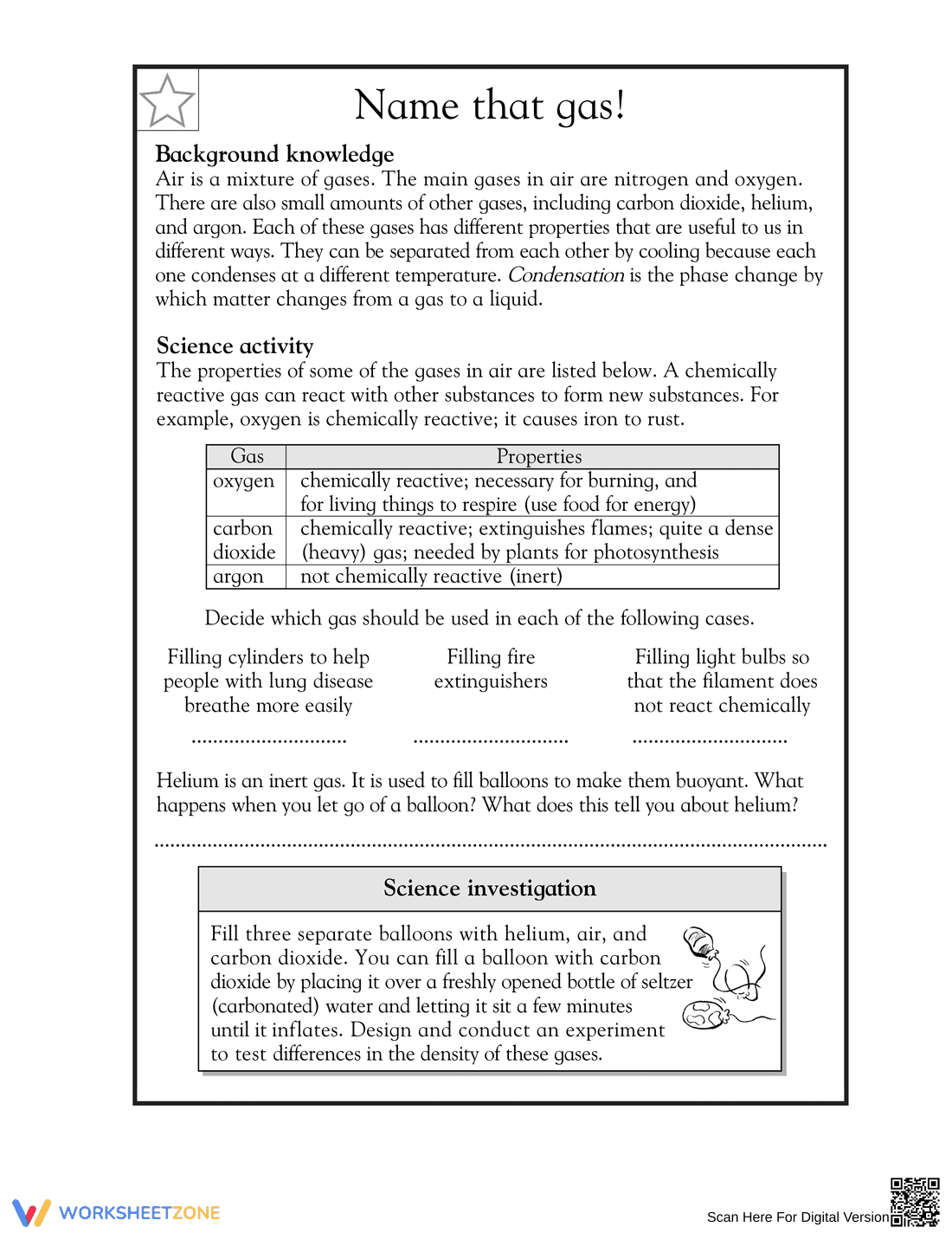
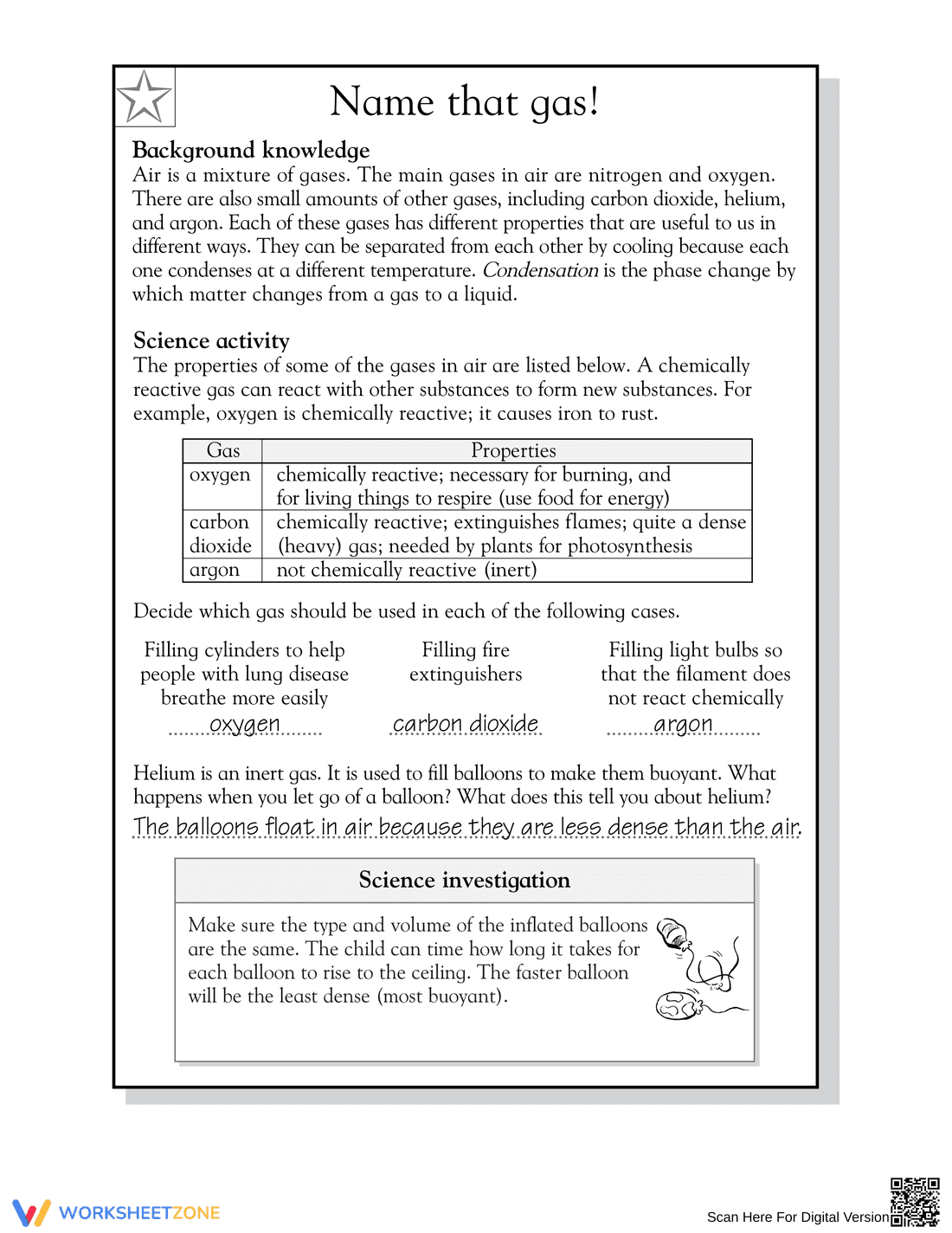
This Grade 5 science worksheet teaches students to identify specific gases based on their unique chemical and physical properties. By connecting background knowledge about air composition to real-world applications like fire extinguishers and respiratory therapy, learners build a concrete understanding of how invisible matter interacts with the world. Students conclude with an inquiry-based investigation design.
At a Glance
- Grade: 5 · Subject: Science / Chemistry
- Standard:
5-PS1-3— Make observations and measurements to identify materials based on their properties- Skill Focus: Chemical reactivity and physical properties of gases
- Format: 1 page · 5 problems · Answer key included · PDF
- Best For: Self-guided chemistry introduction or sub plan
- Time: 25–35 minutes
What's Inside
This single-page resource features a structured layout designed for clarity and student independence. It includes a "Background Knowledge" section defining condensation and gas mixtures, a reference table detailing the properties of oxygen, carbon dioxide, and argon, and three distinct activity blocks. Students match gases to industrial uses, reflect on the buoyancy of helium, and design a density-focused experiment involving balloons and seltzer water.
Zero-Prep Workflow
The zero-prep design makes this worksheet ideal for busy classrooms. Implementation follows a three-step cycle:
- Print and Distribute (1 minute): Self-contained text ensures students begin without a lecture.
- Active Learning (20 minutes): Students use the reference table to solve application scenarios independently.
- Discussion and Review (5 minutes): Use the answer key to verify understanding and discuss the experiment designs.
Total teacher preparation time is under two minutes.
Standards Alignment
Aligned primarily to 5-PS1-3, this activity requires students to "make observations and measurements to identify materials based on their properties." By analyzing reactivity and density data in the table, students practice the scientific process of elimination to categorize substances. This standard code can be copied directly into lesson plans, IEP goals, or district curriculum mapping tools.
How to Use It
Use this worksheet as a "hook" before starting a unit on the states of matter to assess prior knowledge. Alternatively, assign it as a formative assessment after teaching the composition of the atmosphere. To maximize impact, observe students during the "Science Investigation" design phase; look for those who can articulate why carbon dioxide from seltzer would be denser than atmospheric air.
Who It's For
Designed for Grade 5 learners, this resource includes scaffolds like sentence frames and a clear reference table to support English Language Learners and students with IEPs. It pairs naturally with a hands-on demonstration of gas density using vinegar and baking soda or a digital simulation of molecular movement in different atmospheric conditions.
Standardized science education emphasizes integrating Disciplinary Core Ideas with Engineering Practices. According to the RAND AIRS 2024 analysis of instructional materials, scaffolded inquiry tasks—such as the experiment design included here—significantly improve retention of abstract concepts like chemical reactivity. This worksheet addresses 5-PS1-3 by requiring students to distinguish between oxygen, carbon dioxide, and helium through their observable effects on fire, life, and buoyancy. By moving from a text-based reference table to a creative prompt, the resource supports the gradual release of responsibility. This approach ensures that learners understand the functional properties that define gas roles in the atmosphere. Such evidence-based practice aligns with national benchmarks for fifth-grade physical science mastery, preparing students for more complex chemistry concepts in middle school.


