


























Views
Downloads
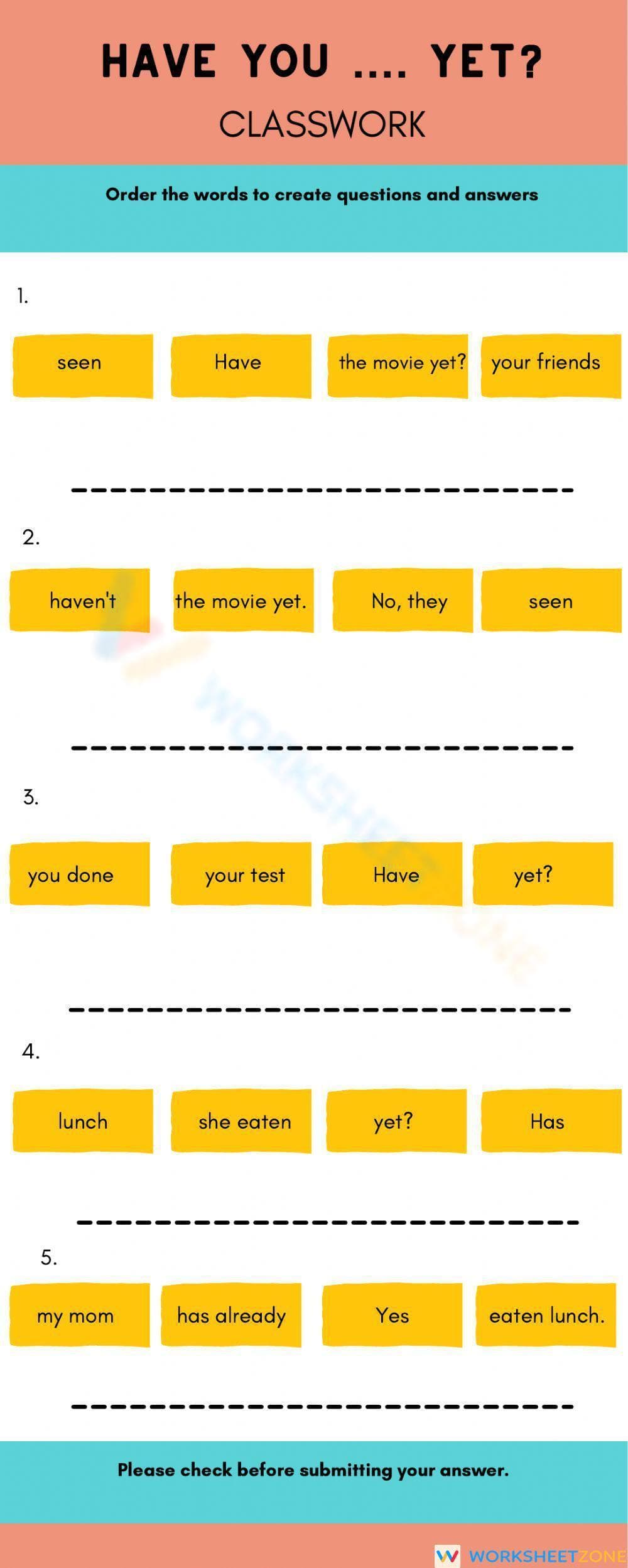

Essential Grade 6 Present Perfect Grammar Worksheet
Paste this activity's link or code into your existing LMS (Google Classroom, Canvas, Teams, Schoology, Moodle, etc.).
Students can open and work on the activity right away, with no student login required.
You'll still be able to track student progress and results from your teacher account.
This focused English Language Arts worksheet strengthens Grade 6 and Grade 7 students' understanding of the present perfect tense. By engaging with scrambled sentences, learners practice correctly positioning "yet" and "already" within questions and answers. This exercise builds essential syntactic awareness, ensuring students can construct complex grammatical structures accurately in their writing and speech.
At a Glance
- Grade: 6 · Subject: English Language Arts
- Standard:
CCSS.ELA-LITERACY.L.6.1— Demonstrate command of the conventions of standard English grammar and usage when writing- Skill Focus: Present Perfect Tense Syntax
- Format: 1 page · 5 problems · Answer key included · PDF
- Best For: Quick grammar check or bell ringer
- Time: 10–15 minutes
The worksheet features a clean, student-friendly layout titled "Have You .... Yet?" designed for immediate classroom application. It contains five targeted sentence-scramble tasks that require students to reorder word blocks into logical, grammatically correct present perfect sentences. The tasks include both interrogative and declarative forms, providing a balanced look at how time markers like "yet" and "already" function in different sentence types.
Implementing this resource is efficient. First, print the single-page PDF (30 seconds). Second, distribute copies for an independent warm-up or guided practice session (1 minute). Third, review using the included answer key for immediate feedback (2 minutes). This process requires under two minutes of teacher preparation, making it an ideal choice for emergency sub plans or busy Monday mornings.
This resource is meticulously aligned to CCSS.ELA-LITERACY.L.6.1, which requires students to demonstrate command of the conventions of standard English grammar and usage. Specifically, it targets the correct formation and use of complex verb tenses, such as the present perfect. This standard code can be copied directly into lesson plans, IEP goals, or district curriculum mapping tools to ensure instructional consistency across the grade level.
Use this worksheet as a formative assessment during the guided practice phase of a lesson on verb tenses to check for student understanding before moving to independent writing. Alternatively, assign it as a quick exit ticket after a direct instruction session to identify students who may need additional scaffolding with adverb placement. While students work, observe their ability to identify subject-verb agreement in present perfect forms.
This activity is designed for middle school students in Grade 6 and Grade 7, including English Language Learners who benefit from the visual support of word blocks. It serves as an excellent companion to a larger unit on verbal phrases or as a remediation tool for students struggling with auxiliary verbs. Pair this worksheet with a short reading passage to have students identify present perfect instances in context.
The 'Have You ... Yet?' worksheet provides a highly structured approach to mastering the present perfect tense, which is a core component of the CCSS.ELA-LITERACY.L.6.1 standard for middle school. Research conducted by Fisher & Frey (2014) highlights the pedagogical importance of scaffolds like sentence reordering to help students internalize complex grammatical rules through the active manipulation of language components. By focusing on the specific syntax of time markers like 'yet' and 'already,' this resource directly addresses common errors in adverb placement that often persist into higher grade levels. This Grade 6 grammar tool enables students to visualize sentence architecture, moving them from rote memorization toward a functional command of English conventions. Educational data from NAEP indicates that targeted, skill-based practice significantly improves student performance in standard English usage. This standalone summary confirms the worksheet's utility as an evidence-based instructional aid for developing syntactic fluency.


