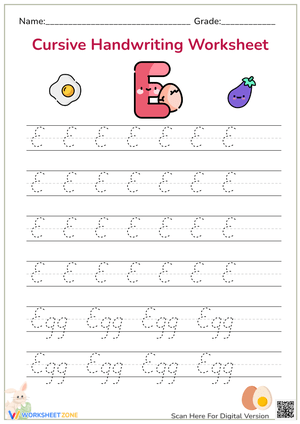
What Cursive E Worksheets Actually Teach
The lowercase cursive e is one of the first letters students master, and for good reason. It's a single, continuous loop that shows up in nearly every word your class will write, from the and where to September. Good cursive e worksheets don't just ask kids to trace a shape. They isolate the entry stroke, the loop, and the exit stroke so students build a repeatable motor pattern instead of copying a picture. That distinction matters most for the grades 2-5 teachers who are introducing joined writing for the first time or rebuilding it during intervention.
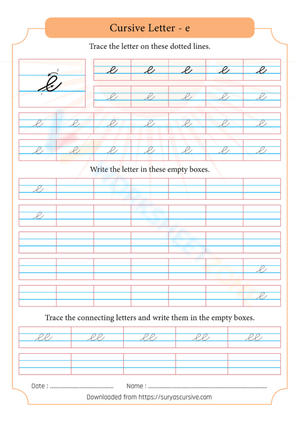
Because the letter e connects to almost everything, it becomes the backbone of letter-joining practice. A worksheet that drills e in isolation and then in short connectors—ee, ed, en—gives students the fine-motor reps they need before they attempt full words. That progression is what separates a printable that builds fluency from one that just fills ten minutes.
The Correct Stroke Sequence for Cursive E
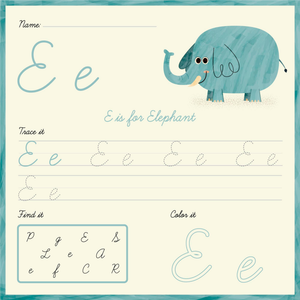
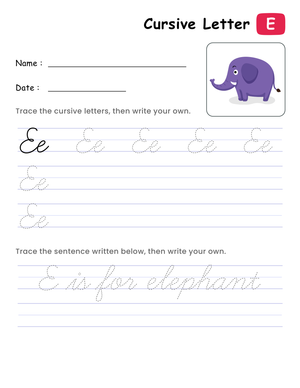
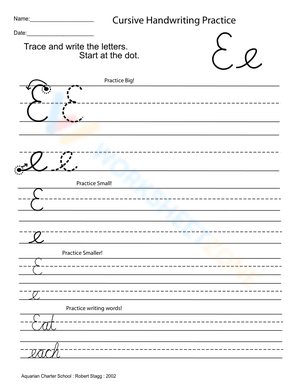
For the lowercase e, students start on the baseline, push up and to the right at a slight slant, curve over the top, and bring the stroke back down through the middle to close a small loop before exiting on the baseline. The key coaching point is that the loop stays open enough to read but small enough not to collide with neighboring letters. Uppercase cursive E is taller and rounder: it uses a double curve, almost like a backward 3 with two stacked bumps, beginning near the top line and finishing with a small tuck toward the middle.
When you model this, narrate the motion out loud—"up, over, around, and out." Worksheets that include directional arrows and a numbered starting dot let students self-check without waiting for you to circle the room. That's especially useful in a class of 25 where you can't watch every hand at once.
Why Cursive E Shows Up on More State Requirements
Cursive isn't the optional relic it was a decade ago. After years of decline, handwriting instruction is being written back into state law, and lowercase letters like e sit right at the center of the proficiency benchmarks teachers are now accountable for.
According to Zaner-Bloser, 25 US states now require cursive instruction in public schools as of 2025—a sharp reversal after cursive faded from many classrooms. For teachers, that shift means lowercase cursive e practice is no longer optional enrichment but a documented grade 3-5 proficiency expectation in half the country.
Education Week has reported that this comeback brings real classroom challenges, including teachers who were never trained to teach cursive themselves. Structured worksheets help close that gap by carrying the correct model for you, so you can lead a lesson confidently even if cursive wasn't part of your own preparation.
Common Cursive E Errors and How to Fix Them
Three mistakes show up again and again. The first is a backward loop, where students close the e in the wrong direction and it reads like a lowercase l. The second is a disconnected entry stroke, where the letter floats instead of joining the previous one. The third is an oversized loop that swallows the following letter.
Here's the pattern most teachers miss: nearly every backward-e error traces back to where the pencil starts, not how the loop is drawn. When a student begins the stroke at the top instead of climbing up from the baseline, the loop almost has to close backward. Fixing the starting point—not endless re-tracing of the finished shape—corrects the majority of malformed e's in a single small-group session, which is why the best worksheets mark the entry dot in a contrasting color.
For students who still struggle, slow the pace and shrink the target. Larger practice boxes reduce the fine-motor load, and repeated e-loop tracing supports the motor planning that many students today find harder than earlier cohorts did.
Classroom Implementation
Treat cursive e worksheets as a short, daily warm-up rather than a once-a-week event. Five focused minutes at the start of writing block builds more fluency than a single long session, because handwriting is a motor skill that rewards frequent, spaced practice.
- Open with a 60-second air-writing drill so students rehearse the motion before pencil hits paper.
- Move from isolated e to connectors—ee, en, ed—within the same sheet so joining feels natural.
- Use a highlighter model: you write the e in yellow, students trace over it, then copy independently beside it.
- Pair the letter with real words from your current unit so handwriting practice doubles as vocabulary review.
For small groups, print a version with larger guidelines for students who need more space and a tighter version for those ready to write at grade-level size. Same letter, different scaffold.
Using Cursive E for Intervention and IEP Goals
Cursive e worksheets work well as intervention tools because the letter is high-frequency and the stroke is measurable. You can set a concrete target—"forms lowercase cursive e with correct starting point in 8 of 10 attempts"—and track it week to week, which makes the data clean enough to support an IEP goal or a progress-monitoring note.
For remediation, don't restart from scratch. Diagnose the specific breakdown—entry stroke, loop direction, or connection—and assign a sheet that isolates only that piece. Targeted practice on one error beats re-teaching the whole letter, and it keeps struggling writers from feeling like they're starting over.
How Cursive E Supports Spelling and Reading
Handwriting and literacy aren't separate lanes. Research summarized by the University of Iowa College of Education points to handwriting as beneficial to reading and often misunderstood, and the Iowa Reading Research Center has revisited cursive specifically as a support for developing readers and spellers. When students form a letter by hand, they encode it more deeply than when they select it on a keyboard.
That's the practical payoff of cursive e drills. As students write the letter inside connected words, they rehearse spelling patterns and letter order at the same time. A handwriting warm-up quietly reinforces the phonics and word-study work you're already doing, which is a strong argument for keeping cursive e practice in the daily routine rather than treating it as an extra.
Frequently Asked Questions
1. What grade do students typically learn to write cursive e?
Most students meet lowercase cursive e in grades 2-3 and are expected to write it fluently by grades 3-5, which lines up with the proficiency windows in states that now require cursive.
2. How many times should students practice a cursive letter before it's fluent?
There's no magic number, but short daily reps beat cramming. Aim for a few minutes each day across two to three weeks rather than one long sheet, since motor skills strengthen with spaced practice.
3. How is cursive e different from print e in stroke formation?
Print e uses a horizontal bar and a separate curve, often started in the middle. Cursive e is a single continuous loop that climbs from the baseline, which is what lets it connect smoothly to the letters around it.
4. Can cursive e worksheets be used for handwriting intervention or IEP goals?
Yes. Because the letter is high-frequency and easy to score, you can write a measurable goal around correct formation and track progress with the same worksheet week to week.
5. How do cursive e worksheets support spelling and reading?
Forming letters by hand helps students encode letter shapes and spelling patterns, so practicing e inside connected words reinforces word study alongside handwriting.