




























Views
Downloads

Halloween Shape Outlines — Printable Kindergarten Math

Paste this activity's link or code into your existing LMS (Google Classroom, Canvas, Teams, Schoology, Moodle, etc.).
Students can open and work on the activity right away, with no student login required.
You'll still be able to track student progress and results from your teacher account.
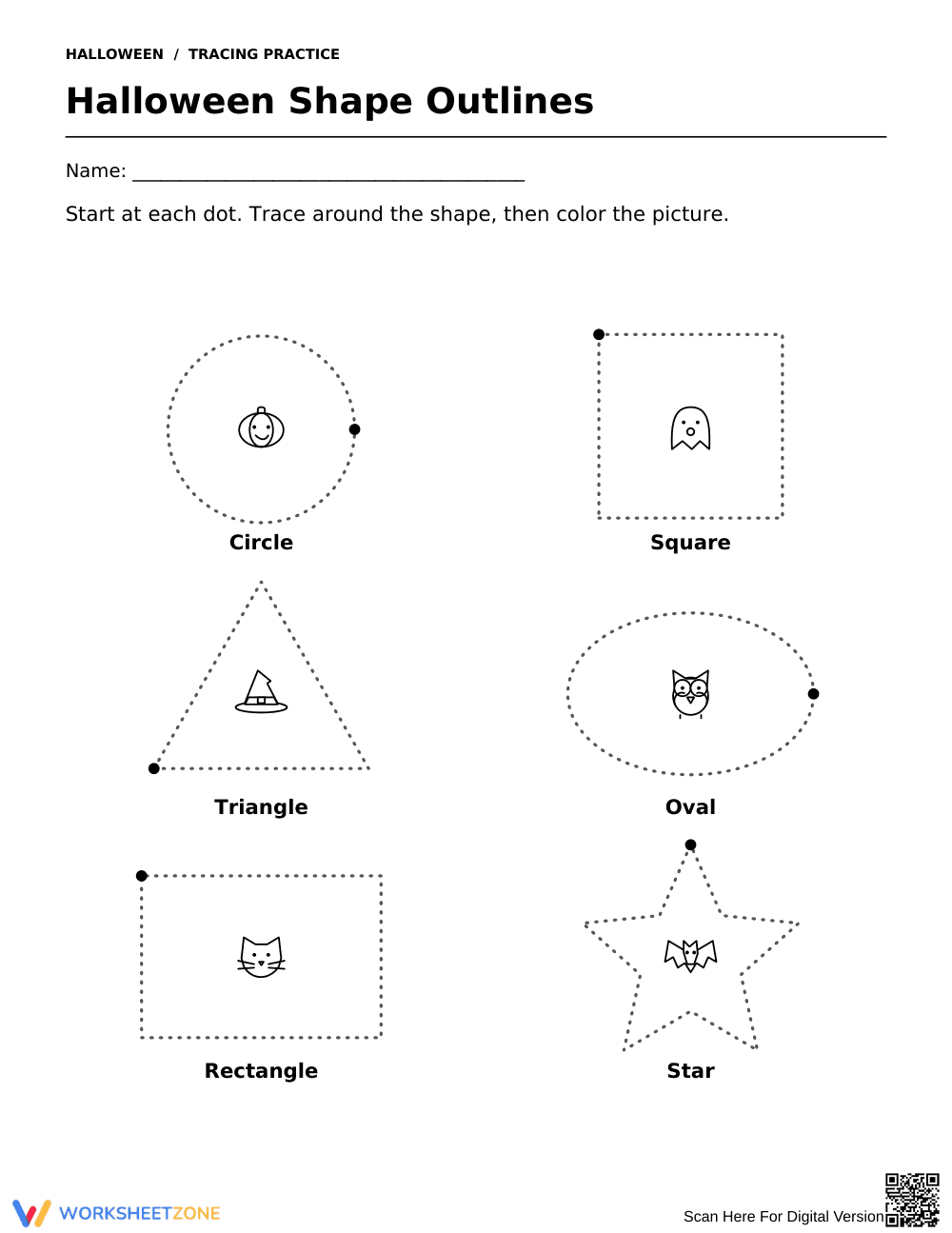
This printable Halloween geometry activity builds early fine motor control and geometric awareness as young learners trace and identify six fundamental two-dimensional shapes. Students follow starting dots to trace around seasonal Halloween icons, reinforcing shape boundaries, spatial orientation, and line control before coloring each picture.
At a Glance
- Grade: Kindergarten · Subject: Math
- Standard:
CCSS.MATH.CONTENT.K.G.B.5— Model shapes in the world by drawing and tracing outlines- Skill Focus: Tracing 2D geometric shapes
- Format: 1 page · 6 problems · Open response · PDF
- Best For: October math centers or morning work
- Time: 10–15 minutes
What's Inside: A single-page practice sheet featuring 6 distinct dashed-line shapes: circle, square, triangle, oval, rectangle, and star. Each figure displays an explicit starting guide dot and a centered Halloween illustration—including a pumpkin, ghost, witch hat, owl, cat, and bat—for engaging tracing and coloring practice.
Zero-Prep Workflow
- Print (30 seconds): Send this clean, black-and-white single sheet directly to your classroom copier or home printer with no trimming required.
- Distribute (30 seconds): Hand out one sheet per student alongside standard crayons, colored pencils, or fine-tip markers.
- Review (1 minute): Model the starting dot on a projector, instruct students to complete the boundary line, and review correct shape names chorally.
Total preparation time is under 2 minutes, making this page an effortless resource for substitute folders, emergency October lesson packets, and transitional arrival activities.
Standards Alignment
Primary Standard: `CCSS.MATH.CONTENT.K.G.B.5` — Model shapes in the world by building shapes from components and drawing shapes. Students connect foundational geometry concepts to physical hand movements by delineating straight edges, vertices, and continuous curved paths. Both standard codes can be copied directly into lesson plans, IEP goals, or district curriculum mapping tools.
How to Use It
Integrate this worksheet during guided math centers after introducing basic geometric figures, or utilize it as a calm morning bell-ringer throughout October. While students trace, observe their pencil grip and stroke progression from the starting dot to assess emerging fine motor readiness and shape recognition in real time. Expected completion time is 10 to 15 minutes.
Who It's For
Designed for preschool, pre-K, and kindergarten students developing pencil grip, bilateral coordination, and visual-motor integration. Pair this practice sheet with wooden pattern blocks, flat shape manipulatives, or a seasonal read-aloud to reinforce tactile geometric exploration.
According to research from Fisher & Frey (2014) on effective guided instruction, structured motor modeling with visual prompts helps early learners bridge the gap between perceptual recognition and graphic reproduction. CCSS.MATH.CONTENT.K.G.B.5 emphasizes drawing and modeling two-dimensional geometric figures to cement foundational spatial awareness. Tracing structured outlines gives emerging writers the tactile feedback needed to master precise pencil control, shape perimeter concepts, and corner transitions. The inclusion of starting guidance dots reduces cognitive hesitation, allowing preschool and kindergarten learners to focus directly on pencil pressure, directional consistency, and visual discrimination. These foundational tracing exercises directly accelerate letter formation fluency and mathematical representation skills.


