


























Views
Downloads

Printable Gymnastics Coloring Page | Grade 3-12 Ready
Paste this activity's link or code into your existing LMS (Google Classroom, Canvas, Teams, Schoology, Moodle, etc.).
Students can open and work on the activity right away, with no student login required.
You'll still be able to track student progress and results from your teacher account.
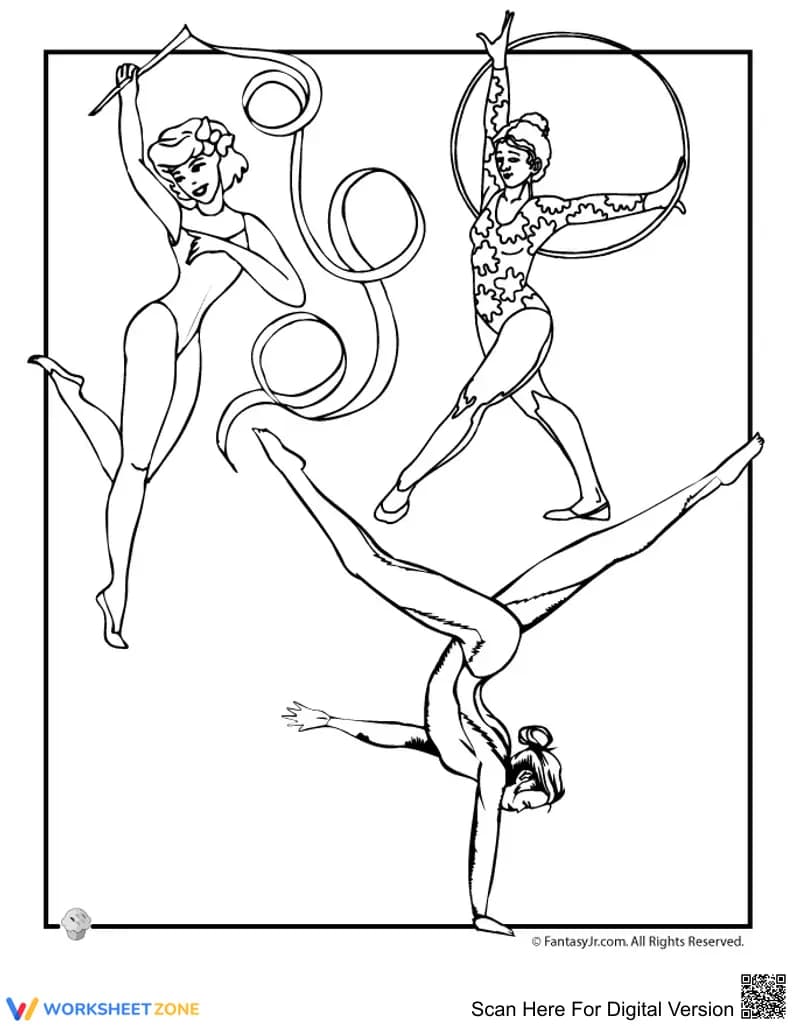
This gymnastics coloring worksheet provides students with a creative outlet to explore the world of competitive sports while developing fine motor control. By engaging with detailed illustrations of rhythmic and artistic gymnastics, learners can connect visual art with domain-specific vocabulary. It is an ideal resource for physical education tie-ins or classroom brain breaks.
At a Glance
- Grade: 3-12 · Subject: Arts & English
- Standard:
CCSS.ELA-LITERACY.L.3.6— Acquire and use domain-specific words and phrases related to sports- Skill Focus: Fine motor skills & artistic expression
- Format: 1 page · 1 task · No answer key · PDF
- Best For: Early finishers and sports-themed units
- Time: 15–20 minutes
Inside this single-page PDF, you will find a high-quality illustration featuring three distinct gymnastic poses: a ribbon routine, a hoop performance, and a floor handstand. The clean line art is designed to accommodate various coloring mediums, from colored pencils to markers. There are no complex instructions, making it accessible for students across a wide age range from elementary to high school.
The zero-prep workflow for this resource is designed for maximum efficiency in busy classrooms. First, print the single-page PDF in about 30 seconds. Second, distribute the sheets to students during transition periods or as a reward. Third, allow students to work independently while you facilitate small group instruction or manage administrative tasks. Total teacher preparation time is under two minutes, making it an excellent sub-plan addition.
This resource aligns with `CCSS.ELA-LITERACY.L.3.6`, focusing on the acquisition of domain-specific vocabulary such as "rhythmic gymnastics," "apparatus," and "form." While primarily an artistic activity, it supports the language strand by providing a visual context for sports-related terminology. Both standard codes can be copied directly into lesson plans, IEP goals, or district curriculum mapping tools to justify the inclusion of creative arts in the literacy block.
Use this worksheet as a formative assessment tool for fine motor development or as a calming activity following high-energy physical education lessons. Teachers can observe student focus and attention to detail during the coloring process. It also serves as an excellent hook for a writing prompt where students describe the movements shown using active verbs and adverbs. Completion typically takes 15 to 20 minutes depending on the medium used.
This worksheet is for students in grades 3 through 12 who have an interest in sports or require a low-stakes creative outlet. It is particularly effective for English Language Learners (ELLs) to build vocabulary through visual association. Pair this resource with a short informational text about Olympic history or a gymnastics-themed anchor chart to deepen the educational impact and provide a natural pairing for direct instruction.
According to the RAND AIRS 2024 report, integrating creative arts into the general curriculum supports cognitive flexibility and student engagement across diverse age groups. This gymnastics coloring page addresses CCSS.ELA-LITERACY.L.3.6 by encouraging students to engage with domain-specific sports vocabulary in a non-threatening, visual format. Research by Fisher & Frey (2014) emphasizes that visual representations are crucial for scaffolding complex vocabulary for both primary learners and older students who may be struggling with academic language. By providing a clear, printable medium for artistic expression, educators can bridge the gap between physical activity and linguistic development. This resource serves as a versatile tool for classroom management, offering a high-interest task that requires minimal teacher intervention while maintaining a connection to standard-aligned learning objectives in the English Language Arts and Physical Education domains.


