


























Views
Downloads


Guide Compare Linear Functions Worksheet | Grade 9 Algebra I
Paste this activity's link or code into your existing LMS (Google Classroom, Canvas, Teams, Schoology, Moodle, etc.).
Students can open and work on the activity right away, with no student login required.
You'll still be able to track student progress and results from your teacher account.
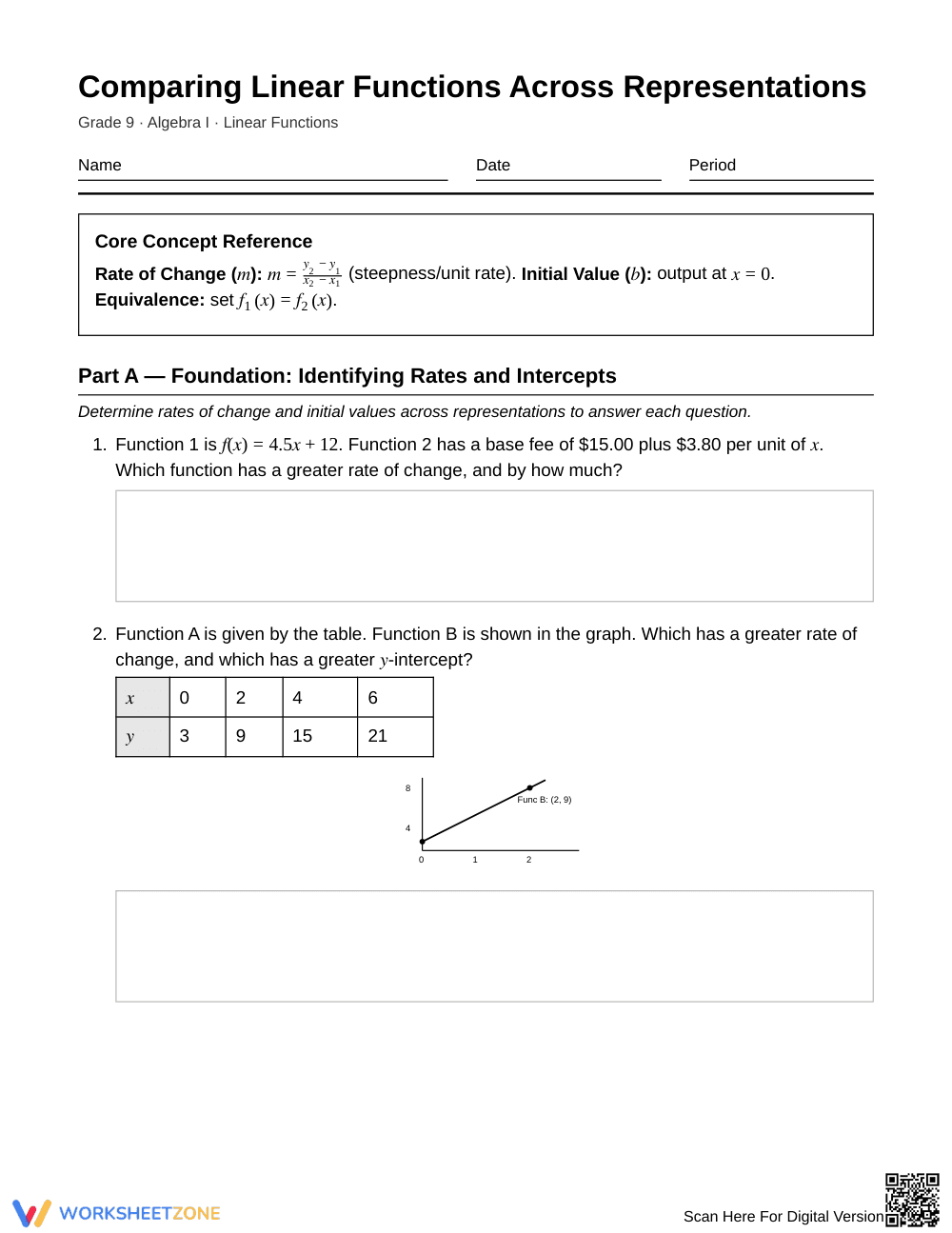
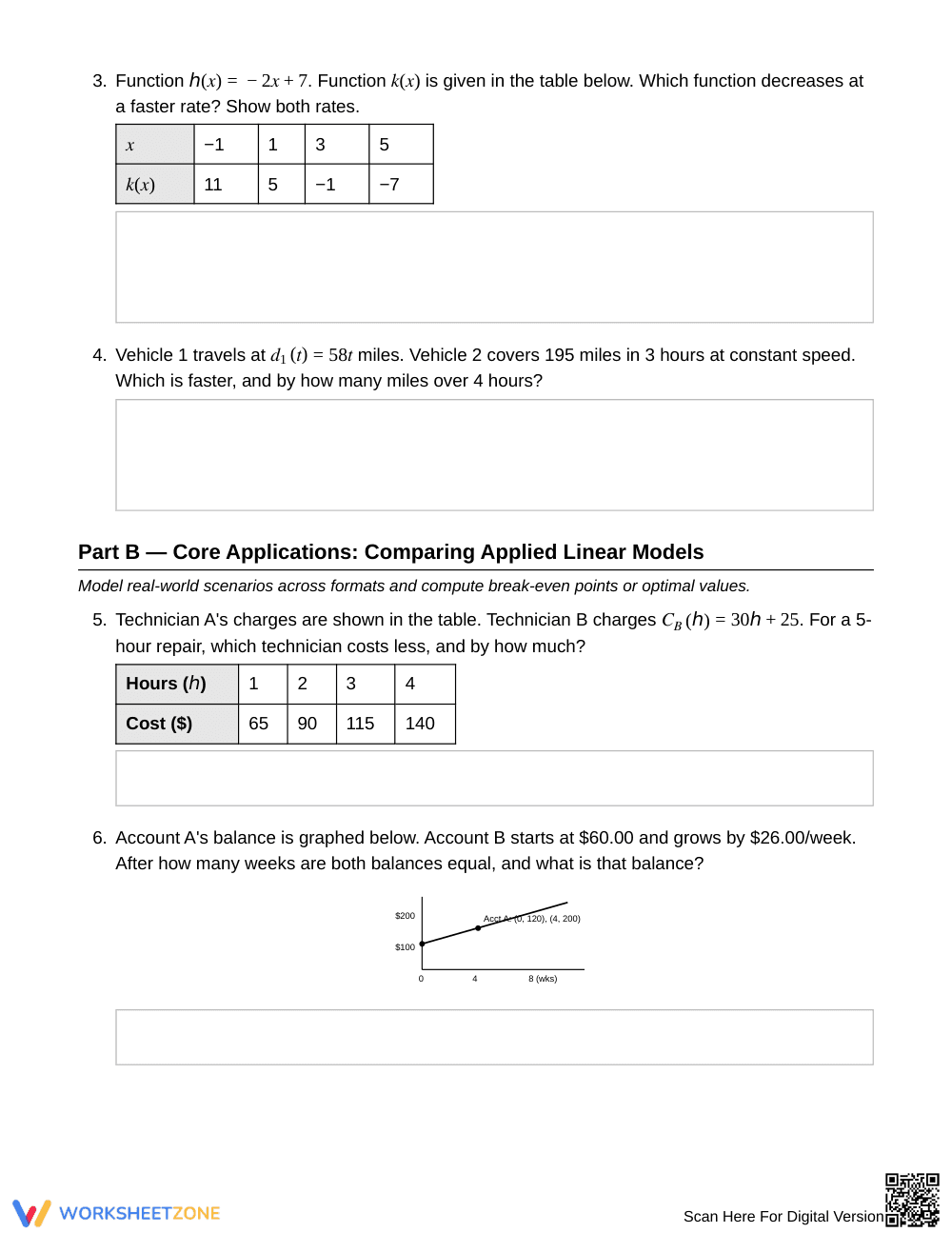
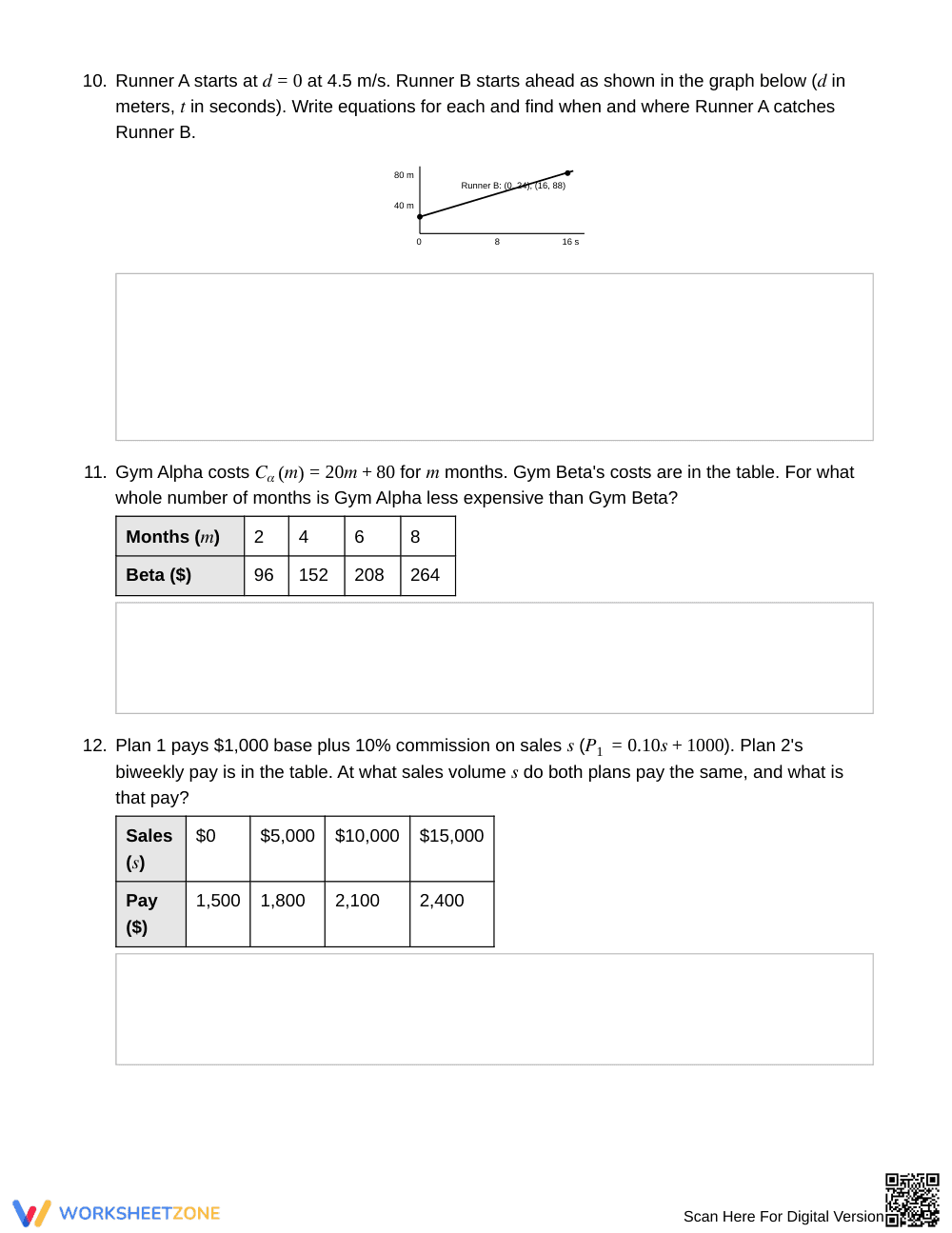
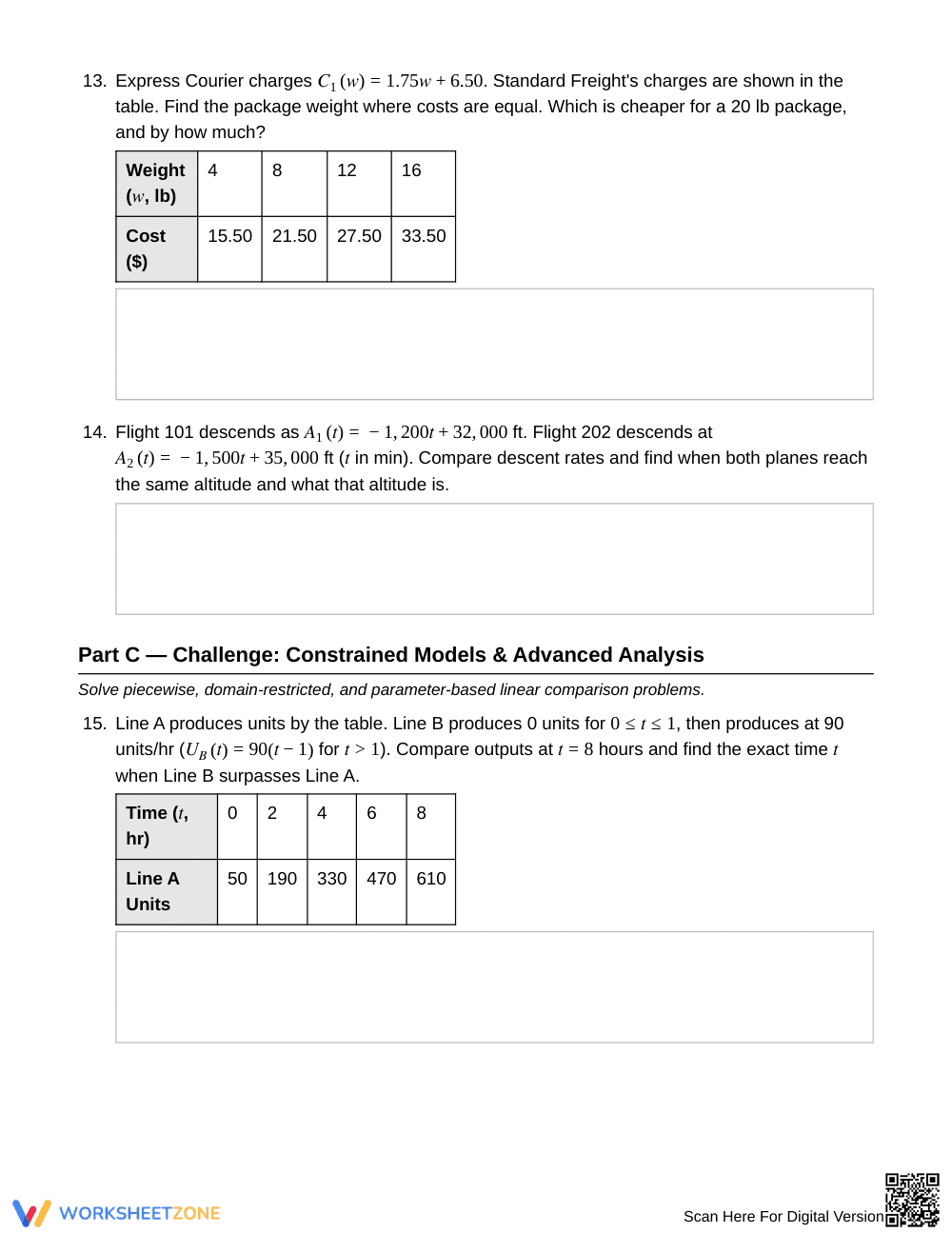
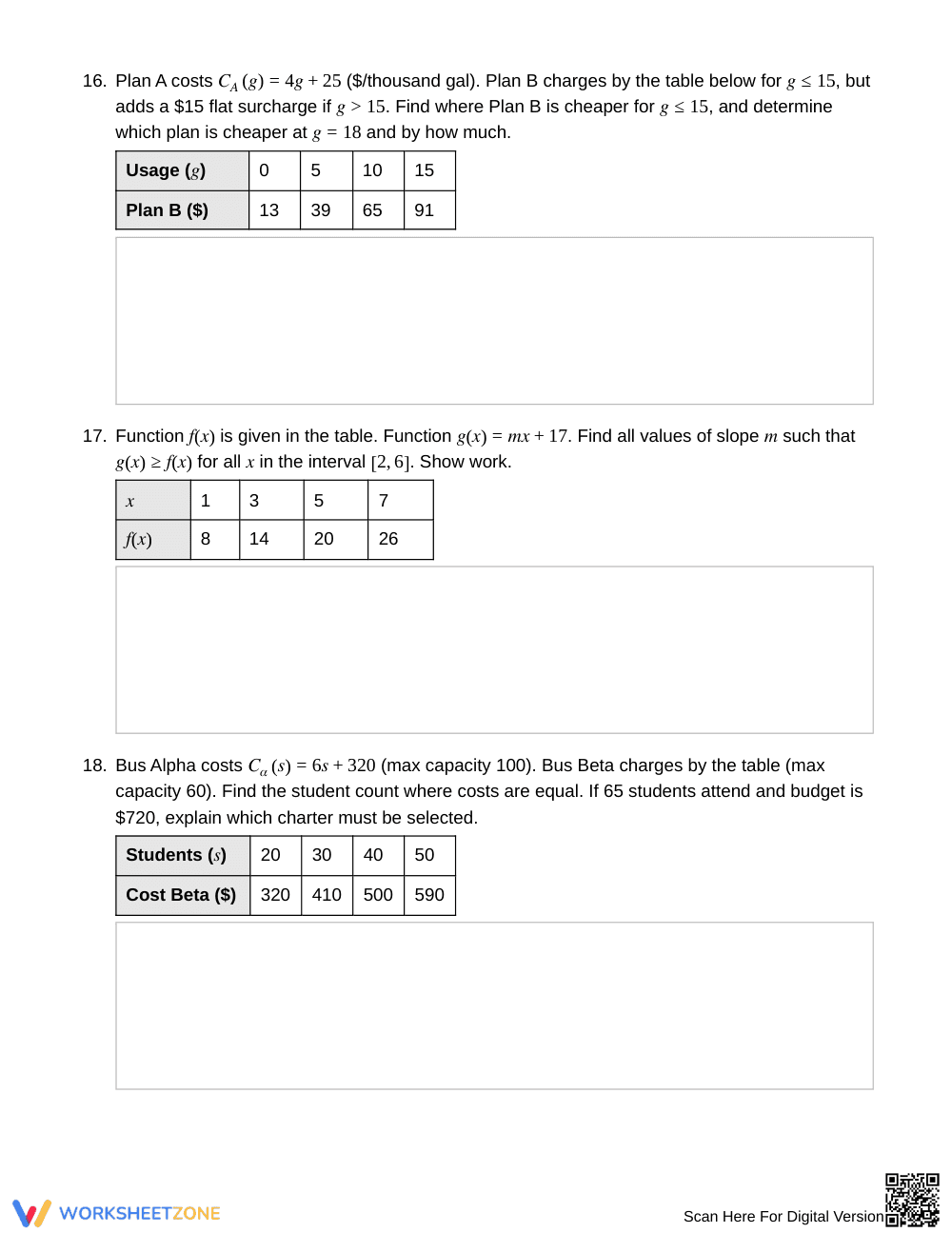
Students use this Grade 9 Algebra I worksheet to compare linear functions presented as equations, tables, and graphs. By working through 18 structured problems, they sharpen their ability to translate between forms, calculate slopes and intercepts, and determine which model best fits a real‑world scenario.
At a Glance
- Grade: 9 · Subject: Algebra I
- Standard:
HSF-IF.C.9— compare linear functions across equations, tables, and graphs- Skill Focus: Compare Linear Functions in Different Forms
- Format: 6 pages · 18 problems · Full answer key included · Comprehensive PDF
- Best For: Guided practice, mastery assessment, and test‑prep review
- Time: 45–60 minutes (approx.)
What's Inside
The packet spans six double‑sided pages and presents 18 problems grouped into three parts—Foundation, Core Applications, and Challenge. Students encounter rate‑of‑change calculations, slope‑intercept translation, table‑to‑graph comparisons, and multi‑step word problems. Each problem is followed by space for work, and the back of the booklet holds a concise answer key.
Mastery Evidence
Teachers can apply a three‑tier rubric that aligns each task with a mastery level.
- Approaching: Students correctly identify slopes or intercepts in 6 of the 18 tasks, using the provided formulas.
- Meeting: Students solve 12 tasks with accurate conversions between equations, tables, and graphs, demonstrating clear reasoning.
- Exceeding: Students complete all 18 problems, including the Challenge set, and justify their comparisons with written explanations that extend beyond the given data.
Standards Alignment
Standards Alignment: HSF-IF.C.9 – Compare linear functions in multiple representations, interpreting slope and intercept to determine equivalence or superiority. This worksheet directly addresses that expectation by requiring students to move between equations, tables, and graphs while justifying their choices. Both standard codes can be copied directly into lesson plans, IEP goals, or district curriculum mapping tools.
How to Use It
How to Use It: • Before a unit on slope‑intercept form, assign the Foundation section as a quick diagnostic; observe how many students correctly compute rates of change to gauge prior knowledge. • During the Core Applications, have students work in pairs on the real‑world scenarios, then use the Challenge set as a culminating exit ticket to assess independent mastery. Each activity typically requires 45–60 minutes.
Who It's For
Who It's For: This worksheet is designed for Grade 9 Algebra I students who have completed introductory slope‑intercept lessons. The varied problem contexts provide natural differentiation—students who need extra support can focus on the Foundation tasks, while advanced learners can extend their reasoning with the Challenge problems. Pair it with a slope‑intercept anchor chart or a short video on converting tables to equations for seamless integration.
Fisher & Frey (2014) emphasize that explicit instruction in comparing mathematical representations builds deep conceptual understanding. This Grade 9 Algebra I worksheet operationalizes that recommendation by giving students eighteen tasks that require them to identify slopes, intercepts, and equivalence across equations, tables, and graphs—directly addressing standard HSF-IF.C.9, which calls for comparing linear functions in multiple forms. The progressive structure moves from guided rate‑of‑change calculations to independent real‑world comparisons, mirroring the gradual‑release model shown to improve transfer of skills. Teachers can document mastery by noting how many of the 18 items each student completes accurately, providing clear evidence for formative assessment and IEP progress monitoring. Downloading and assigning this resource supports research‑based practice while meeting state standards.


