


























Views
Downloads
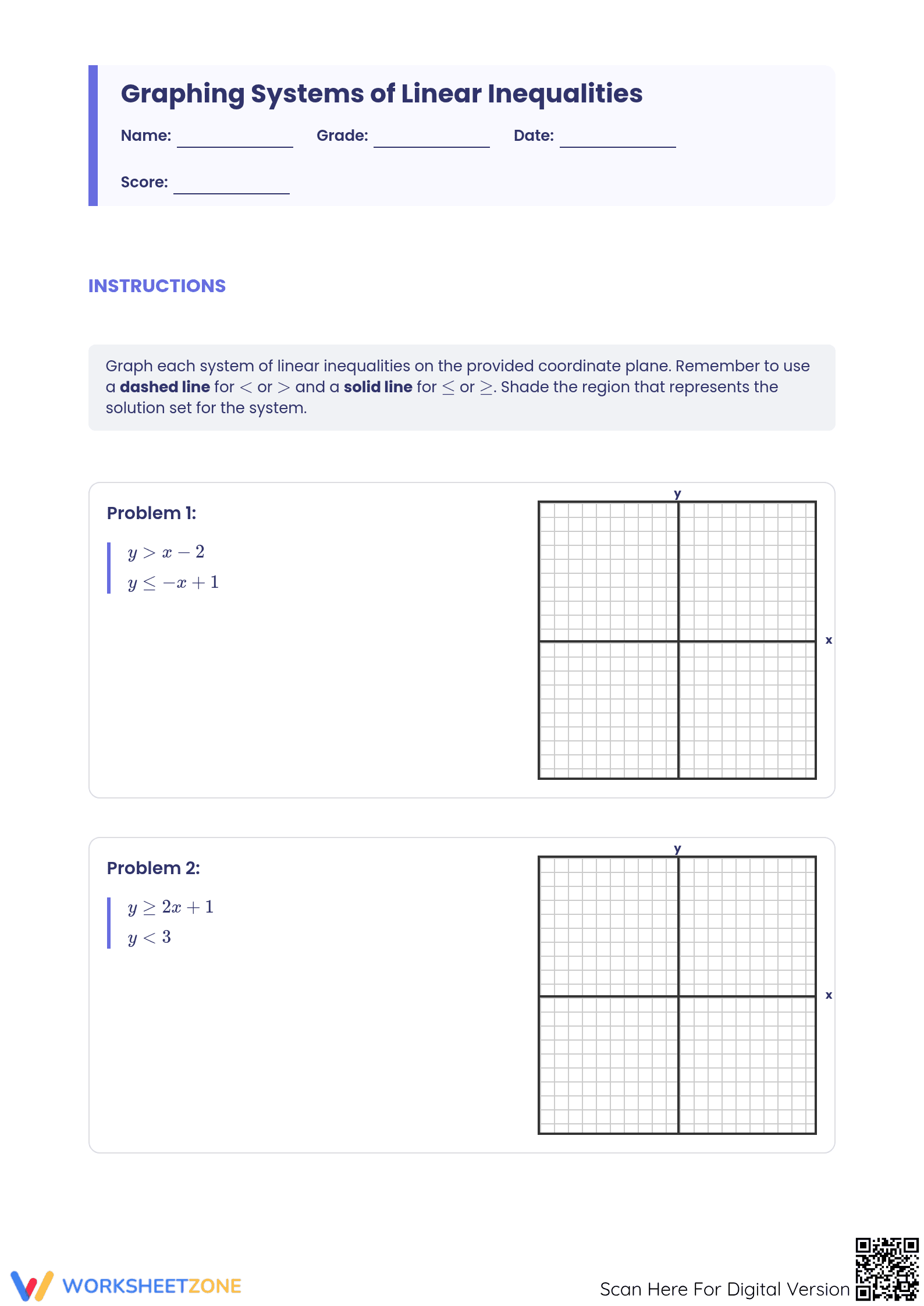
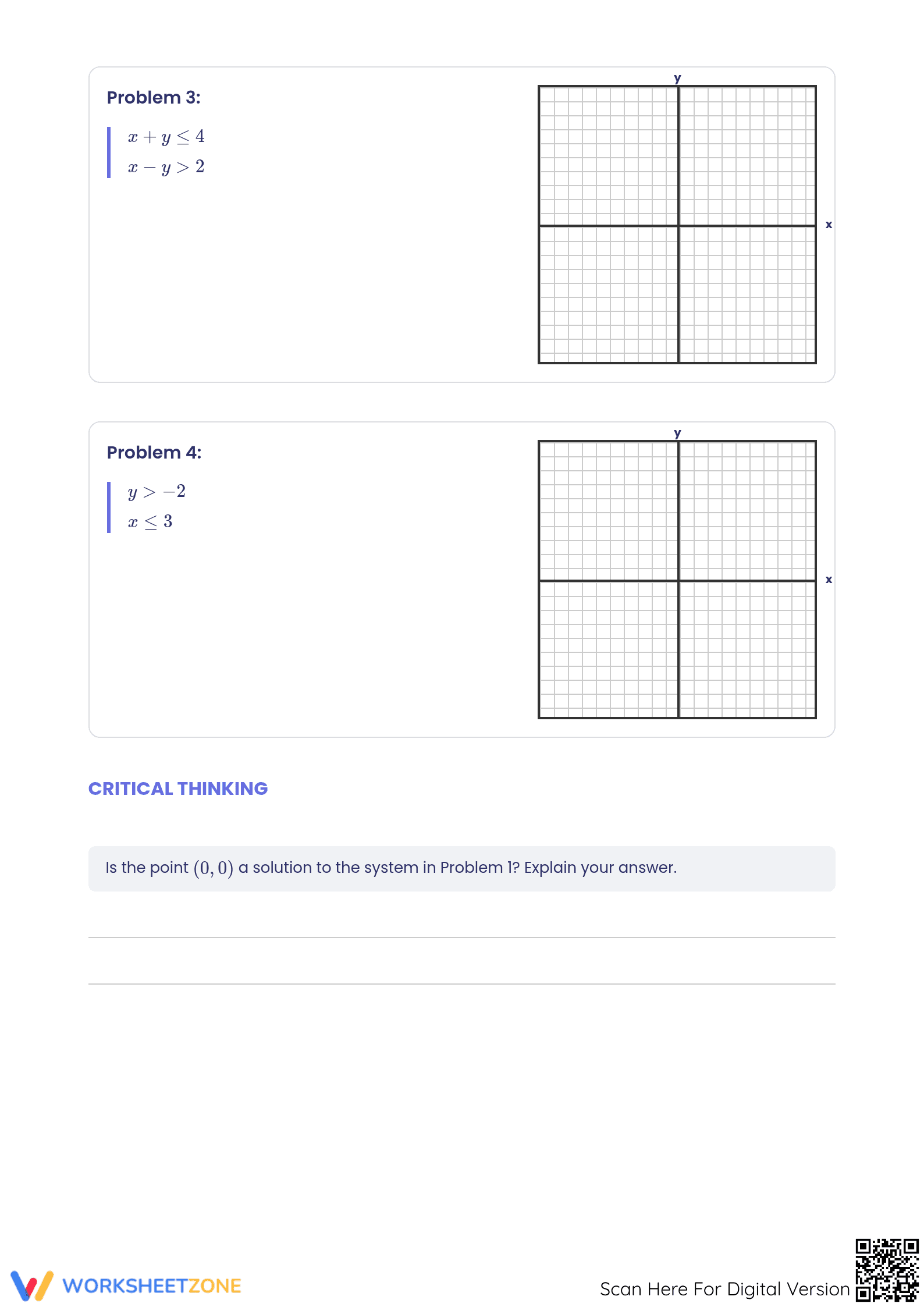

Printable Systems of Linear Inequalities Graphing Worksheet
Paste this activity's link or code into your existing LMS (Google Classroom, Canvas, Teams, Schoology, Moodle, etc.).
Students can open and work on the activity right away, with no student login required.
You'll still be able to track student progress and results from your teacher account.
Graphing systems of linear inequalities is a foundational algebraic skill that requires precision in both boundary line selection and shading regions. This worksheet provides students with a structured environment to practice identifying solution sets as the intersection of two half-planes. By the end of these exercises, learners will confidently demonstrate their mastery of coordinate geometry and inequality constraints.
At a Glance
- Grade: 8 · Subject: Math
- Standard:
HSA-REI.D.12— Graph the solution set to a system of linear inequalities- Skill Focus: Graphing systems of linear inequalities
- Format: 2 pages · 5 problems · Answer key included · PDF
- Best For: Algebra 1 independent practice and assessment
- Time: 20–30 minutes
What's Inside
This two-page PDF resource contains four dedicated graphing problems, each featuring a pair of linear inequalities and a high-resolution coordinate grid. The layout provides ample space for students to plot boundary lines and shade relevant regions. Additionally, a critical thinking section on the second page challenges students to verify specific coordinate solutions algebraically, ensuring they understand the conceptual why behind the visual intersection.
Zero-Prep Workflow
The classroom-ready design of this resource minimizes teacher workload through a streamlined three-step workflow. First, print the two-page document (30 seconds) and distribute it directly to your students. Second, allow learners to work through the problems using the provided instructions on solid vs. dashed lines (20 minutes). Finally, use the included answer key for rapid grading or self-assessment (2 minutes). Total teacher preparation time is strictly under two minutes.
Standards Alignment
This worksheet is rigorously aligned with HSA-REI.D.12, which requires students to graph the solution set to a system of linear inequalities as the intersection of the corresponding half-planes. It also touches upon 8.EE.C.8 by applying systems of equations concepts to inequality contexts. Both standard codes can be copied directly into lesson plans, IEP goals, or district curriculum mapping tools.
How to Use It
Use this worksheet as a mid-lesson check for understanding during your unit on systems of inequalities. It is ideal for independent practice immediately following a direct instruction session on boundary line types. During the activity, observe students as they determine which side of the line to shade; this serves as an excellent formative assessment indicator of their comprehension of inequality symbols.
Who It's For
This resource is designed for Grade 8 and Algebra 1 students who have mastered graphing individual linear equations and are ready to combine multiple constraints. It is particularly effective for visual learners who benefit from clear coordinate planes. Pair this worksheet with a coordinate plane anchor chart or a systems of equations introductory passage for a comprehensive instructional package.
The instructional design of this graphing systems of linear inequalities resource adheres to the pedagogical frameworks outlined by Fisher & Frey (2014) regarding the gradual release of responsibility. By providing structured grids and explicit instructions on dashed versus solid lines, the worksheet scaffolds the complex cognitive task of managing multiple mathematical constraints. Research from EdReports (2024) emphasizes the importance of high-quality, standards-aligned practice materials in fostering procedural fluency and conceptual depth in secondary mathematics. This worksheet specifically targets the intersection of visual representation and algebraic logic required by the HSA-REI.D.12 standard. Providing students with targeted opportunities to shade overlapping regions helps solidify their understanding of solution sets as common points between two or more mathematical conditions. Such focused practice is essential for mastery in coordinate geometry and prepares students for more advanced modeling in higher-level mathematics courses.


