


























Views
Downloads

Adjectives vs. Adverbs Printable Worksheet | Grade 2 ELA
Paste this activity's link or code into your existing LMS (Google Classroom, Canvas, Teams, Schoology, Moodle, etc.).
Students can open and work on the activity right away, with no student login required.
You'll still be able to track student progress and results from your teacher account.
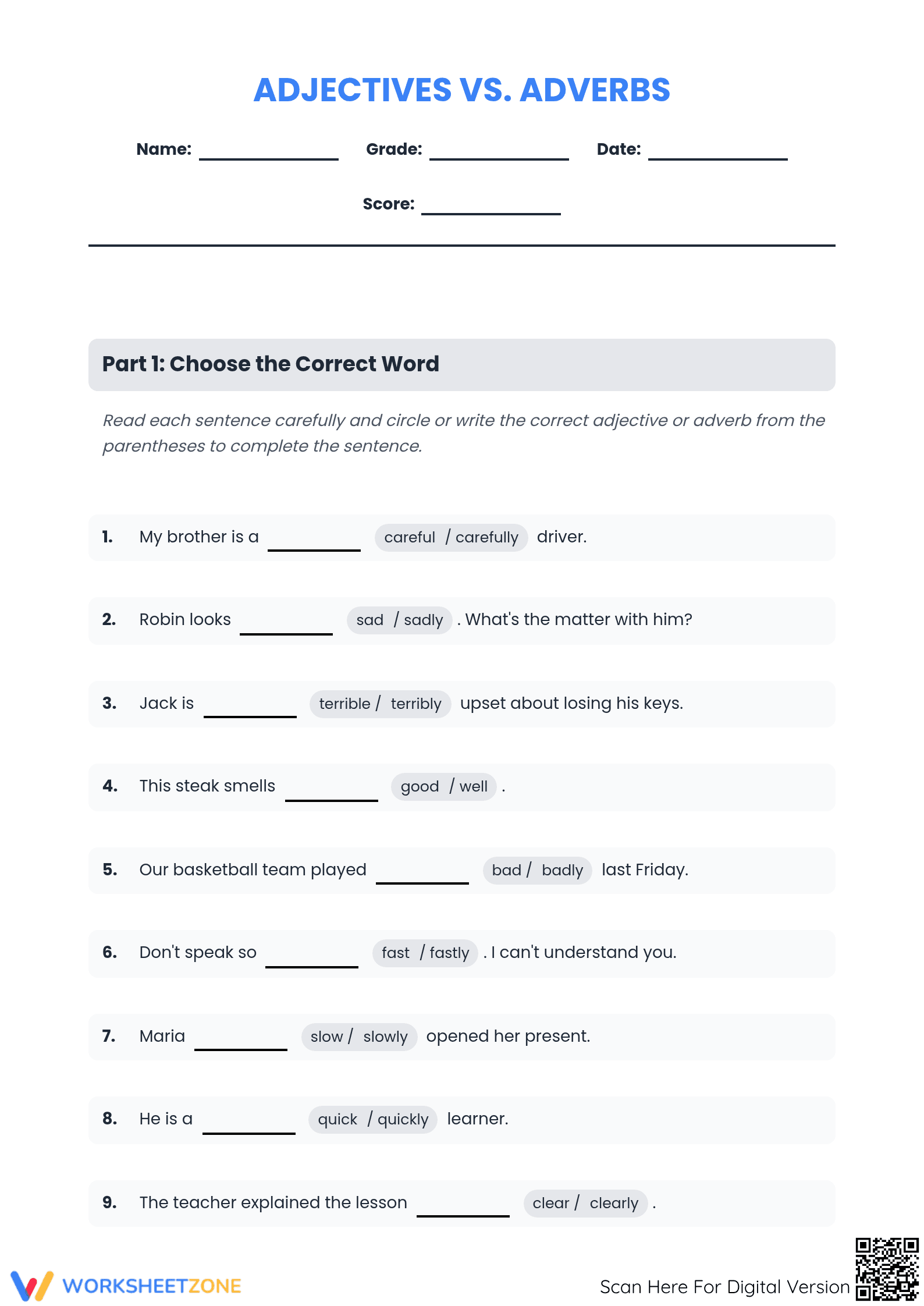
This focused grammar worksheet helps students distinguish between adjectives and adverbs while practicing their correct usage in context. By completing these targeted exercises, learners will build strong foundational language skills, ensuring they can accurately modify nouns and verbs to make their writing more descriptive and precise.
At a Glance
- Grade: 2 · Subject: ELA
- Standard:
CCSS.ELA-LITERACY.L.2.1.E— Choose between adjectives and adverbs depending on what is modified- Skill Focus: Adjectives vs. Adverbs
- Format: 3 pages · 30 problems · Answer key included · PDF
- Best For: Independent practice and review
- Time: 15–20 minutes
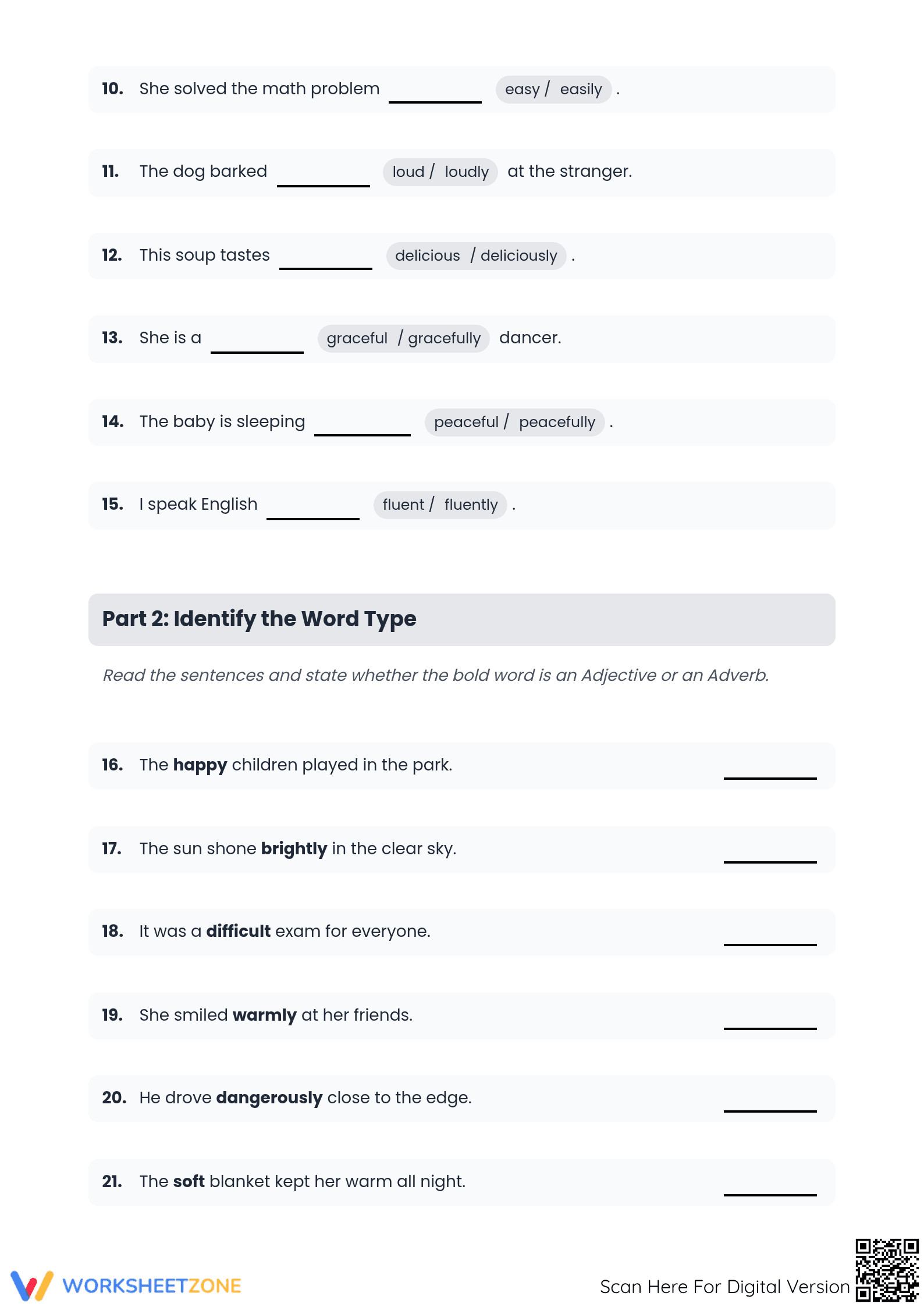
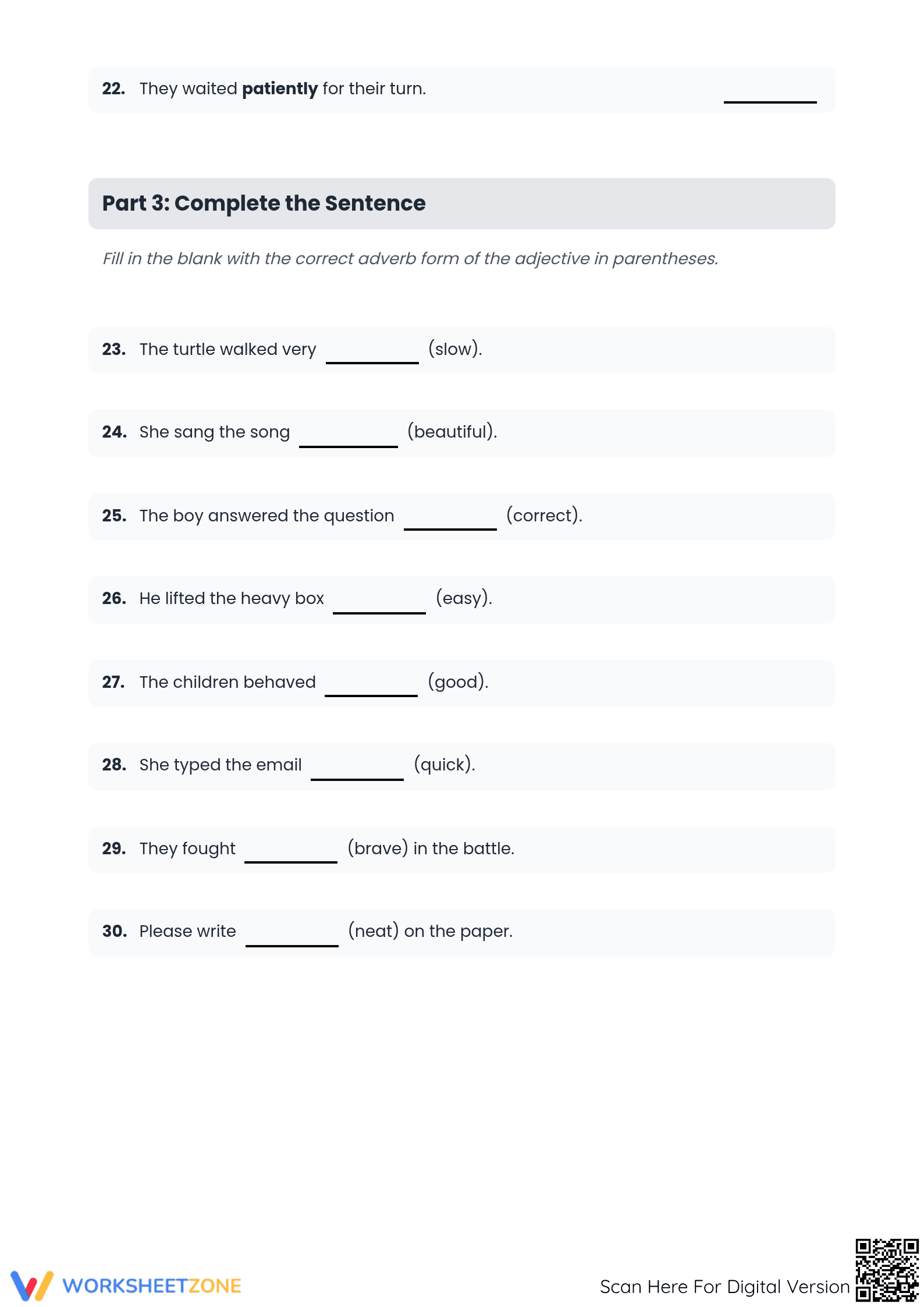
This comprehensive resource features three distinct sections designed to reinforce grammar rules. Part one requires students to choose the correct modifier from parentheses to complete 15 sentences. Part two asks learners to identify whether a bolded word is an adjective or an adverb across seven sentences. Finally, part three challenges students to complete eight sentences by forming the correct adverb from a given adjective. A complete answer key is provided for quick grading.
- Guided practice: Students begin by selecting the correct word from a provided pair, offering heavy scaffolding for the first 15 problems.
- Supported practice: The next 7 problems shift to identification, requiring learners to analyze the function of bolded words within complete sentences.
- Independent practice: The final 8 tasks demand higher-level application, as students must independently convert adjectives into their corresponding adverb forms.
This gradual-release structure follows the proven I Do, We Do, You Do model to build student confidence.
This resource is directly aligned to CCSS.ELA-LITERACY.L.2.1.E: Use adjectives and adverbs, and choose between them depending on what is to be modified. It also supports general vocabulary acquisition and sentence-level reading comprehension. Both standard codes can be copied directly into lesson plans, IEP goals, or district curriculum mapping tools.
Deploy this worksheet during your literacy block after direct instruction on modifiers. It serves as an excellent independent center activity or a quiet morning work assignment. As a formative assessment tip, observe whether students struggle more with identifying the words or forming the adverbs in part three, which can guide your next mini-lesson. Most students will complete the three pages in 15 to 20 minutes.
This activity is primarily designed for second-grade students mastering basic parts of speech, but it also serves as a valuable review for third graders. For students needing extra support, allow them to complete only the first section or provide an anchor chart detailing common adverb suffixes like "-ly." It pairs perfectly with a direct instruction lesson on descriptive writing or a mentor text highlighting vivid verbs and nouns.
Mastering the distinction between modifiers is a critical step in early elementary language development. Aligned with CCSS.ELA-LITERACY.L.2.1.E, this resource helps students choose between adjectives and adverbs depending on what is modified. According to Fisher & Frey (2014), explicit grammar instruction combined with structured, gradual-release practice significantly improves students' ability to transfer these skills into their own independent writing. When learners can confidently identify and apply the correct modifiers, they enhance both their reading comprehension and their expressive communication. By moving from simple selection tasks to active word formation, this worksheet provides the exact cognitive progression recommended by literacy researchers for cementing foundational grammar concepts. Consistent practice with these targeted exercises ensures that students internalize the rules of syntax, paving the way for more complex sentence structures in upper elementary grades.


