


























Views
Downloads

Essential Kindergarten Glossary: How Pictures Help Us Read
Paste this activity's link or code into your existing LMS (Google Classroom, Canvas, Teams, Schoology, Moodle, etc.).
Students can open and work on the activity right away, with no student login required.
You'll still be able to track student progress and results from your teacher account.
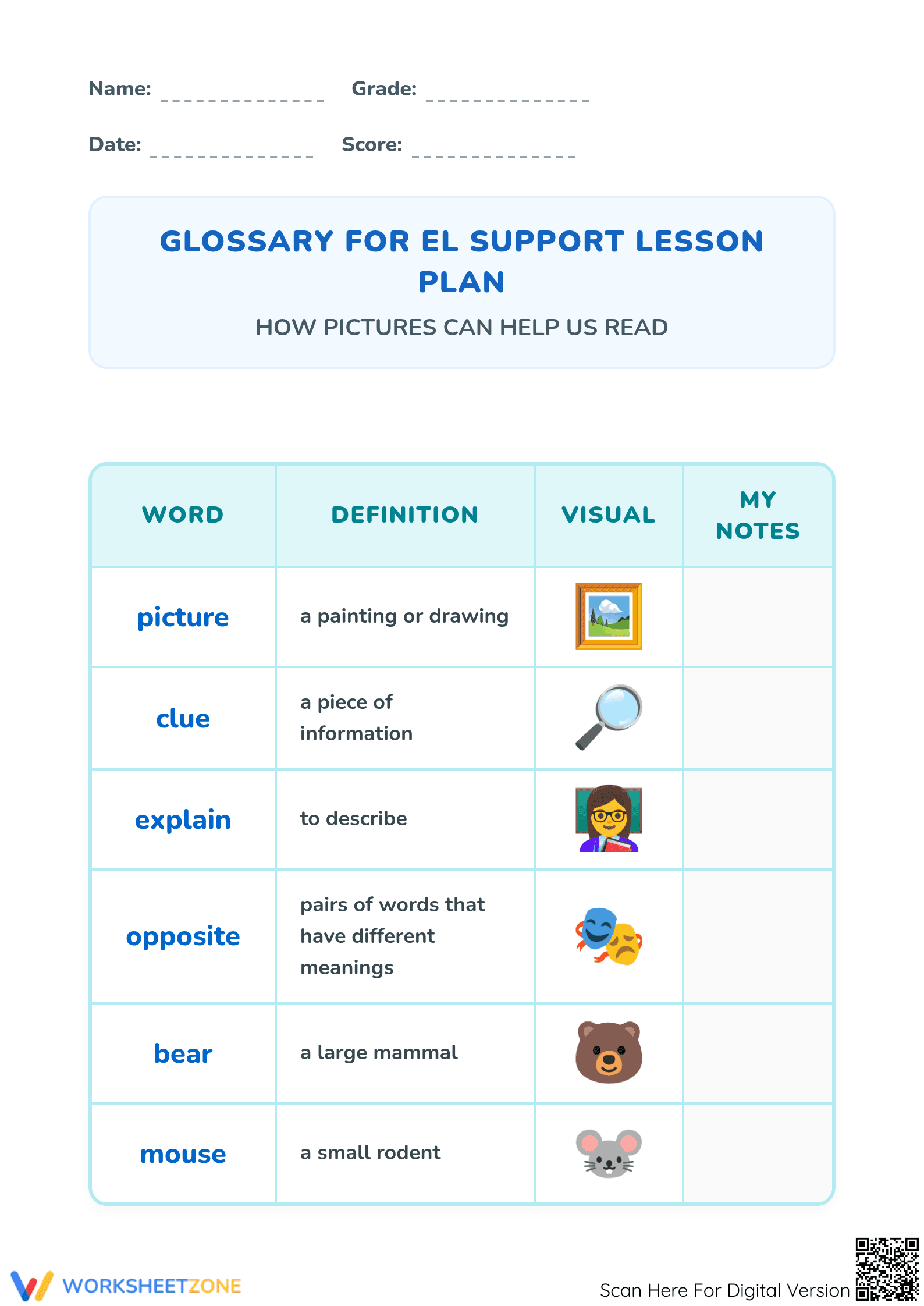
This Kindergarten vocabulary glossary helps early readers understand how visual clues support comprehension. By providing clear definitions and corresponding icons for 8 essential terms, students learn to bridge the gap between images and text. This resource ensures English Learners and emerging readers have the foundational language needed for successful fiction reading and fluency.
At a Glance
- Grade: Kindergarten · Subject: ELA
- Standard:
RL.K.4— Ask and answer questions about unknown words in a text- Skill Focus: Vocabulary Acquisition
- Format: 2 pages · 8 problems · Reference Tool · PDF
- Best For: EL Support and Small Group Instruction
- Time: 10–15 minutes
What's Inside
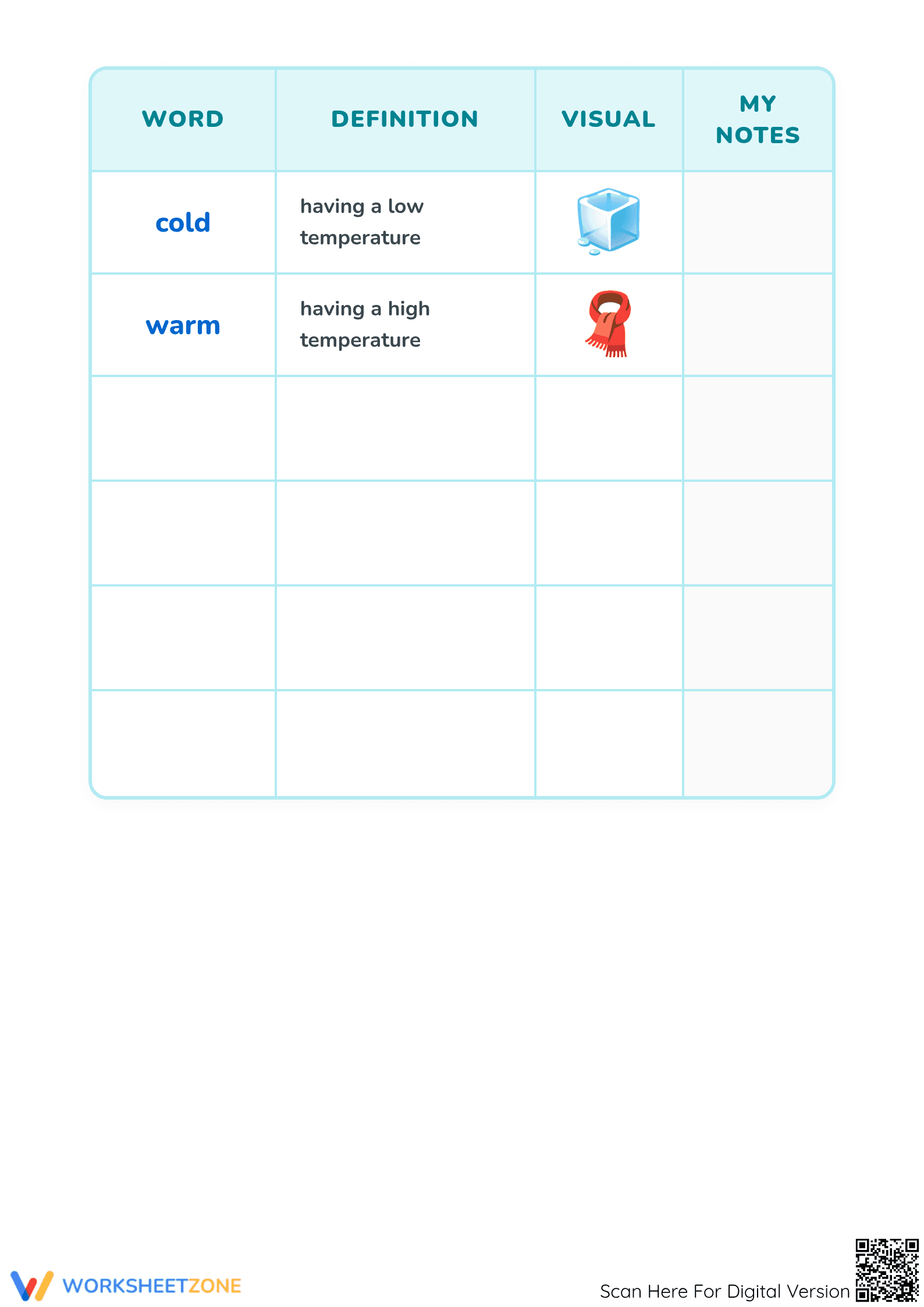
This 2-page PDF features a structured table containing eight high-frequency words such as "clue," "explain," and "opposite." Each entry includes a student-friendly definition and a colorful visual icon to reinforce meaning. A dedicated "My Notes" column allows for student interaction, while the second page provides additional space for custom vocabulary words encountered during the lesson.
Zero-Prep Workflow
- Print: Select the two-page PDF and print enough copies for your small group or entire class in under 30 seconds.
- Distribute: Hand out the glossary at the start of your EL support block to provide immediate scaffolding for the day's text.
- Review: Spend 5 minutes reviewing the visual icons together to anchor definitions before starting your direct instruction or text analysis.
Standards Alignment
This resource is aligned with `CCSS.ELA-LITERACY.RL.K.4`, which requires students to ask and answer questions about unknown words in a text. By providing a pre-populated glossary, teachers scaffold the answering portion of the standard for emerging readers. Both standard codes can be copied directly into lesson plans, IEP goals, or district curriculum mapping tools.
How to Use It
Use this glossary during the introduction to new material phase of a reading lesson. It is particularly effective when paired with a picture book to demonstrate how the word "clue" manifests in illustrations. For formative assessment, observe if students can point to the visual column when they encounter a word like "bear" or "mouse" in their independent reading.
Who It's For
This worksheet is specifically designed for Kindergarten English Learners (ELs) and students requiring Tier 2 vocabulary intervention. It pairs naturally with any fiction picture book or an anchor chart focused on reading strategies. The visual supports provide a necessary scaffold for students who are still developing phonemic awareness and decoding skills.
According to Fisher & Frey (2014), the use of visual scaffolds and intentional vocabulary front-loading is a critical component of the gradual release of responsibility model, especially for English Language Learners. This glossary addresses the RL.K.4 standard by providing a concrete reference point for abstract concepts like "explain" and "opposite." Research from the NAEP highlights that early exposure to structured vocabulary tools significantly correlates with long-term reading comprehension success. By integrating icons with text, this resource reduces cognitive load, allowing Kindergarteners to focus on the relationship between images and meaning. The inclusion of a "My Notes" section encourages active processing, a technique proven by EdReports 2024 to increase retention in early literacy programs. This printable tool serves as a bridge between oral language and printed text, ensuring that all students, regardless of their starting point, can access grade-level curriculum.


