


























Students learn about measurement in this unit. Students are going to:
- Use nonstandard units to calculate a given distance.
- Analyze how using larger and smaller nonstandard units relates to one another.
- How precise do measurements and calculations need to be?
- How are mathematical properties of things or processes measured, computed, and/or interpreted?
- What does it mean to evaluate or estimate a numerical quantity?
- What qualifies a tool or approach as suitable for a particular task?
- When is it better to estimate rather than calculate?
- Why does "what" we measure affect "how" we measure?
- Length: Measurement of an object from end to end.
- Less Than: Not as great in amount or quantity.
- More Than: Greater in amount, degree, or number.
- masking tape
- chalk
- Recording Sheet worksheet (M-1-5-1_Recording Sheet), one copy for each group
- Lesson 1 Exit Ticket (M-1-5-1_Lesson 1 Exit Ticket), one copy per student,
- Instruction should be guided in part by your observations made during class activities and discussions.
- To ascertain whether students can use nonstandard units of measurement and whether they comprehend that the smaller the unit of measure, the more units are needed, use the Lesson 1 Exit Ticket (M-1-5-1_Lesson 1 Exit Ticket).
W: Measurement is introduced to the class.
H: Students use both "giant" and "baby" steps to measure distances.
E: Students use three different steps to cover distances: walking, baby, and giant.
R: Students gather to record and discuss the variations among the different types of steps as a way to review the material they learned during the activity.
E: Assess students' comprehension of the connection between step size and number of steps taken through dialogue. Keep an eye on the students' steps throughout the exercise to make sure they are generally consistent.
T: Adapting the lesson to the needs of the students is possible. Students can finish a small-group exercise comparing lengths measured in various step sizes as a review. Students can use cut-out feet to measure distances for a more difficult task.
O: Students practice covering distances with various step types. They ascertain the correlation between the step size and the number of steps required to traverse the distance.
Note: Set up various stations throughout the room with the same distance marked off (4 to 5 feet) in advance of this lesson. In front of the classroom, draw a line that is 4-5 feet long.
"You are going to learn about measurement today. We're going to use varying-sized steps to measure a distance. There will be enormous, gigantic steps and tiny, baby steps. I'll demonstrate my giant step for you." As an example, take a giant step. Ask two or three students to present their giant steps to the class from the front of the room. "Let me show you my baby step next." Present a baby step; it is advised that you make a heel/toe step to maintain consistency. Ask two or three students to identify their baby steps by coming to the front of the room.
"We're going to measure a distance now using these various steps. I want you to count how many enormous steps I take to go from one end to the other." Ask students to tally how many enormous steps it takes you to go the specified distance. On the board, create a chart that resembles the one below.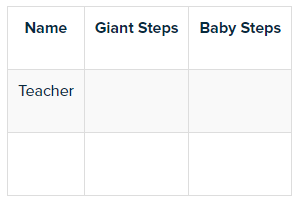
"How many giant steps did I take?" Write the number down on the chart. "Count the number of baby steps I take to go the same distance now." On the chart, note how many steps there are.
"You will now work in pairs to complete the task that I just completed." (Due to classroom space constraints, students might have to work in small groups.) Give the recording sheet (M-1-5-1_Recording Sheet) to every group. "Every student in your group will alternately measure the distance using enormous steps at first and then baby steps. Assign each person to a single turn of giant steps. On the recording sheet, be sure to note the number of steps next to the individual's name. After that, assign each person a small task to complete in turn. On the recording sheet, write this number next to the person's name in the Baby Steps column."
Give the students a specific amount of time to measure and record their steps. Finally, reconvene the class. Gather the recording sheets, then move the data onto the board. Discuss what students noticed while measuring the distance with giant and baby steps. Encourage a conversation about why it took them the same distance in fewer giant steps than baby steps or more baby steps than giant steps.
On the board chart, add a third column labeled "Walking Step."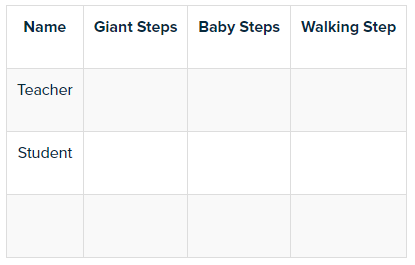
Ask one of the students to show you how to walk a step. Ask students to describe the differences between giant and baby steps and walking steps. "Do you believe you will take more or fewer walking steps than giant steps? Why? How many walking steps—as opposed to baby steps—do you anticipate taking? Why? For the same distance, why does the teacher cover it in fewer giant steps than the student? What makes a student different from another student?" Make sure the students understand how the three different types of steps relate to each other. To cover a given distance, fewer steps are required the larger the step. The more steps are required to cover a distance, the smaller the step. The number of steps you take when using walking steps falls between the total number of giant steps and baby steps.
Extension:
Routine: Have students count silently the number of giant steps it takes to get to each location and the number of walking or baby steps it takes to return when they line up to go to different places in the building (music class, library, etc.).
Small Group: Divide the students into three groups. Establish a clear boundary on the ground. To measure the distance, have one group take giant steps. To measure the distance, the third group uses walking steps, while the second group uses baby steps. Before the groups begin measuring, decide which group will take the most steps and which will take the fewest. Compare the results to the students' predictions after they have completed measuring.
Expansion: Give students three different sizes of feet cut from tagboard or construction paper. Ask students to estimate how many feet, measured end to end, would be needed to cover a given distance after they have seen it marked. Finally, ask the students to measure and verify their hypotheses.

Giant Steps, Baby Steps (M-1-5-1)
Students learn about measurement in this unit. Students are going to:
- Use nonstandard units to calculate a given distance.
- Analyze how using larger and smaller nonstandard units relates to one another.


