


























Views
Downloads


Get to Know Geometry: Printable Rectangles and Triangles
Paste this activity's link or code into your existing LMS (Google Classroom, Canvas, Teams, Schoology, Moodle, etc.).
Students can open and work on the activity right away, with no student login required.
You'll still be able to track student progress and results from your teacher account.
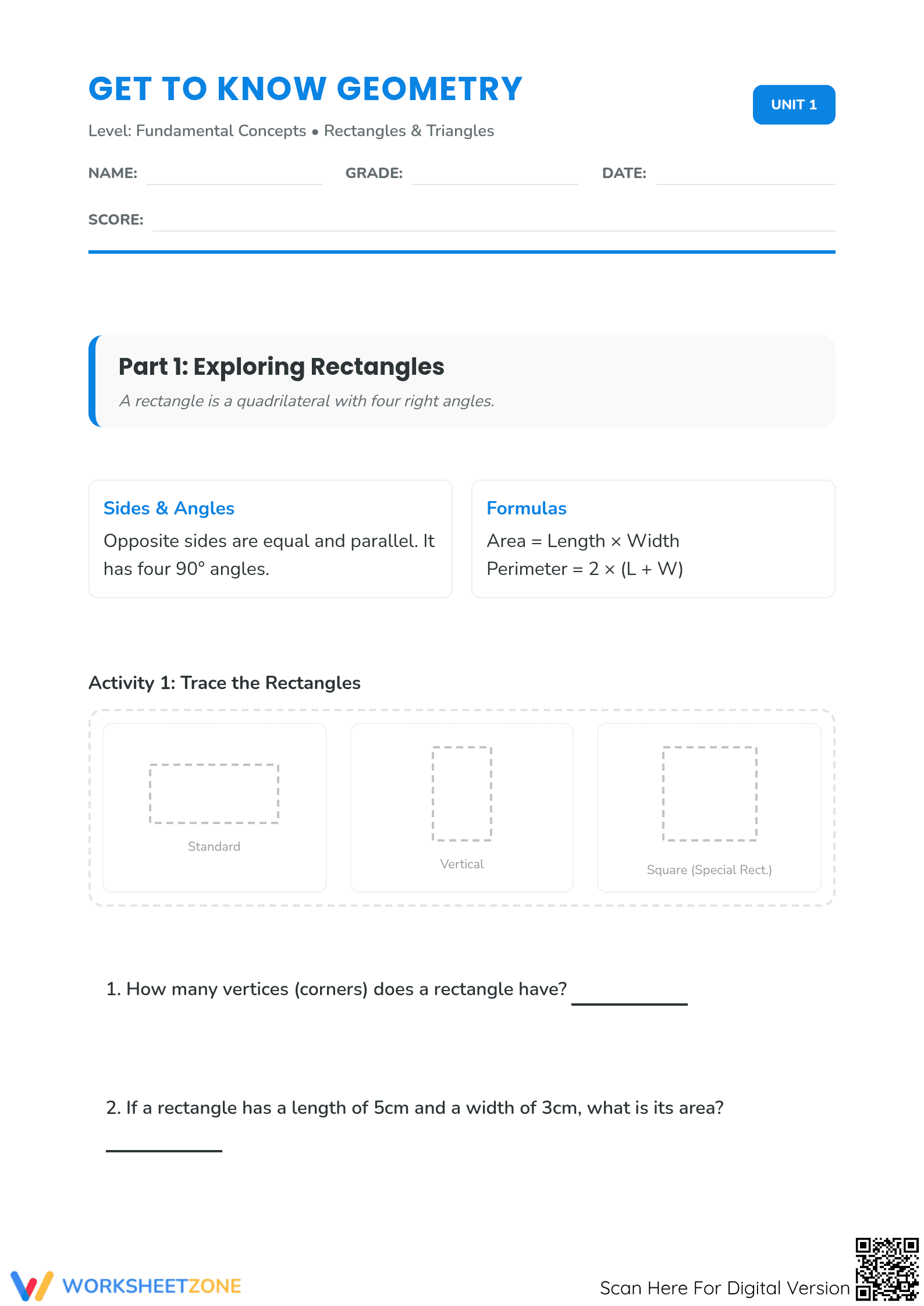
Master the fundamentals of 2D geometry with this comprehensive 3-page worksheet focused on rectangles and triangles. Students will explore polygon properties, calculate area and perimeter using standard formulas, and identify various shape types. By the end of these activities, learners will have a solid grasp of how polygons are defined and measured, ensuring they are prepared for more complex spatial reasoning tasks.
At a Glance
- Grade: 6 · Subject: Geometry
- Standard:
CCSS.MATH.CONTENT.6.G.A.1— Find the area of right triangles and other triangles, special quadrilaterals- Skill Focus: Polygon Properties & Area
- Format: 3 pages · 15 problems · Answer key included · PDF
- Best For: Introduction to fundamental geometry concepts
- Time: 30–45 minutes
This resource contains three distinct parts spread across three pages. Part one focuses on rectangles, providing definitions and formulas for area and perimeter alongside tracing activities and calculation problems. Part two transitions to triangles, covering equilateral, isosceles, and scalene varieties with an emphasis on internal angle sums. The final page features an identification challenge to reinforce visual recognition of these core geometric figures.
Skill Progression
- Guided practice: The worksheet begins with tracing activities for rectangles and triangles, allowing students to physically engage with shape boundaries while reading clear definitions and formulas.
- Supported practice: Students apply their knowledge through structured questions that prompt them to count vertices, calculate area using provided dimensions, and identify angle types based on visual cues.
- Independent practice: The final identification challenge requires students to name shapes without scaffolds, demonstrating their ability to distinguish between rectangles, squares, and triangles autonomously.
This sequence follows the gradual-release model, moving from basic recognition to conceptual application and ending with mastery-based identification.
Standards Alignment
The primary focus of this worksheet is `CCSS.MATH.CONTENT.6.G.A.1`, which requires students to find the area of right triangles, other triangles, and special quadrilaterals by composing into rectangles or decomposing into triangles and other shapes. Additionally, it supports Grade 5 foundations by exploring the properties of categories of two-dimensional figures. Both standard codes can be copied directly into lesson plans, IEP goals, or district curriculum mapping tools.
How to Use It
This worksheet is ideal for use during the "We Do" phase of direct instruction, where the teacher can guide students through the formulas on page one before letting them tackle the area calculations. It also serves as an excellent formative-assessment tool at the end of a geometry unit; observe students during the triangle angle sum calculation (Question 5) to see if they understand the additive property of angles. Expected completion time is approximately 40 minutes.
Who It's For
Designed for Grade 6 students, this resource is equally effective for Grade 5 advanced learners or middle school students needing a refresher on polygon properties. The clear layout and visual tracing elements provide necessary scaffolds for English Language Learners and students with IEPs. Naturally pair this worksheet with a set of pattern blocks or a digital geometry applet to help students visualize the relationships between different quadrilaterals.
Geometry education in the middle grades serves as a critical bridge to high-school spatial analysis. This Grade 6 worksheet, aligned to `CCSS.MATH.CONTENT.6.G.A.1`, addresses the foundational skill of calculating area and identifying properties of triangles and quadrilaterals. Research emphasizes scaffolding complex mathematical tasks through guided practice and visual models, a strategy explicitly employed in this resource's tracing and formula-based sections. By integrating clear definitions with hands-on tracing and analytical problem-solving, the worksheet ensures students move beyond rote memorization toward conceptual understanding of geometric dimensions. The inclusion of internal angle sum calculations further deepens the learner's grasp of polygon characteristics. This resource provides rigorous, standards-aligned practice necessary for students to meet the demands of modern STEM curricula while maintaining accessibility for diverse learners.


