


























Views
Downloads

Printable 2D Triangles Reference Guide | Grade 6+ Aligned
Paste this activity's link or code into your existing LMS (Google Classroom, Canvas, Teams, Schoology, Moodle, etc.).
Students can open and work on the activity right away, with no student login required.
You'll still be able to track student progress and results from your teacher account.
This essential geometry worksheet provides a comprehensive overview of 2D triangle classifications for secondary students. By combining a structured notes page with a visual reference guide, it ensures learners can accurately identify and describe triangles based on their side lengths and angle measures. This resource serves as a foundation for more complex trigonometric and geometric proofs.
At a Glance
- Grade: 6–12 · Subject: Geometry
- Standard:
HSG-MG.A.1— Use geometric shapes and their properties to describe objects- Skill Focus: Triangle classification by sides and angles
- Format: 2 pages · 6 reference points · Answer key included · PDF
- Best For: Secondary geometry review and guided notes
- Time: 15–20 minutes
What's Inside
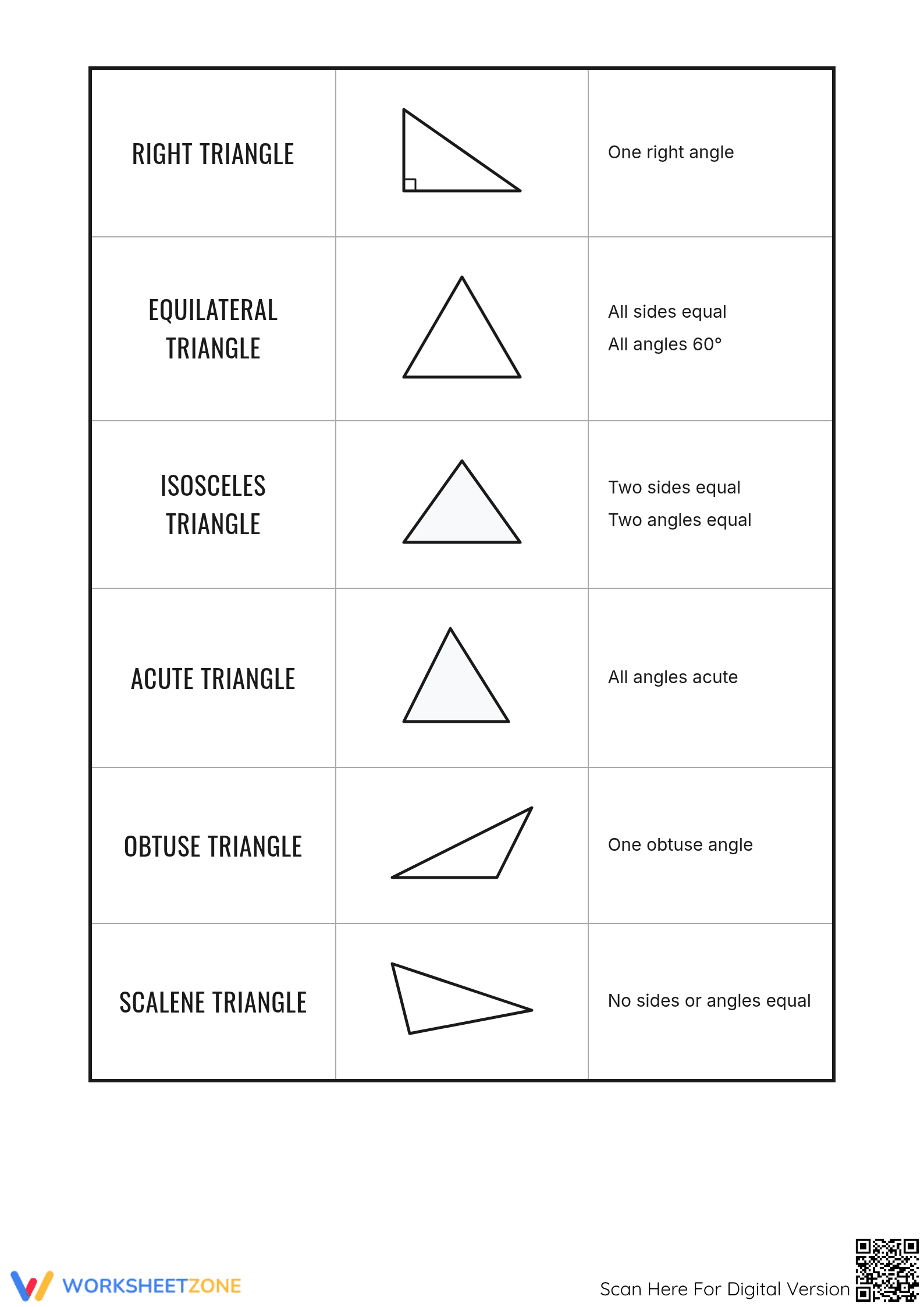
This two-page PDF includes a dedicated "Notes" section on the first page, allowing students to record definitions or teacher-led instructions during a lesson. The second page features a clear classification chart defining Right, Equilateral, Isosceles, Acute, Obtuse, and Scalene triangles. Each entry includes a labeled geometric diagram and a concise description of the shape's defining properties.
Zero-Prep Workflow
This resource is designed for immediate classroom integration with a total prep time of under two minutes. First, print the two-page set for each student (1 minute). Next, distribute the sheets during the "Explore" phase of your geometry unit (30 seconds). Finally, students can use the reference chart to complete independent practice or keep it in their binders for review (30 seconds).
Standards Alignment
This worksheet is primarily aligned to HSG-MG.A.1, focusing on the properties of geometric shapes. It also supports 7.G.A.2, which requires students to construct and identify triangles with given conditions. Both standard codes can be copied directly into lesson plans, IEP goals, or district curriculum mapping tools to ensure instructional accountability and standards-based grading compliance.
How to Use It
Use this worksheet as a "flipped classroom" pre-study guide where students read the definitions before a lecture. Alternatively, it works as a scaffolded support tool for students during a multi-step geometry assessment or a collaborative sorting activity. During instruction, observe if students can differentiate between triangles categorized by angles versus those categorized by their side lengths.
Who It's For
This resource is perfect for Grade 6 through Grade 12 students who are introduced to or reviewing Euclidean geometry. It is particularly helpful for English Language Learners (ELLs) and students with IEPs who benefit from clear visual aids and explicit definitions. Pair this with a digital geometry software tool or a set of protractors for a hands-on exploration.
According to a ScienceDirect TpT Analysis, high-quality visual aids in mathematics significantly reduce cognitive load, allowing secondary students to focus on higher-order application rather than rote memorization. This worksheet facilitates this process by providing a clear, standardized reference for the HSG-MG.A.1 standard. By identifying 6 distinct triangle types—including Scalene, Isosceles, and Obtuse—students build a conceptual schema necessary for the rigor of high school geometry. Research from Fisher & Frey (2014) emphasizes that "guided notes" strategies, like the one provided in this resource, improve information retention and student engagement during direct instruction. Educators can confidently integrate this printable as a reliable anchor for geometric properties and triangle classification. The inclusion of clear diagrams ensures that the terminology is accessible to diverse learners across the middle and high school spectrum, making it a versatile tool for any standards-aligned math curriculum.


