


























Views
Downloads

Genetic Crosses Practice Worksheet | Essential Biology
Paste this activity's link or code into your existing LMS (Google Classroom, Canvas, Teams, Schoology, Moodle, etc.).
Students can open and work on the activity right away, with no student login required.
You'll still be able to track student progress and results from your teacher account.
This comprehensive biology resource helps students master the mechanics of Mendelian inheritance through rigorous practice. By calculating probabilities for various traits, learners bridge the gap between abstract genetic theory and observable physical characteristics. This worksheet ensures students can confidently predict offspring outcomes using standard Punnett square methodologies and logical deduction.
At a Glance
- Grade: 9-12 · Subject: Biology
- Standard:
HS-LS3-3— Apply probability to explain the variation and distribution of expressed traits- Skill Focus: Monohybrid, Incomplete, and Codominance Crosses
- Format: 5 pages · 17 problems · Answer key included · PDF
- Best For: High school biology unit review
- Time: 45–60 minutes
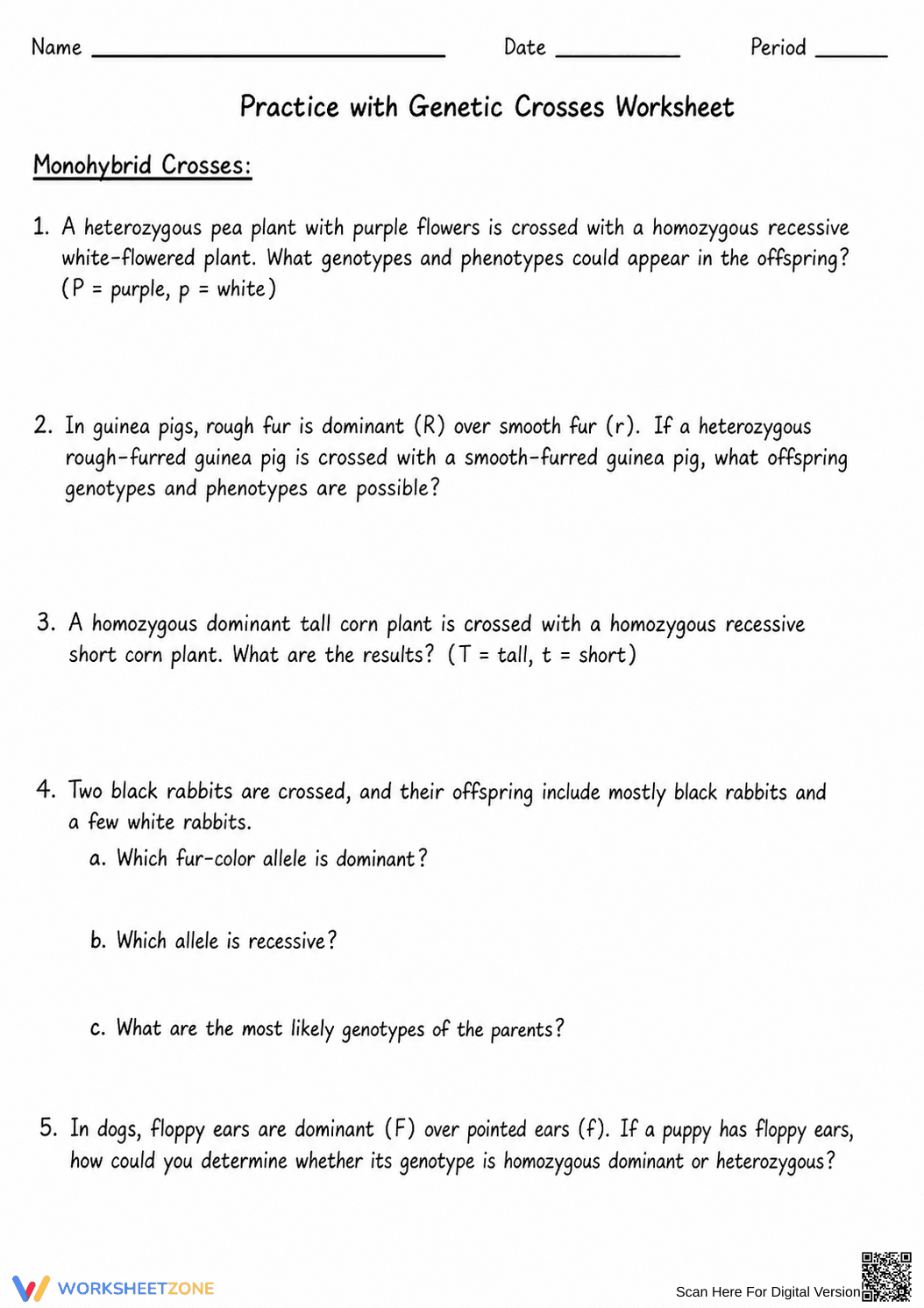
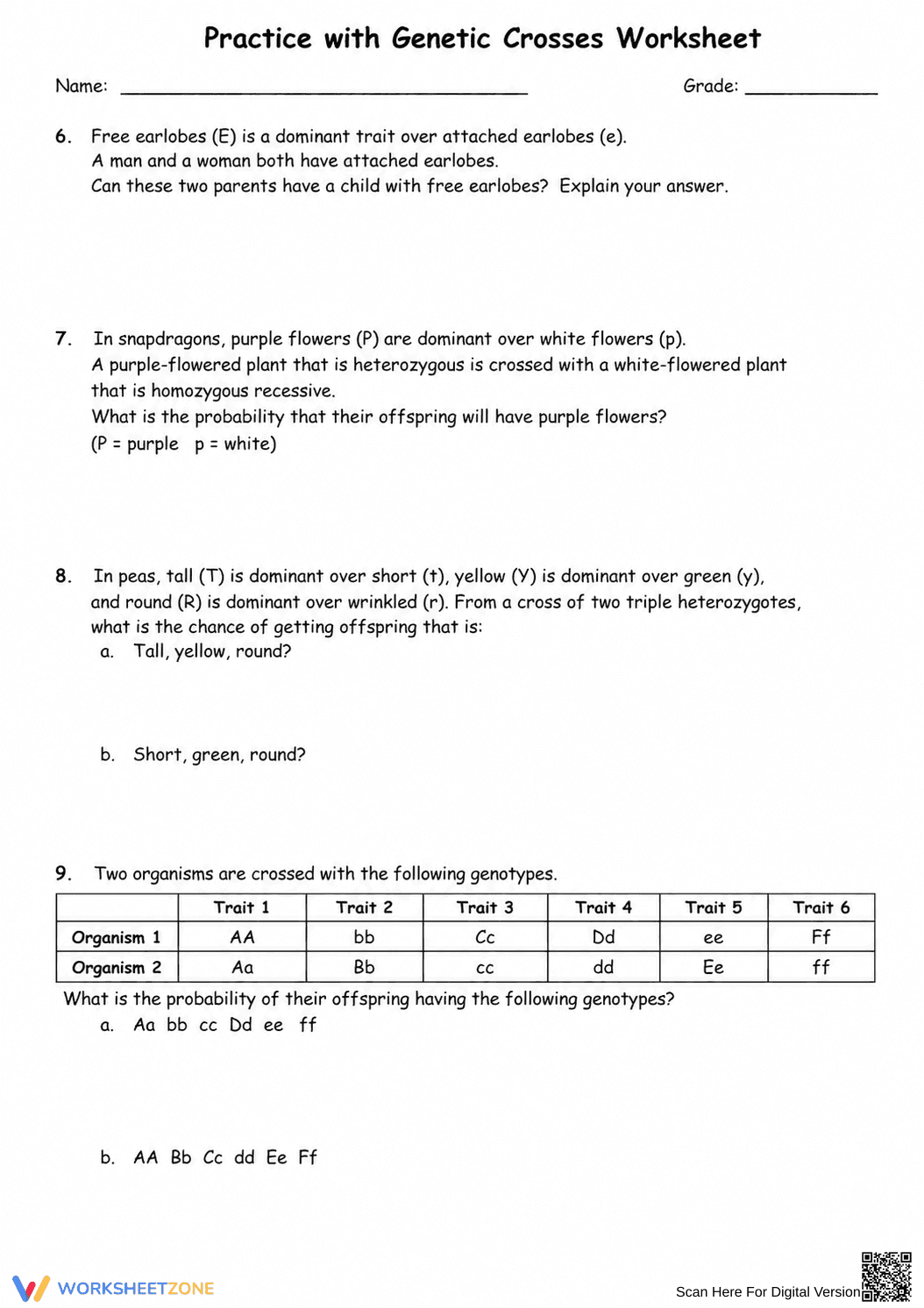
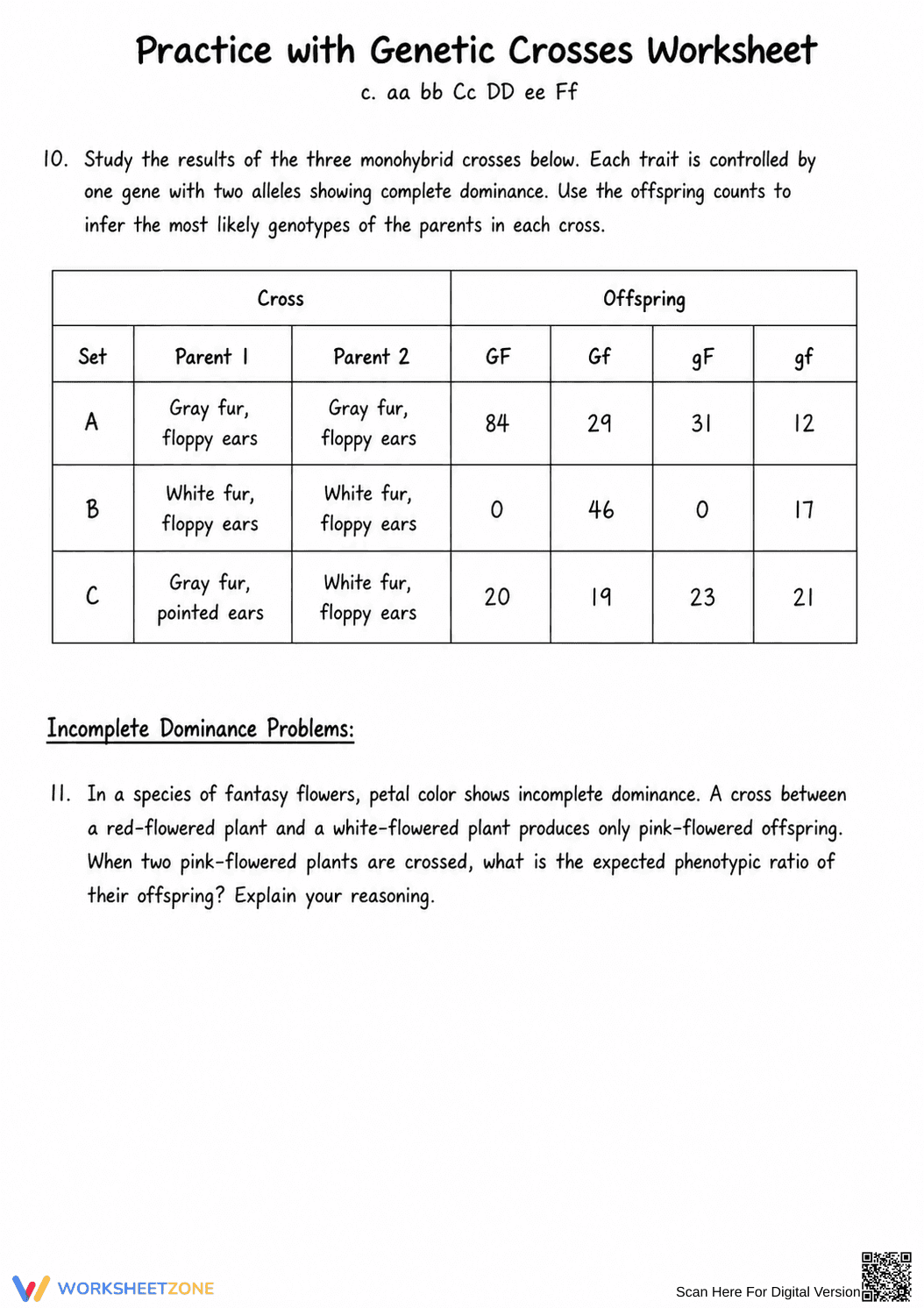
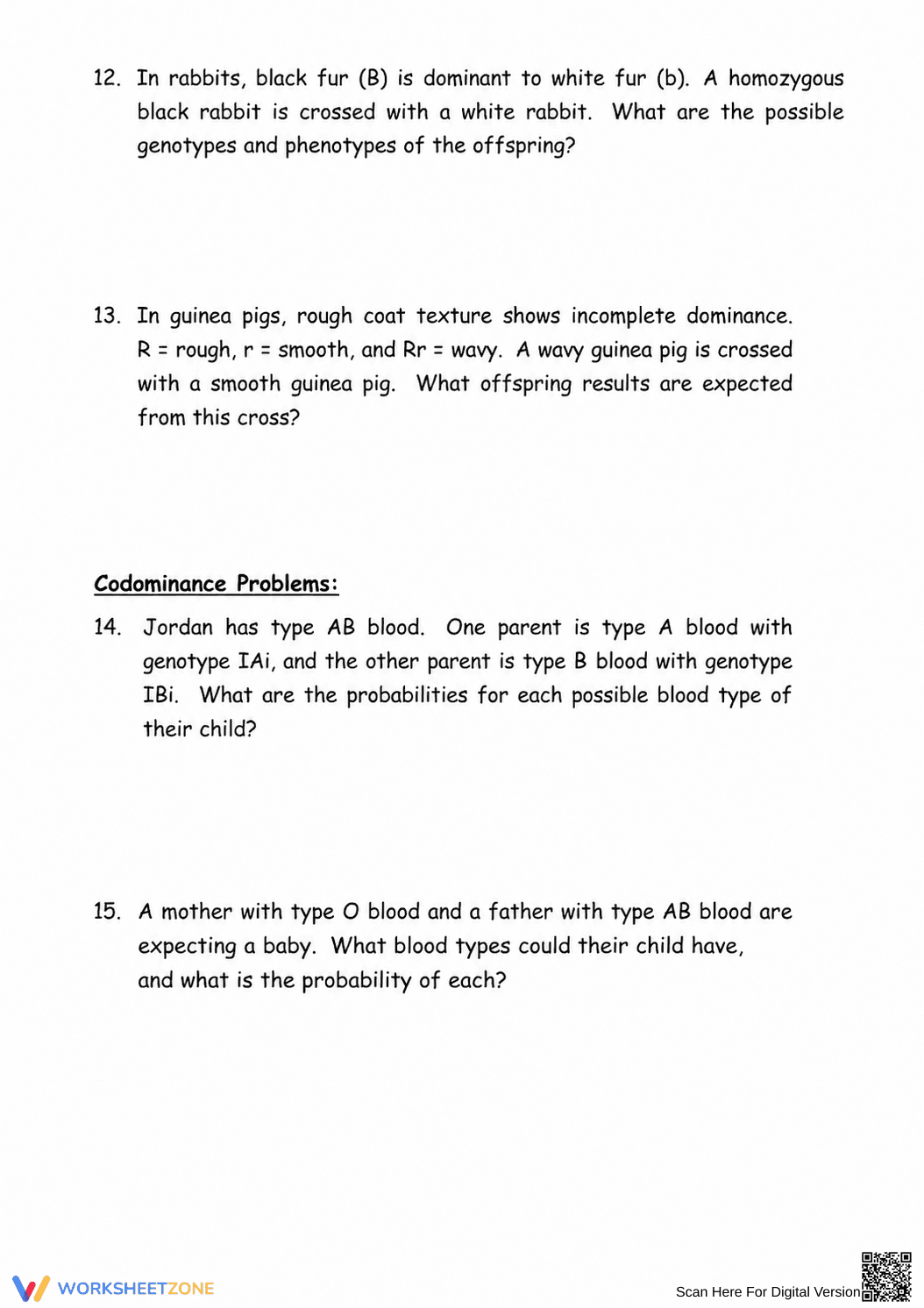
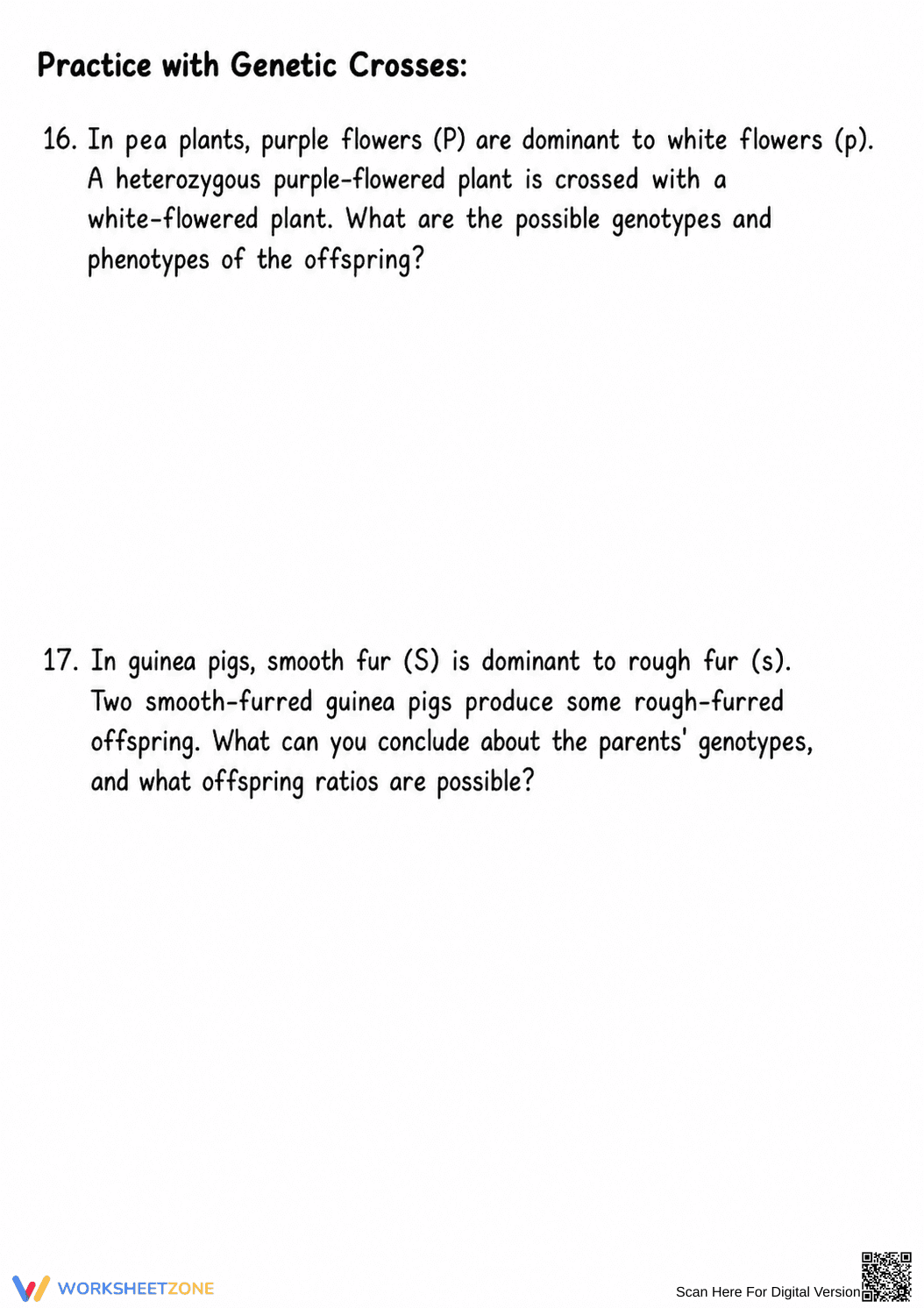
What's Inside: This 5-page PDF contains 17 detailed word problems ranging from simple monohybrid crosses to complex inheritance patterns. The layout provides ample white space for students to draw Punnett squares and record genotypic and phenotypic ratios. It covers diverse organisms including pea plants, guinea pigs, rabbits, and human blood types to illustrate universal genetic principles across different species.
Skill Progression
- Guided Practice: The first 5 problems focus on basic monohybrid crosses, requiring students to identify dominant and recessive alleles from provided text cues and set up simple squares.
- Supported Practice: Problems 6-10 introduce probability calculations and the challenge of inferring parental genotypes from offspring data tables, adding a layer of analytical depth.
- Independent Practice: The final section challenges students with incomplete dominance and codominance scenarios, such as human blood typing, requiring high-level application of non-Mendelian rules.
This gradual-release model ensures students build confidence before tackling multi-trait or complex inheritance logic in a standard I Do, We Do, You Do instructional sequence.
Standards Alignment: This resource is aligned to HS-LS3-3: "Apply concepts of statistics and probability to explain the variation and distribution of expressed traits in a population." It also supports middle school foundations by developing the understanding of how gene combinations result in offspring variation. Both standard codes can be copied directly into lesson plans, IEP goals, or district curriculum mapping tools.
How to Use It: Assign this worksheet during the middle of a genetics unit after students have been introduced to homozygous and heterozygous terminology. It serves as an excellent formative assessment tool; teachers should circulate and observe if students are correctly placing gametes on the axes of their Punnett squares. Expect a completion time of 50 minutes for a standard high school biology period.
Who It's For: This resource is designed for high school biology students, including those in Honors or AP tracks needing a refresher on Mendelian basics. It pairs naturally with a classroom anchor chart on allele notation or a direct instruction lesson on the Law of Segregation and independent assortment.
According to the RAND AIRS 2024 report on secondary science achievement, structured problem-solving in genetics significantly improves student retention of complex biological concepts. This worksheet addresses the HS-LS3-3 standard by requiring students to apply mathematical probability to biological systems, a core competency identified by the National Assessment of Educational Progress (NAEP). By engaging with 17 distinct scenarios, students move beyond rote memorization of Punnett squares toward a functional understanding of trait distribution. Research from Fisher & Frey (2014) emphasizes that the gradual release of responsibility—moving from simple dominance to codominance—is essential for mastering the abstract nature of heredity. This resource provides the necessary scaffolding to ensure that learners can accurately predict phenotypic ratios while understanding the underlying genotypic causes, making it a robust tool for any standards-aligned science curriculum.


