


























Views
Downloads
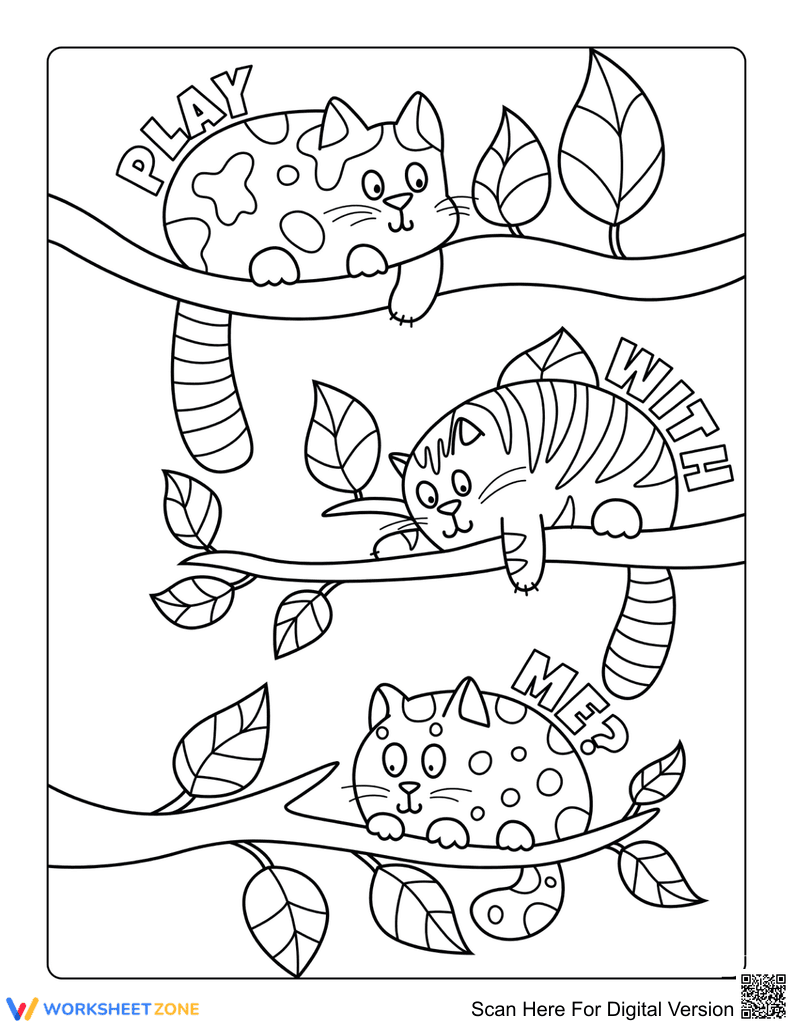

Funny Cat Doodle Printable Coloring Page | Grade K
Paste this activity's link or code into your existing LMS (Google Classroom, Canvas, Teams, Schoology, Moodle, etc.).
Students can open and work on the activity right away, with no student login required.
You'll still be able to track student progress and results from your teacher account.
This Funny Cat Doodle worksheet provides a creative outlet for young learners to practice essential fine motor control. By engaging with the whimsical illustrations of cats on branches, students develop the hand-eye coordination necessary for early writing tasks. It is a high-interest activity that combines artistic expression with foundational pre-writing skills to ensure students are ready for more complex literacy demands.
At a Glance
- Grade: Kindergarten · Subject: English
- Standard:
CCSS.ELA-LITERACY.L.K.1.A— Use fine motor control to print letters and color within lines- Skill Focus: Fine motor development
- Format: 1 page · 1 task · No answer key · PDF
- Best For: Morning work or early finishers
- Time: 15–20 minutes
Inside this resource, you will find a single-page PDF featuring three distinct, stylized cat characters resting on tree branches. The line art is clean and bold, making it accessible for small hands using crayons, colored pencils, or markers. There are no complex instructions or text-heavy sections, allowing students to focus entirely on their grip, pressure, and color selection without distraction.
The zero-prep workflow for this worksheet is designed for maximum efficiency in a busy classroom. First, print the single-page PDF (30 seconds). Second, distribute the sheets to students along with their preferred coloring supplies (1 minute). Third, review the completed work to observe pencil grip and spatial awareness (30 seconds). Total teacher preparation time is under 2 minutes, making it an ideal sub plan addition or emergency filler activity.
This activity aligns with `CCSS.ELA-LITERACY.L.K.1.A`, which focuses on the physical mechanics of writing and letter formation. While students are coloring the intricate patterns on the cats, they are strengthening the same muscle groups used for printing upper- and lowercase letters. This standard code can be copied directly into lesson plans, IEP goals, or district curriculum mapping tools to document fine motor progress.
Use this worksheet during the transition from lunch to quiet time to help students settle and focus. It also serves as an excellent formative assessment tool; observe if students can maintain a consistent tripod grip for the full 20 minutes. Expected completion time ranges from 15 to 25 minutes depending on the student's attention to detail and artistic choices.
This resource is primarily for Kindergarten students but is suitable for any early learner needing fine motor intervention or occupational therapy support. It pairs naturally with a read-aloud about pets or a direct instruction lesson on primary and secondary colors. The simple subject matter ensures high engagement for both boys and girls in the early childhood setting.
Research from Fisher & Frey (2014) emphasizes the importance of scaffolded fine motor activities in the early childhood classroom. Developing the intrinsic muscles of the hand through coloring is a prerequisite for the mastery of CCSS.ELA-LITERACY.L.K.1.A. This Funny Cat Doodle worksheet provides the necessary resistance and spatial boundaries to help students transition from gross motor movements to the refined control required for legible handwriting. According to the NAEP, students who enter first grade with strong pre-writing skills, including the ability to color within defined boundaries, show higher rates of literacy achievement. By integrating this 1-page resource into daily routines, educators provide a low-stakes environment for students to build the stamina needed for longer writing blocks. This specific task encourages the tripod grip which is essential for long-term writing success and ergonomic comfort in the classroom.


