


























Views
Downloads
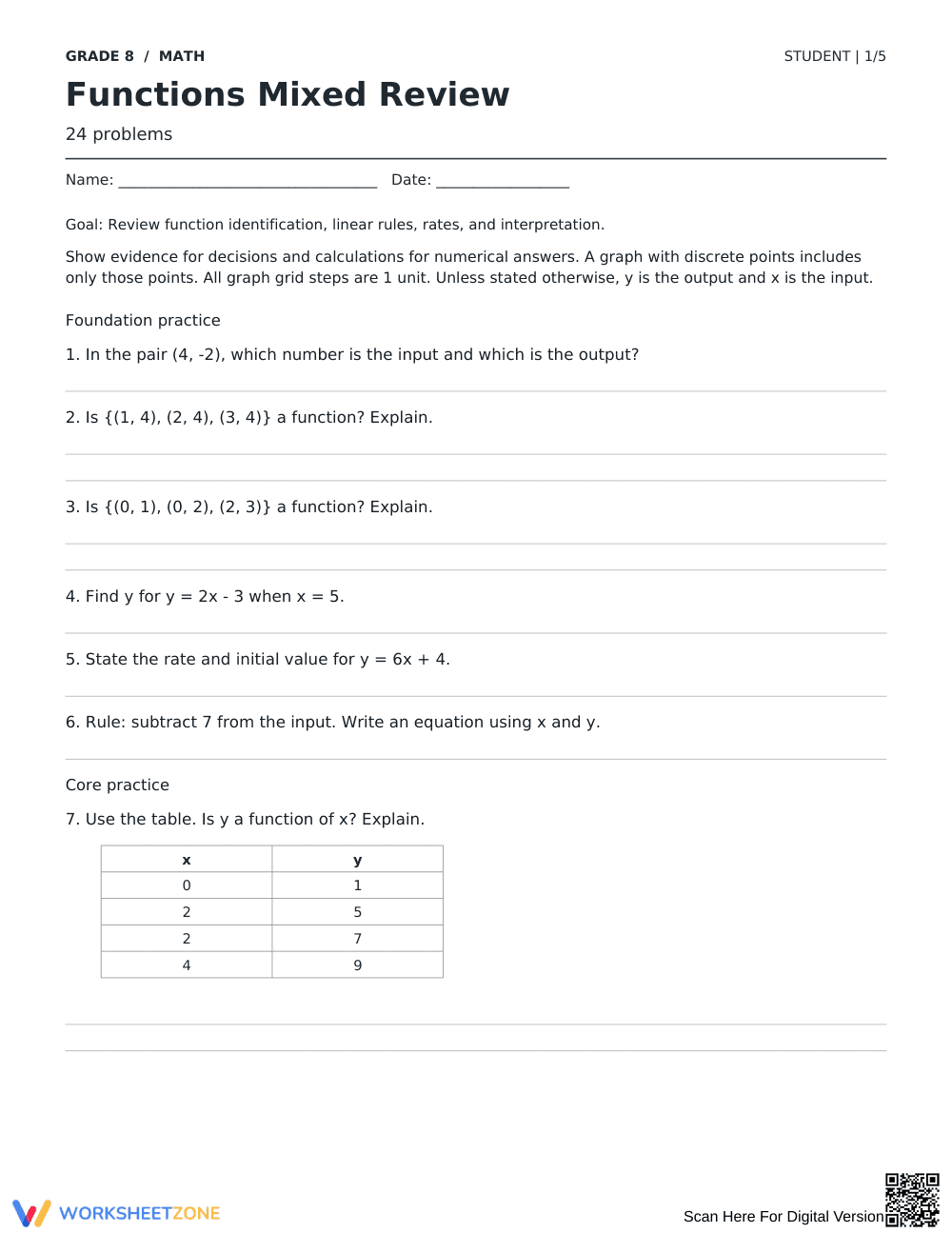
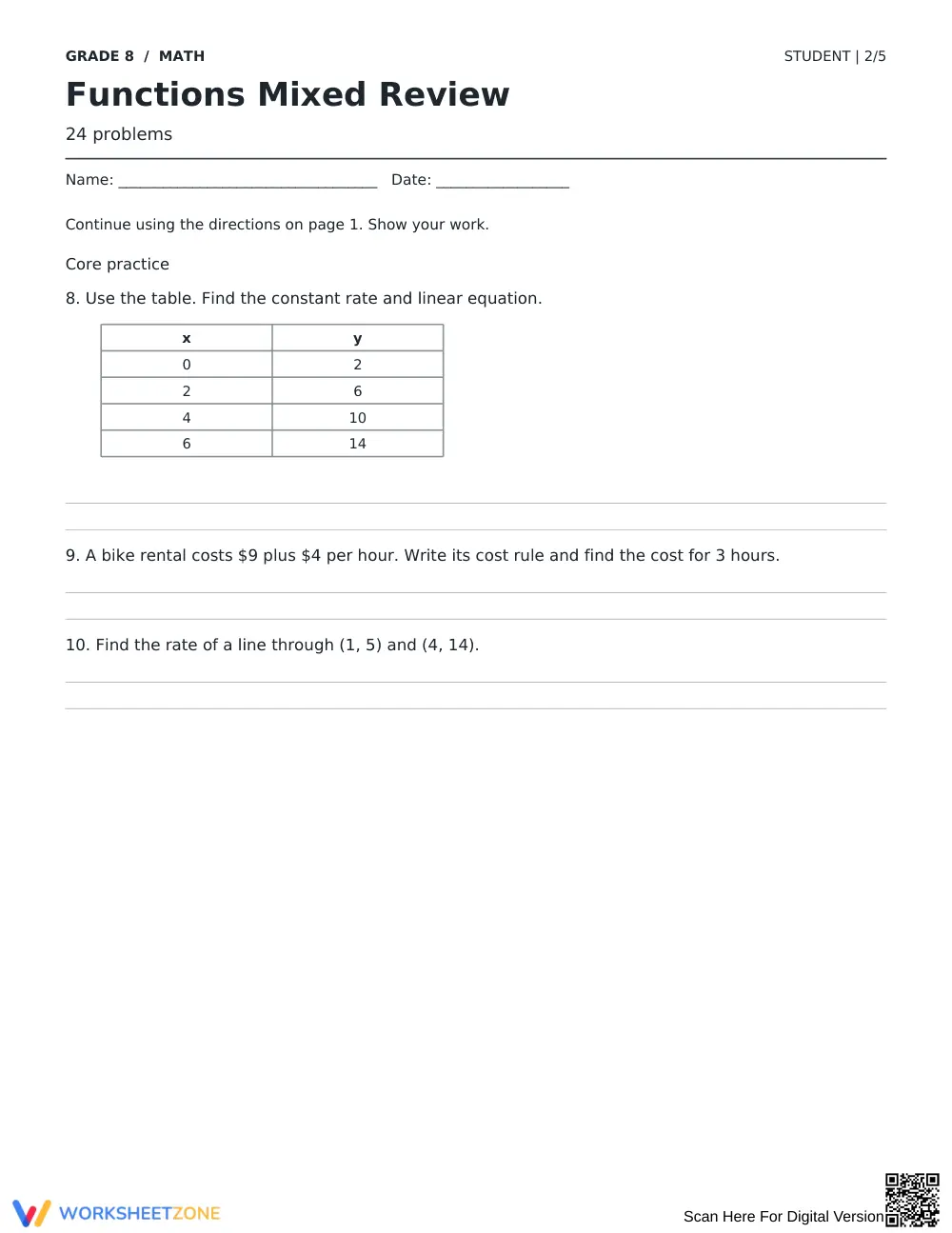


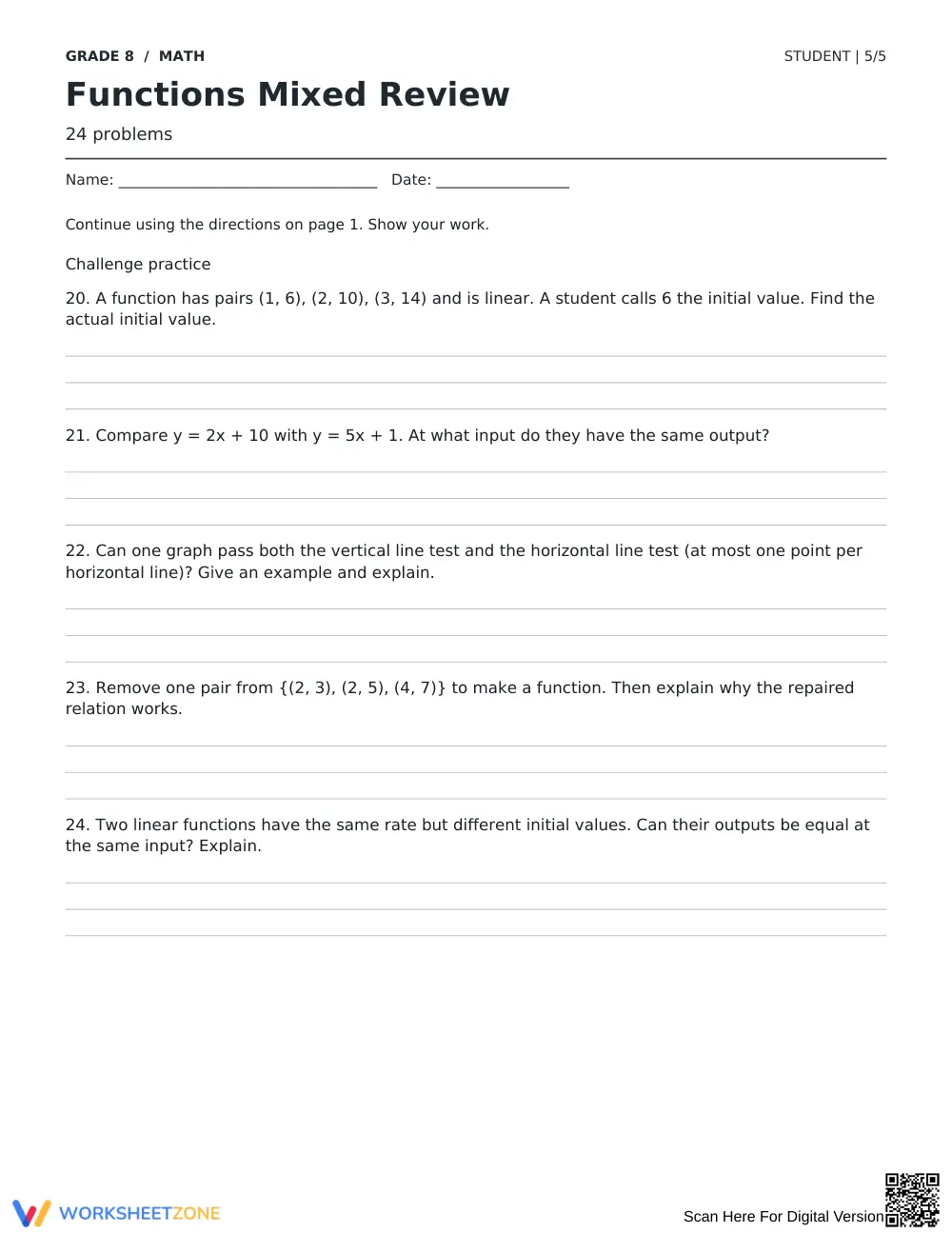

Functions Review Worksheet | Grade 8 Math Complete
Paste this activity's link or code into your existing LMS (Google Classroom, Canvas, Teams, Schoology, Moodle, etc.).
Students can open and work on the activity right away, with no student login required.
You'll still be able to track student progress and results from your teacher account.
This 5-page math worksheet strengthens Grade 8 students' ability to define, evaluate, and compare functions. Learners analyze ordered pairs, tables, graphs, and linear equations across 24 structured practice problems to build functional reasoning and algebraic fluency.
At a Glance
- Grade: 8 · Subject: Math
- Standard:
CCSS.MATH.CONTENT.8.F.A.1— Understand that a function assigns to each input exactly one output- Skill Focus: Functions identification, rate comparison, and linear equations
- Format: 5 pages · 24 problems · Answer key included · PDF
- Best For: Unit review, test prep, independent practice
- Time: 30–45 minutes
Inside this 5-page student worksheet, learners complete 24 varied problems supported by a 2-page answer key with scoring guidance. The exercises feature coordinate sets, input-output tables, Cartesian graphs, verbal rate situations, and linear equations in slope-intercept form.
Skill Progression
- Guided Practice (Foundation): Problems 1–6 reinforce inputs, outputs, simple function rules, and initial values.
- Supported Practice (Core): Problems 7–18 apply function definitions to tables, graphs, contextual word problems, and rate comparisons.
- Independent Practice (Challenge): Problems 19–24 require counterexamples, system comparisons, relation repairs, and geometric justifications.
This progression mirrors the gradual release of responsibility model, moving students from basic identification to rigorous reasoning.
Standards Alignment
The primary standard addressed is CCSS.MATH.CONTENT.8.F.A.1, which requires students to understand that a function assigns to each input exactly one output. Supporting standard CCSS.MATH.CONTENT.8.F.B.4 focuses on constructing functions to model linear relationships. Both standard codes can be copied directly into lesson plans, IEP goals, or district curriculum mapping tools.
How to Use It
Use this review after direct instruction on linear functions or as a 2-day test review packet. For formative assessment, check items 7 and 12 to identify any confusion regarding repeated inputs versus repeated outputs. Students typically finish in 30 to 45 minutes.
Who It's For
This resource is designed for eighth-grade math classes, accelerated middle school learners, and introductory algebra students. Teachers can assign the Foundation section for targeted intervention while providing the Challenge problems for advanced practice. Pair this worksheet with an anchor chart detailing the vertical line test.
Mastery of function concepts is a critical benchmark in middle school mathematics, establishing the foundation for high school algebra and STEM coursework. Under CCSS.MATH.CONTENT.8.F.A.1, eighth-grade students must conceptualize a function as a mathematical rule pairing each input with exactly one output across tables, graphs, equations, and verbal contexts. Research by Fisher & Frey (2014) highlights that structured skill progression—moving systematically from foundational recall to complex problem-solving—substantially improves student retention and conceptual transfer in mathematics. By integrating diverse representations including coordinate grids, rate comparisons, and contextual modeling, this 24-item practice set enables learners to diagnose boundary cases and articulate mathematical justifications. Consequently, educators can reliably evaluate standards mastery, address persistent misconceptions surrounding domain and range, and support students in building durable algebraic reasoning skills essential for secondary mathematics achievement and long-term academic success.


