


























1 / 2
0
Views
0
Downloads


10.0
0
Save
0 Likes
Fruit Riddles: A Fun Worksheet for Problem Solving
0 Views
0 Downloads
Paste this activity's link or code into your existing LMS (Google Classroom, Canvas, Teams, Schoology, Moodle, etc.).
Students can open and work on the activity right away, with no student login required.
You'll still be able to track student progress and results from your teacher account.
Information
Description
What It Is:
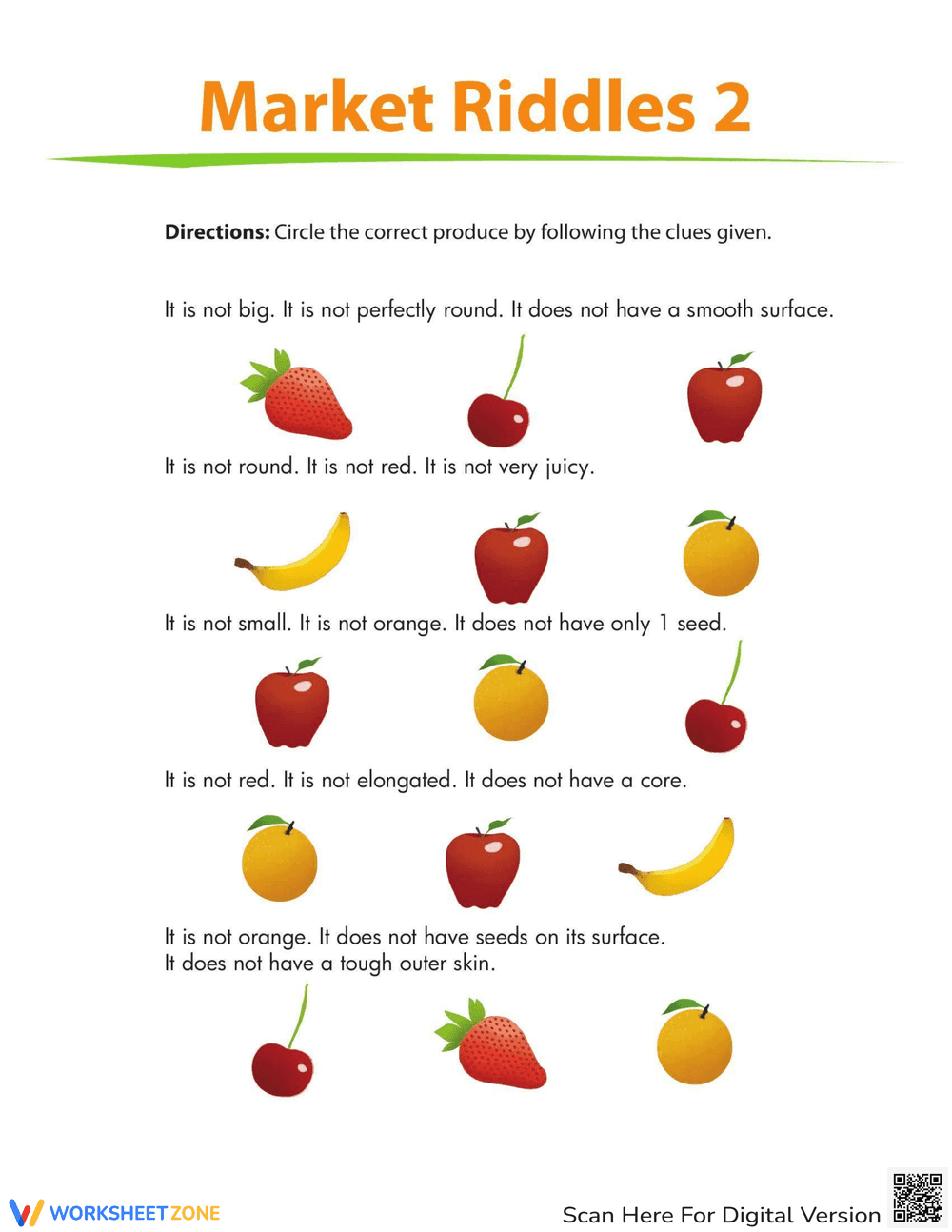
This is a worksheet titled 'Market Riddles' that challenges students to identify fruits based on descriptive clues. The worksheet presents a series of riddles, each followed by three fruit illustrations (strawberry, cherry, apple, banana, orange). Students must read the clues and circle the correct fruit that matches the description. The riddles describe the fruit's color, shape, and other characteristics.
Grade Level Suitability:
This worksheet is most suitable for Kindergarten to 2nd grade. The riddles use simple language and focus on common fruit characteristics, making it accessible to young learners. The activity promotes reading comprehension and critical thinking skills appropriate for this age group.
Why Use It:
This worksheet helps develop reading comprehension, problem-solving, and critical thinking skills. It also reinforces vocabulary related to fruits and their characteristics. The riddle format makes learning engaging and fun, encouraging students to actively participate in the activity.
How to Use It:
Read the directions aloud to the student. Then, read each riddle carefully. Encourage the student to identify key words in the riddle that describe the fruit. After reading the riddle, the student should examine the three fruit illustrations and circle the one that best matches the description.
Target Users:
This worksheet is designed for elementary school students, particularly those in kindergarten through second grade. It is also suitable for ESL learners who are learning basic vocabulary related to fruits and descriptive adjectives. It can be used in the classroom or as a supplementary activity at home.
This is a worksheet titled 'Market Riddles' that challenges students to identify fruits based on descriptive clues. The worksheet presents a series of riddles, each followed by three fruit illustrations (strawberry, cherry, apple, banana, orange). Students must read the clues and circle the correct fruit that matches the description. The riddles describe the fruit's color, shape, and other characteristics.
Grade Level Suitability:
This worksheet is most suitable for Kindergarten to 2nd grade. The riddles use simple language and focus on common fruit characteristics, making it accessible to young learners. The activity promotes reading comprehension and critical thinking skills appropriate for this age group.
Why Use It:
This worksheet helps develop reading comprehension, problem-solving, and critical thinking skills. It also reinforces vocabulary related to fruits and their characteristics. The riddle format makes learning engaging and fun, encouraging students to actively participate in the activity.
How to Use It:
Read the directions aloud to the student. Then, read each riddle carefully. Encourage the student to identify key words in the riddle that describe the fruit. After reading the riddle, the student should examine the three fruit illustrations and circle the one that best matches the description.
Target Users:
This worksheet is designed for elementary school students, particularly those in kindergarten through second grade. It is also suitable for ESL learners who are learning basic vocabulary related to fruits and descriptive adjectives. It can be used in the classroom or as a supplementary activity at home.


