




























Views
Downloads



Free Residual Sign Claims Worksheet | Grade 12 Statistics

Paste this activity's link or code into your existing LMS (Google Classroom, Canvas, Teams, Schoology, Moodle, etc.).
Students can open and work on the activity right away, with no student login required.
You'll still be able to track student progress and results from your teacher account.
Master residual‑sign interpretation and model‑fit claims with this focused Grade 12 Statistics worksheet. Students work through ten diagnostic tasks that sharpen error‑spotting, correct residual calculations, and evaluate whether a regression model meets assumptions. The activities reinforce conceptual links between algebraic formulas and graphical evidence, helping learners translate numeric residual values into meaningful statistical conclusions.
At a Glance
- Grade: 12 · Subject: Statistics
- Standard:
HSS-ID.B.6— interpret residual signs, assess model fit, and justify regression choices- Skill Focus: Correct Residual‑Sign and Fit Claims
- Format: 5 pages · 10 detailed problems · Answer key included · PDF download
- Best For: diagnostic review after a regression unit, or targeted remediation
- Time: 20–30 minutes of focused practice
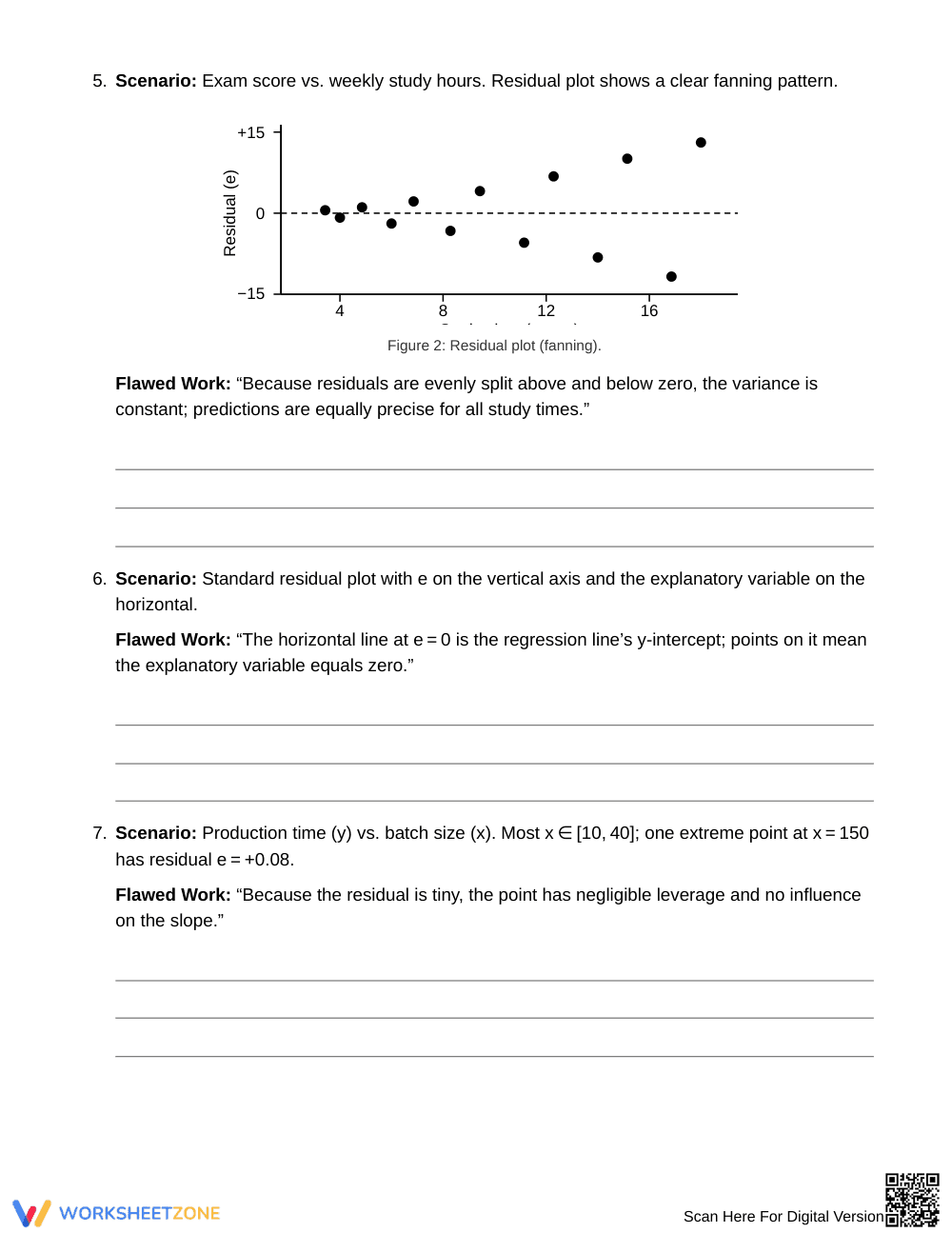
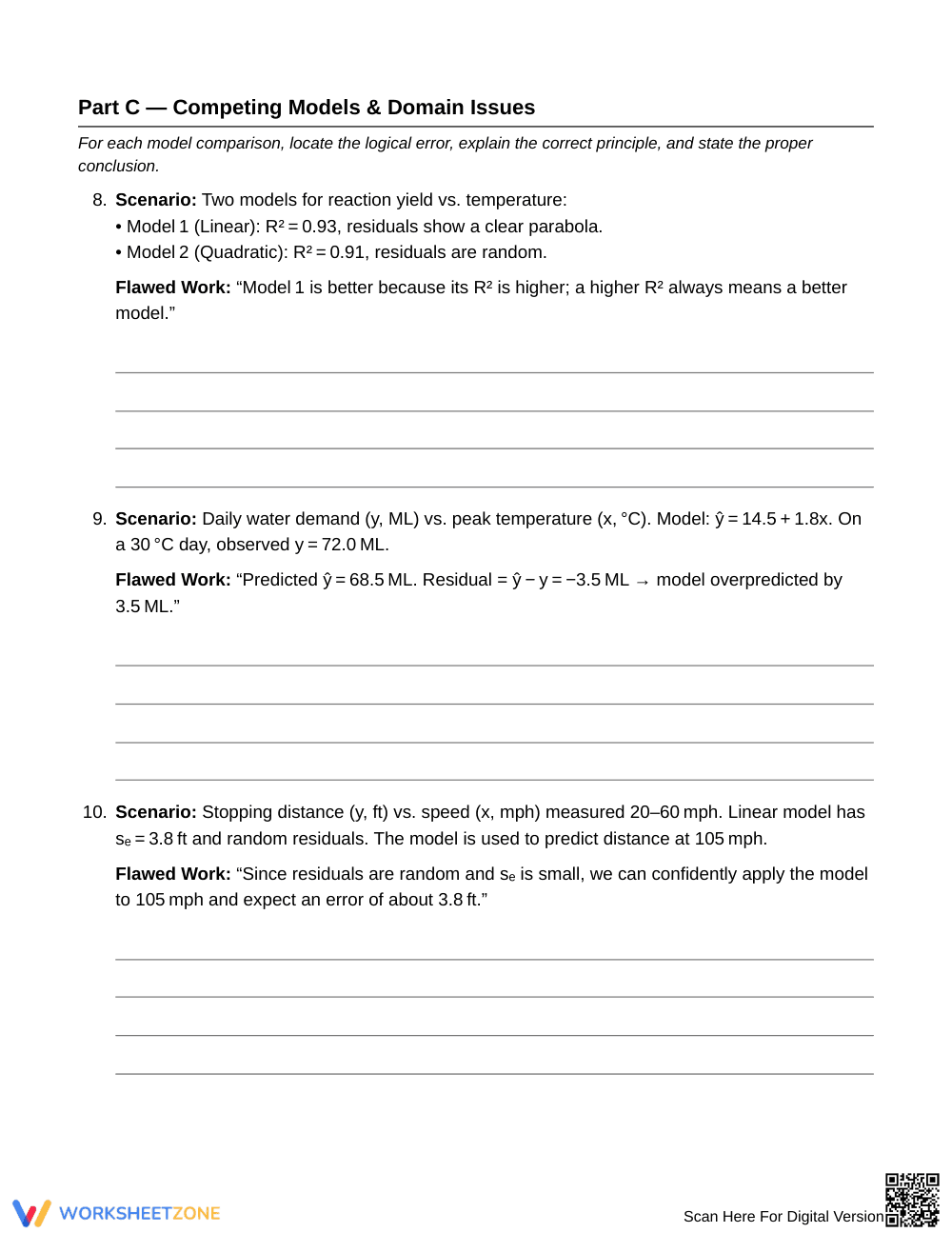
Inside the packet you’ll find three parts: Part A asks students to compute residuals and critique flawed reasoning; Part B presents residual plots that require diagnostic interpretation; Part C challenges learners to compare competing models and address domain‑specific misconceptions. Each part includes a worked example, sentence frames, and a concise answer key on the back.
Skill Progression
- Guided practice (3 tasks): teacher models residual sign calculation using a step‑by‑step example; students complete similar items with a sentence frame.
- Supported practice (4 tasks): learners work independently on mixed‑scenario problems while a word bank of key terms is provided.
- Independent practice (3 tasks): students tackle full‑scale model‑fit claims without scaffolds, demonstrating mastery of the standard.
Standards Alignment
HSS-ID.B.6 – Students interpret the meaning of residuals, assess whether residuals display random scatter, and use this information to judge the appropriateness of a regression model. This worksheet directly targets that expectation by requiring correction of sign errors, evaluation of residual plots, and justification of model choice. Both the standard code and its plain‑English description can be copied straight into lesson plans, IEP goals, or district curriculum maps.
How to Use It
Use the worksheet as a quick formative check after a direct‑instruction lesson on linear regression; collect responses to gauge which residual‑sign misconceptions persist. Alternatively, assign it as a homework “error‑analysis” activity, then review the answer key together to reinforce correct reasoning. Expected completion time is 20–30 minutes.
Who It's For
Designed for advanced‑placement Statistics students who have completed a regression unit, the tasks also serve as remediation for learners who need additional practice with residual interpretation. Pair the worksheet with a teacher‑created anchor chart of residual‑sign rules for optimal support.
Research shows that explicit error‑analysis activities improve statistical reasoning and reduce persistent misconceptions (Fisher & Frey 2014). This worksheet aligns with standard HSS‑ID.B.6, guiding students to interpret residual signs and assess model fit, while the structured progression mirrors the gradual‑release model proven to boost mastery in high‑school mathematics. By confronting common sign‑error patterns and demanding justification of model choices, teachers provide authentic evidence of student understanding that can be recorded in grade‑book rubrics or IEP progress notes. The concise answer key and clear scaffolds ensure that instruction remains focused and time‑efficient, making the resource ready for immediate classroom deployment. A meta‑analysis of AP Statistics interventions reported an average gain of 12 percentile points when students engaged in targeted residual‑diagnostic tasks (RAND AIRS 2024). Incorporating this worksheet therefore not only satisfies the Common Core expectation but also contributes growth on standardized assessments. Teachers can integrate the tasks into a 5‑minute bell‑ringer or an activity, that the alignment to HSS‑ID.B.6 provides rigor and relevance.


