


























Views
Downloads



Free Emissions Worksheet | Grade 12 Environmental Science
Paste this activity's link or code into your existing LMS (Google Classroom, Canvas, Teams, Schoology, Moodle, etc.).
Students can open and work on the activity right away, with no student login required.
You'll still be able to track student progress and results from your teacher account.
Students compare emissions and removal scenarios by calculating carbon budgets, airborne fractions, and radiative forcing, then judge which pathways keep atmospheric CO₂ under a stated limit. The worksheet builds Grade 12 quantitative reasoning with real-scale carbon cycle numbers.
At a Glance
- Grade: 12 · Subject: Environmental & Earth/Space Science
- Standard:
None assigned— students calculate carbon budgets and compare emission pathways against a CO₂ limit.- Skill Focus: Comparing emissions and removal scenarios
- Format: 5 pages · 12 problems · Answer key included · PDF
- Best For: Carbon cycle unit practice and review
- Time: 45–60 minutes
What's Inside
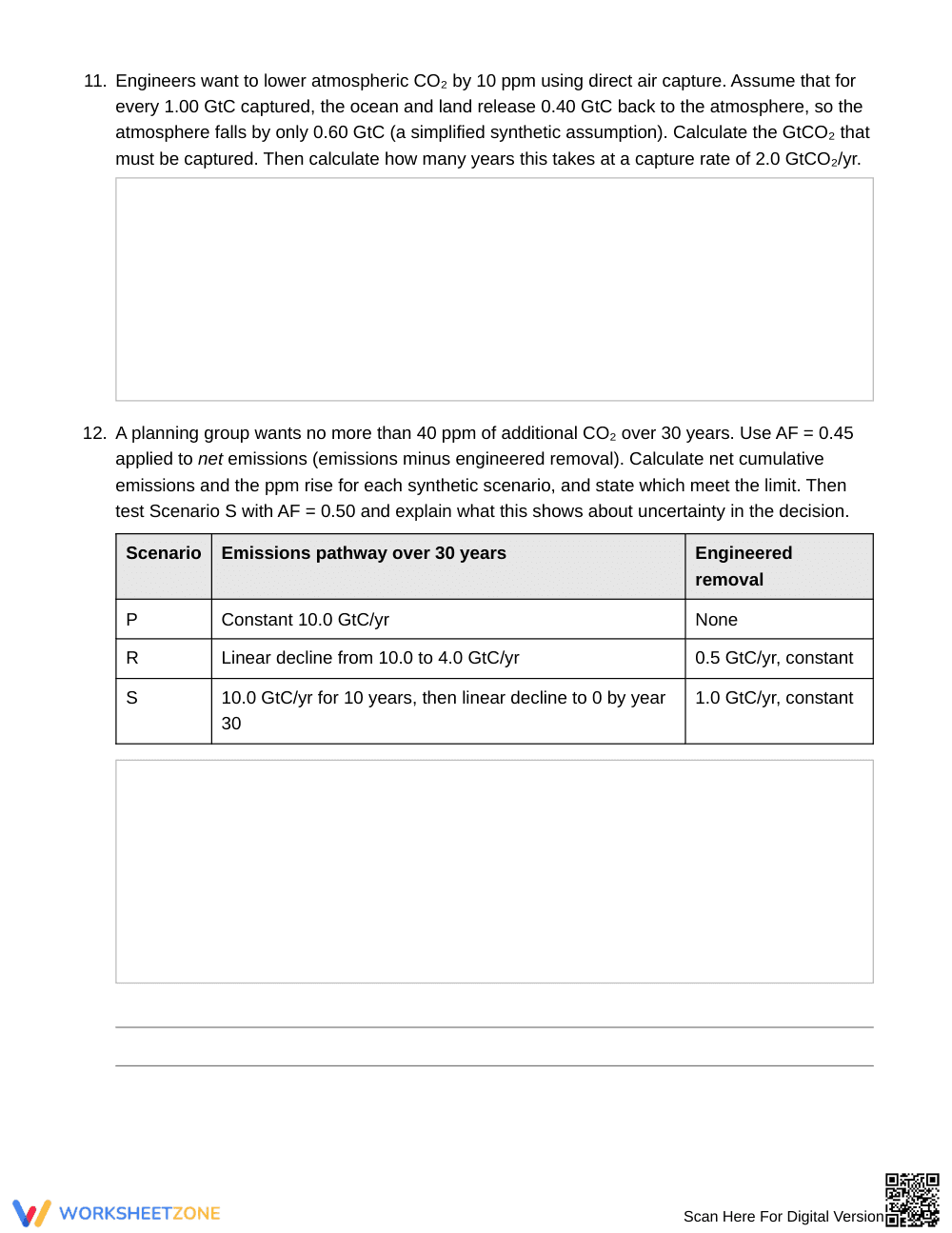
Twelve problems across 5 pages in three parts: direct calculation, multi-step budgets with proxy data and uncertainty, and application scenarios. A formula and constants box supports every part, an ice-core data table and a scenario table supply the evidence, and a full answer key shows worked results.
Skill Progression
- Guided practice (Part A, 3 problems): one formula or conversion each, with the formula box as the scaffold.
- Supported practice (Part B, 6 problems): multi-step budgets, combined uncertainty, proxy rates, and forcing, with every step shown.
- Independent practice (Part C, 3 problems): forest restoration, direct air capture, and scenario comparison, each justified with numbers.
The sequence follows gradual release: I Do, We Do, You Do.
Standards Alignment
No primary standard code was supplied for this worksheet, so none is listed. The tasks practice analyzing data, using mathematical models, and evaluating evidence about climate. Add your own state or district code when copying this resource into lesson plans, IEP goals, or curriculum mapping tools.
How to Use It
- After direct instruction: assign Parts A and B as in-class practice while you circulate.
- Unit review: assign Part C as homework or a discussion task before a carbon cycle assessment.
Formative tip: watch for students who skip unit conversions, such as ppm to GtC or GtCO₂ to GtC, before using the budget equation. Expect 45–60 minutes.
Who It's For
Grade 12 environmental, Earth, and space science students who are comfortable with logarithms and basic algebra. Students who need support can start with Parts A and B; Part C extends stronger learners. Pair it with a Keeling Curve graph or a carbon cycle diagram.
The Grade 12 Environmental & Earth/Space Science worksheet Comparing Emissions and Removal Scenarios teaches students to quantify carbon budgets and judge climate pathways with numbers. Across 12 problems and 5 pages, students convert GtCO₂ to GtC, calculate residence time, apply a 0.45 airborne fraction, propagate uncertainty, estimate radiative forcing with ΔF = 5.35 × ln(C ÷ C₀), and test whether three synthetic scenarios keep CO₂ growth under 40 ppm. No standard code is assigned. The structure follows the gradual-release model described by Fisher & Frey (2014): direct calculation first, multi-step modeling second, and decision-making under uncertainty last. An answer key is included, so teachers can check setup, units, and three-significant-figure rounding quickly. The synthetic data keep attention on method rather than on memorized values, making the resource suitable for a carbon cycle unit review, a climate data lab, or an assessment-preparation session.


