


























Views
Downloads


Free Disjoint & Independent Worksheet | Grade 12 Statistics
Paste this activity's link or code into your existing LMS (Google Classroom, Canvas, Teams, Schoology, Moodle, etc.).
Students can open and work on the activity right away, with no student login required.
You'll still be able to track student progress and results from your teacher account.
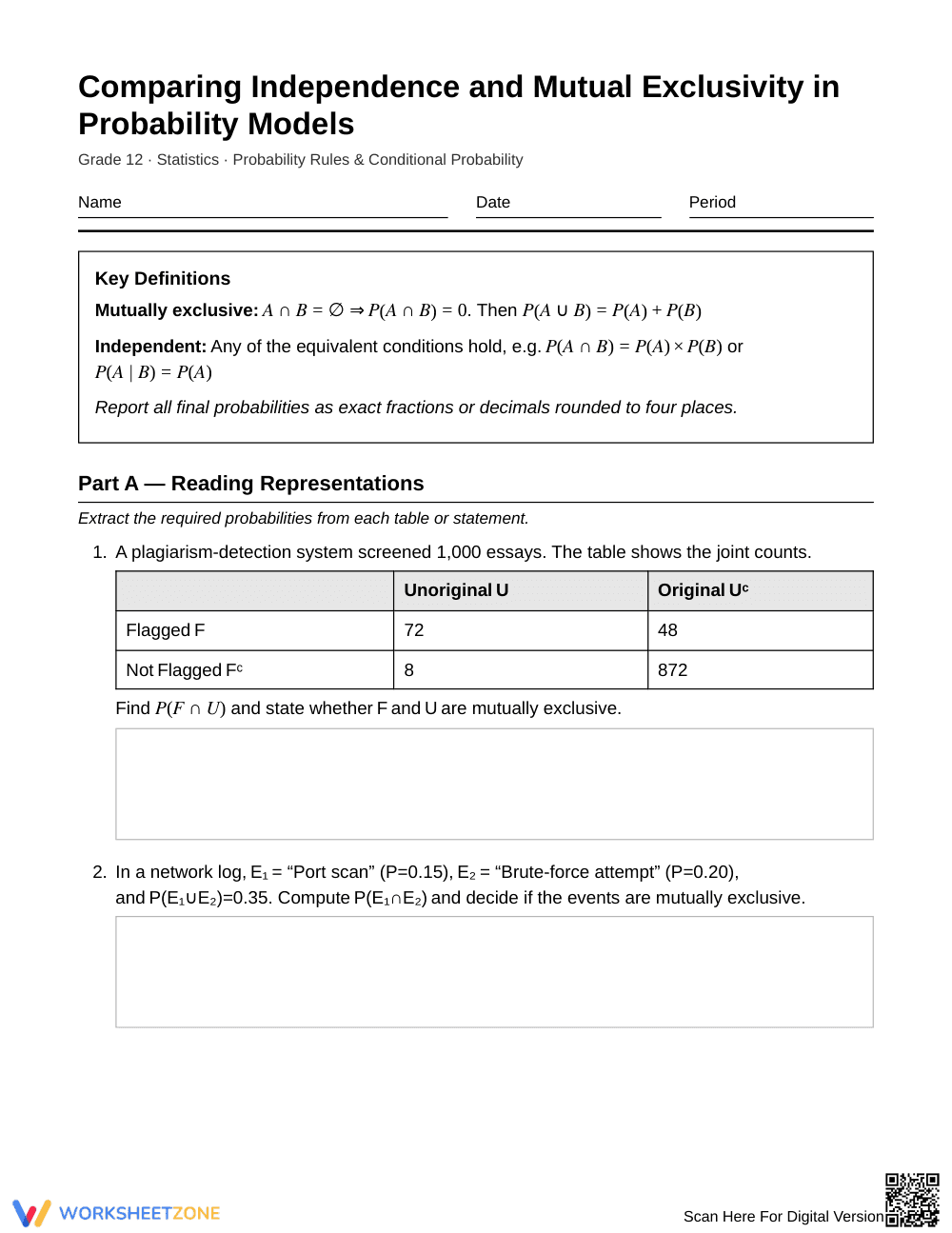
Mastering the mathematical difference between independent and mutually exclusive events is crucial for advanced probability. This Grade 12 Statistics worksheet gives students 12 targeted problems across 4 pages to extract joint values, build two-way tables, and algebraically disprove common probability fallacies. Learners resolve confusion between disjoint outcomes and statistical independence with clarity and mathematical precision.
At a Glance
- Grade: 12 · Subject: High School Statistics
- Standard: Probability Rules — Distinguish independent events from mutually exclusive events using formal conditional probability rules
- Skill Focus: Compare Independence and Mutual Exclusivity
- Format: 4 pages · 12 problems · Answer key included · PDF
- Best For: AP Statistics exam prep and post-lecture review
- Time: 45–60 total minutes
This four-page worksheet features twelve structured exercises organized into three progressive sections. Students interpret real-world contexts including plagiarism software, cybersecurity network logs, baggage security scanners, and factory defect audits. The activity incorporates reference formula boxes, two-way contingency table construction, conceptual multiple-choice items, and an exhaustive two-page step-by-step answer key for rapid verification.
Skill Progression
- Guided Practice (Part A, 3 problems): Students consult explicit definition boxes to calculate intersections and conditional probabilities from contingency tables and scenario descriptions with structured prompts.
- Supported Practice (Part B, 6 problems): Learners construct two-way frequency tables, test independence conditions, and evaluate conditional relationships across manufacturing and spam filter contexts.
- Independent Practice (Part C, 3 problems): Students deconstruct authentic peer fallacies, critique technical claims, and write algebraic proofs showing when events can simultaneously satisfy both conditions.
This sequence mirrors the gradual-release model, shifting learners from guided extraction to rigorous independent mathematical critique.
Standards Alignment
This resource reinforces core advanced high school statistics learning goals governing conditional probability and independence rules. Students verify whether P(A|B) equals P(A) and evaluate the intersection condition P(A ∩ B) = P(A)P(B) against the disjoint condition P(A ∩ B) = 0. Both standard descriptions can be copied directly into lesson plans, IEP goals, or district curriculum mapping tools.
How to Use It
Deploy this worksheet after direct instruction on the general multiplication rule or as an intensive AP Statistics review session before unit exams. During class, monitor how students approach Part B, Question 3; watch for learners who mistakenly assume mutually exclusive events have no influence on one another rather than recognizing that exclusivity guarantees strong dependence. Expect 45 to 60 minutes for comprehensive student completion.
Who It's For
Designed for Grade 12 Statistics and AP Probability students, this resource suits both standard and accelerated classrooms. For students needing support, the Part A definition box provides an immediate procedural scaffold, while Part C offers high-level extension for advanced thinkers. Pair this printable with a two-way frequency table anchor chart during small-group remediation.
High school statistics instruction frequently encounters a persistent student misconception: conflating mutually exclusive events with independent events. This practice resource targets that conceptual challenge through structured analytical tasks requiring learners to evaluate conditional probabilities, complete contingency tables, and verify independence algebraically. According to research from Fisher & Frey (2014) on purposeful instructional design, scaffolded shifts from worked representations to unprompted fallacy evaluation significantly improve conceptual retention in advanced mathematics. When twelfth-grade students calculate joint probabilities from two-way tables before formally proving why non-zero mutually exclusive events must be strongly dependent, they develop rigorous probabilistic reasoning rather than relying on flawed intuitive heuristics. This four-page resource establishes clear operational boundaries between intersection emptiness and multiplicative independence across twelve focused problems. Consequently, educators gain reliable formative data to confirm student readiness for advanced statistical inference and college-level probability models.


