




























Views
Downloads




Free Constant-Rate Models Worksheet | Grade 9 Algebra I

Paste this activity's link or code into your existing LMS (Google Classroom, Canvas, Teams, Schoology, Moodle, etc.).
Students can open and work on the activity right away, with no student login required.
You'll still be able to track student progress and results from your teacher account.
This worksheet helps Grade 9 Algebra I students decide when a constant-rate model stops fitting a situation. Students test linear models against impossible values and real-looking data, identify exponential patterns, and then build a valid model of their own.
At a Glance
- Grade: 9 · Subject: Algebra I
- Standard:
HSF-LE.A.1— Tell linear situations from exponential ones and justify the choice- Skill Focus: Determine when a constant-rate model is inadequate
- Format: 5 pages · 6 problems · Answer key included · PDF
- Best For: Rate of change unit practice
- Time: 35–45 minutes
What's Inside
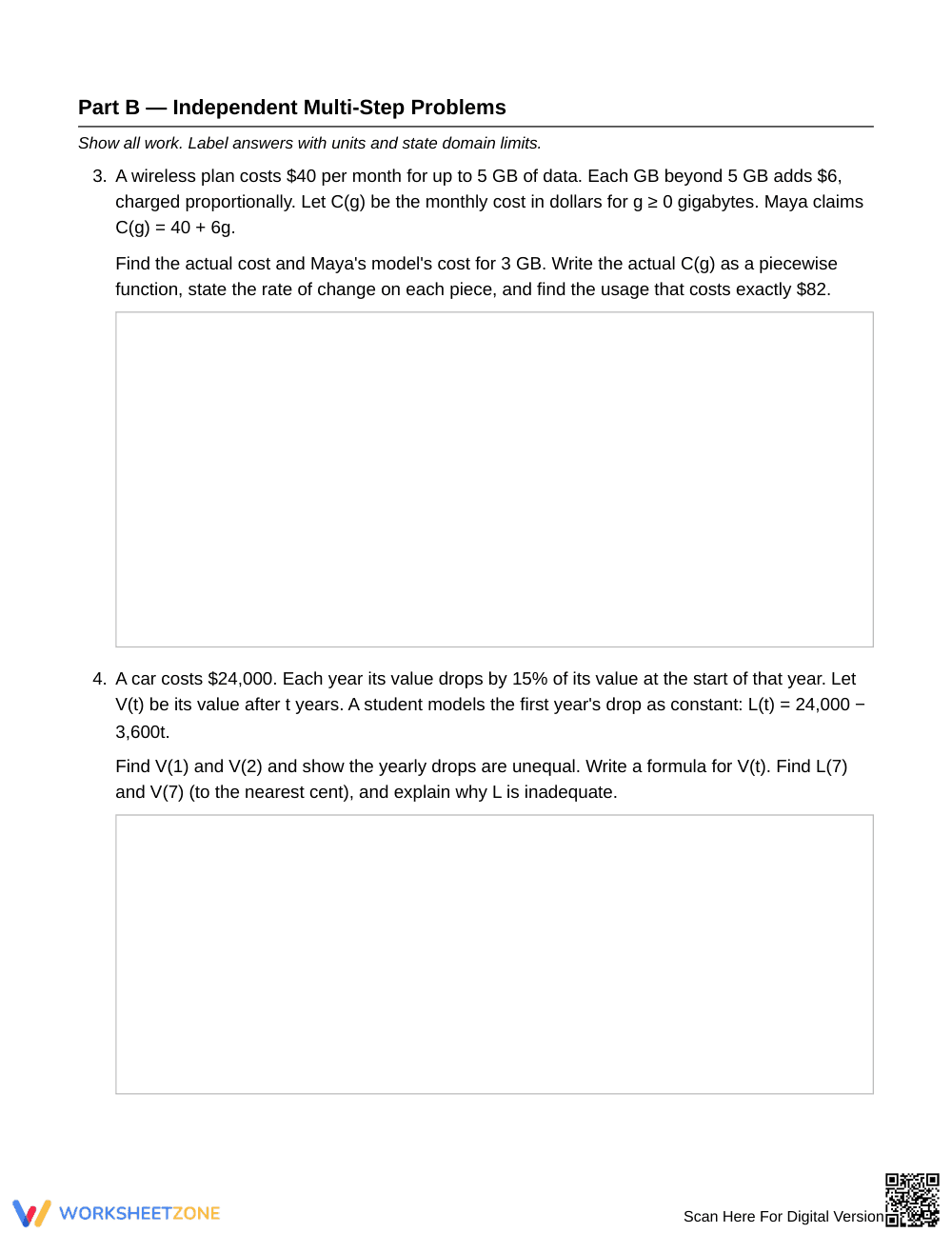
The 5-page packet contains 6 tasks in three parts, plus a 2-page answer key. A definitions box states the constant-rate rule, answer conventions, and domain notation. Tasks include a fill-in tank model, a completed difference-and-ratio table, a piecewise data plan, a depreciation problem, a seedling graph, and a construction task with five required components.
Skill Progression
- Guided practice: Part A, 2 problems with fill-in steps, a table, and a one-sentence explanation.
- Supported practice: Part B, 3 multi-step problems with named functions and a definitions box to check work.
- Independent practice: Part C, 1 construction task requiring context, formula, domain, algebraic proof, and a failure case.
The sequence follows gradual release: I Do, We Do, You Do.
Standards Alignment
HSF-LE.A.1 asks students to distinguish situations modeled by linear functions from those modeled by exponential functions, including recognizing that linear functions change by equal differences over equal intervals and exponential functions by equal factors. The standard code can be copied directly into lesson plans, IEP goals, or district curriculum mapping tools.
How to Use It
Use it after direct instruction on linear and exponential functions: assign Part A as a guided check, then Part B as independent work. You can also use Parts B and C as a unit review before a test. While students work, watch whether they compute both differences and ratios before choosing a model. Expect 35–45 minutes for all three parts.
Who It's For
Built for Grade 9 Algebra I students who can write linear equations and are ready to question them. Students who need support can complete Part A first and rely on the definitions box; advanced students can extend their work in Part C. Pair it with an anchor chart comparing equal differences and equal factors.
HSF-LE.A.1 asks students to distinguish linear from exponential situations, and this Grade 9 Algebra I worksheet practices that skill by having students determine when a constant-rate model is inadequate. Across 6 tasks, students compute differences and ratios, find impossible outputs such as negative tank volume, write piecewise and exponential formulas, and construct their own linear model with a stated domain and a justified failure point. The packet runs 5 pages with a 2-page answer key. Research on instructional practice, including Fisher & Frey (2014), supports structured gradual release, in which teachers move from modeling to guided work to independent application. This worksheet follows that sequence, moving from fill-in steps to multi-step problems to open construction. It fits a Slope & Rate of Change unit, takes about 35 to 45 minutes, and gives teachers concrete evidence of whether students can justify a model choice with numbers rather than guess.


