


























Views
Downloads



Free Conic Transformations Worksheet | Grade 12 Precalculus
Paste this activity's link or code into your existing LMS (Google Classroom, Canvas, Teams, Schoology, Moodle, etc.).
Students can open and work on the activity right away, with no student login required.
You'll still be able to track student progress and results from your teacher account.
This Grade 12 Precalculus worksheet equips students to master conic section transformations and focal locus constraints through rigorous analytic geometry. Learners derive Cartesian equations for parabolas, ellipses, and hyperbolas using focus, directrix, and eccentricity parameters before solving advanced real-world navigation and acoustics models.
At a Glance
- Grade: 12 · Subject: Precalculus
- Standard:
Analytic Geometry— Derive equations of conic sections using focal loci and directrices- Skill Focus: Mix Transformations and Focal Constraints
- Format: 6 pages · 16 problems · Answer key included · PDF
- Best For: Advanced analytic geometry practice
- Time: 60–90 minutes
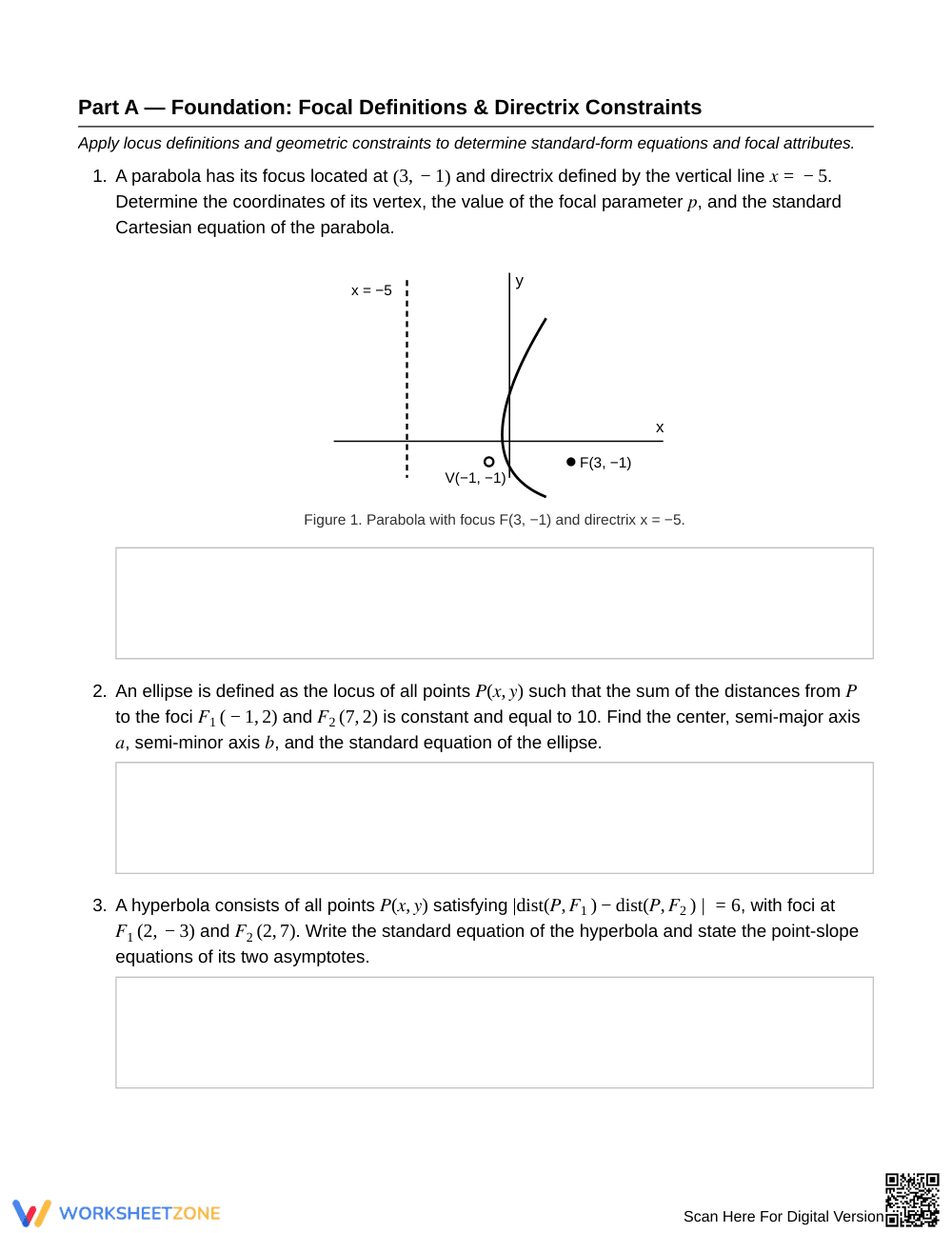
Spanning 6 comprehensive student pages with a matching 6-page complete solution key, this resource delivers 16 multi-step analytic geometry problems. It features a foundational reference box detailing unified eccentricity definitions and standard focal formulas, labeled geometric coordinate diagrams, algebraic completing-the-square exercises, and multi-part applied modeling tasks including LORAN radio hyperbolic lines of position and parabolic solar concentrators.
Skill Progression
- Guided practice (Problems 1–4): Students apply explicit locus formulas and directrix parameters to establish foundational standard equations for vertical and horizontal conics using clear reference cues.
- Supported practice (Problems 5–12): Learners navigate complex parameter constraints, completing the square for general second-degree forms and calculating eccentricities, co-vertices, and latus rectum dimensions with reduced scaffolding.
- Independent practice (Problems 13–16): Students independently resolve multi-part non-standard applications, including whispering galleries, parabolic reflectors, and simultaneous confocal systems.
This structured progression reflects the gradual-release instructional framework, guiding advanced learners from direct geometric locus definitions to unassisted non-routine modeling.
Standards Alignment
This resource aligns with high school analytic geometry standards requiring students to derive the equations of ellipses and hyperbolas given foci using the distance formula, and to construct parabolas from focus and directrix loci. In addition, the material supports advanced standards for graphing conic sections, transforming polynomial relations, and interpreting conic models in physical systems. Both standard codes can be copied directly into lesson plans, IEP goals, or district curriculum mapping tools.
How to Use It
Deploy this worksheet after direct instruction on locus definitions or as an intensive unit review across two 45-minute blocks. For formative assessment, examine student work on Part B to verify whether learners identify transverse axes correctly before attempting algebraic substitutions. Expected completion time spans 60 to 90 minutes.
Who It's For
Designed for Grade 12 Precalculus and honors mathematics students, this resource offers targeted enrichment for college-bound learners preparing for STEM pathways. Provide students requiring differentiation with an annotated locus sketch sheet, and pair these exercises with interactive dynamic geometry software lessons exploring focal beam reflections.
Mastering conic section transformations and focal constraints demands systematic synthesis of coordinate algebra and locus definitions. According to Fisher & Frey (2014), intentional scaffolding within complex STEM domains ensures students successfully transfer procedural fluency into independent problem-solving capabilities. This 6-page Grade 12 Precalculus worksheet structures that instructional trajectory through 16 rigorous exercises spanning parabolic directrices, elliptical whispering galleries, and hyperbolic navigation models. By transitioning learners through guided locus derivations, completing-the-square methods, and confocal systems, the resource reinforces conceptual understanding of second-degree relations while meeting rigorous analytic geometry standards. The accompanying 6-page answer key provides step-by-step verification, supporting educators in conducting targeted error analysis and diagnosing misunderstandings regarding focal parameters, eccentricity ratios, and axis orientation. Consequently, students cultivate the spatial reasoning and algebraic precision required for advanced calculus coursework and collegiate STEM disciplines.


