


























Views
Downloads


Free Conditional Probability Worksheet | Grade 12 Statistics
Paste this activity's link or code into your existing LMS (Google Classroom, Canvas, Teams, Schoology, Moodle, etc.).
Students can open and work on the activity right away, with no student login required.
You'll still be able to track student progress and results from your teacher account.
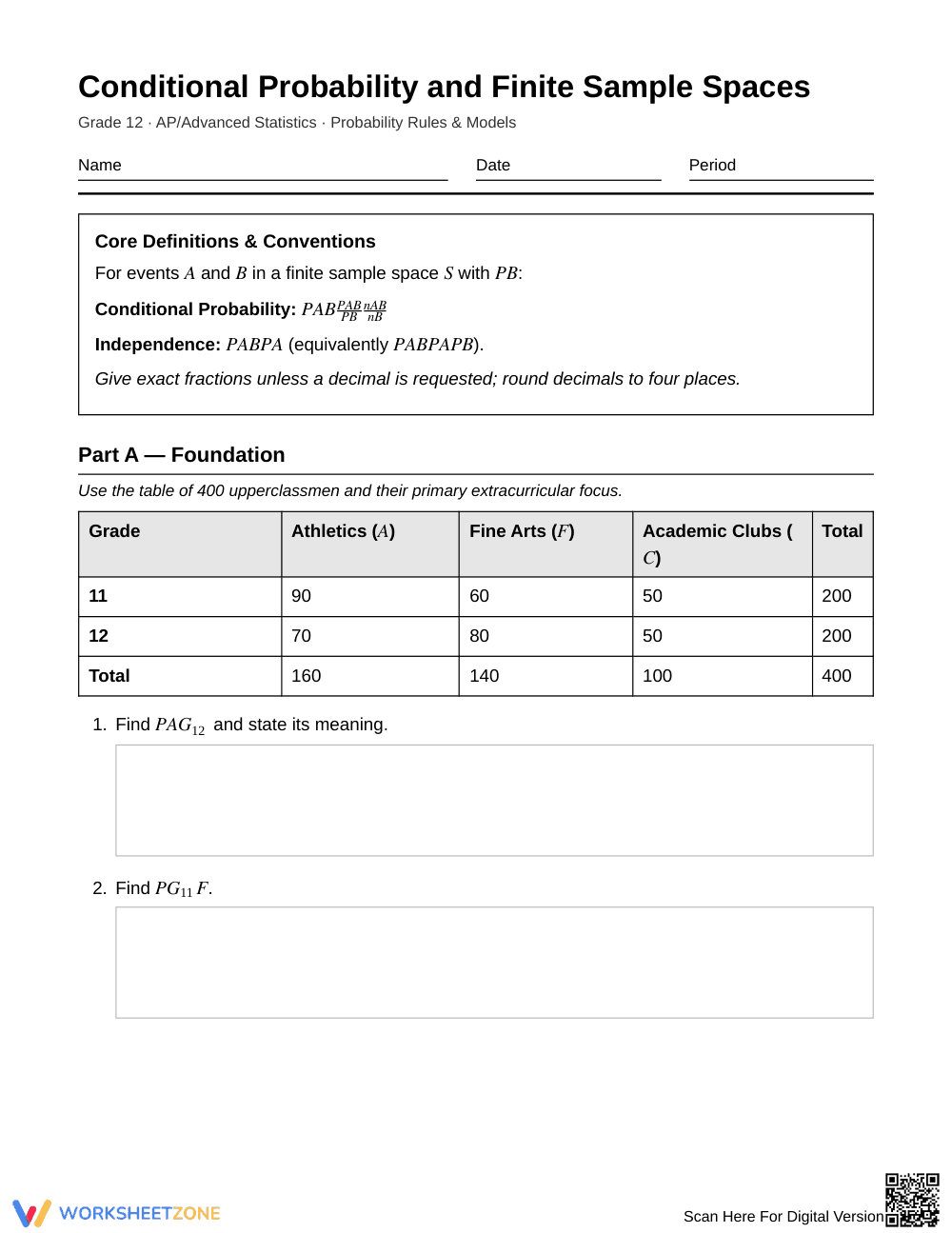
This advanced statistics worksheet provides students with targeted practice calculating conditional probabilities, analyzing contingency tables, and testing event independence. Across 16 structured exercises, high school learners progress from basic restricted sample spaces to multi-stage diagnostic models, building probabilistic reasoning and quantitative fluency for college-level statistics.
At a Glance
- Grade: 12 · Subject: Statistics
- Standard: Advanced Statistics — Calculate conditional probabilities and test event independence
- Skill Focus: Conditional Probability & Independence
- Format: 4 pages · 16 problems · Answer key included · PDF
- Best For: AP Statistics probability review
- Time: 45–60 minutes
What's Inside
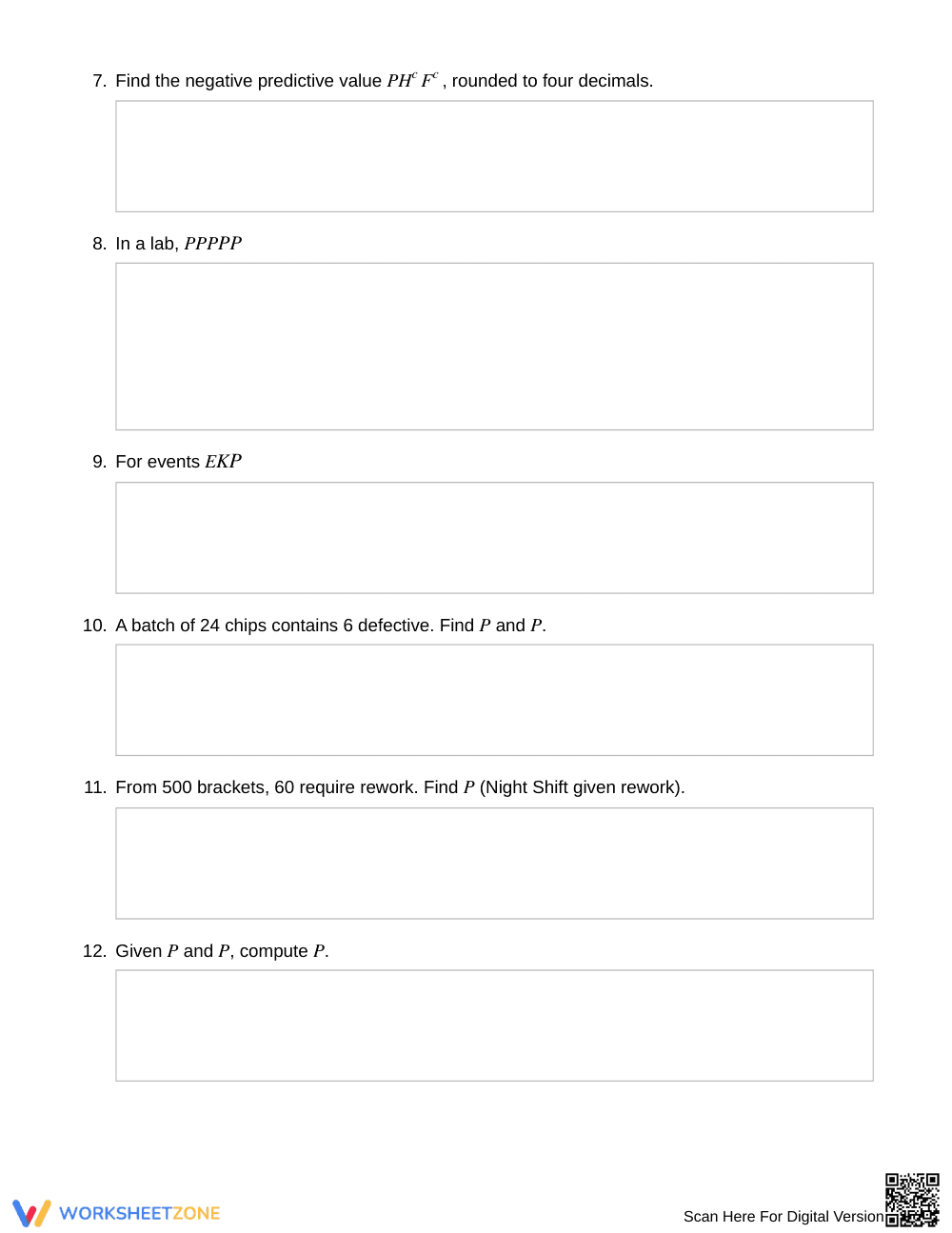
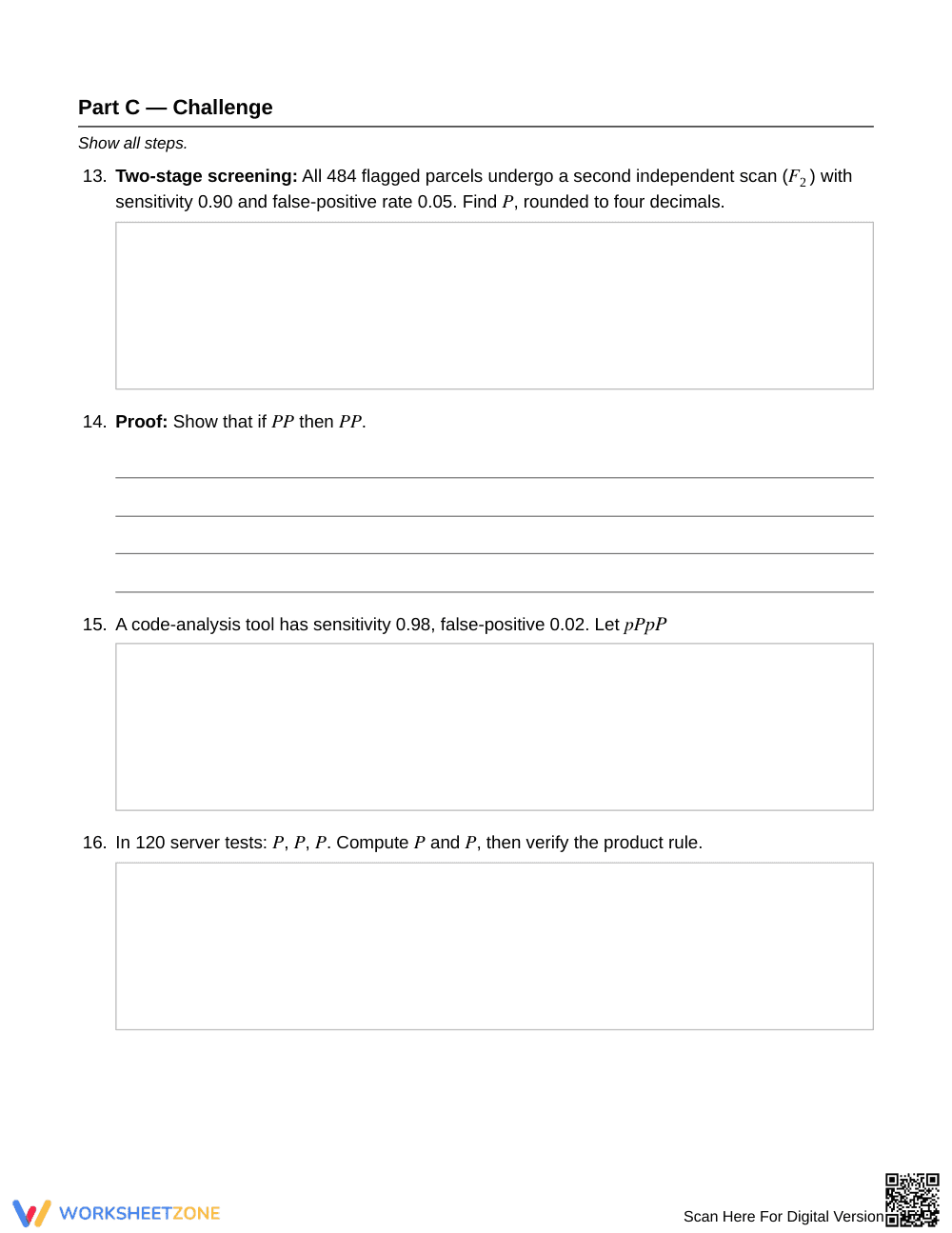
The 4-page resource includes 16 mathematical tasks with core definition boxes and probability formulas. Students analyze contingency tables, diagnostic test parameters (sensitivity and false-positive rates), and symbolic proofs. A 2-page answer key provides exact fractions, four-decimal values, and algebraic justifications.
Skill Progression
- Guided Practice (Part A, 4 problems): Uses a 400-student table to establish restricted sample spaces, compute basic conditional values, and test independence.
- Supported Practice (Part B, 8 problems): Applies formulas to 10,000-parcel screening data, positive predictive values, laboratory unions, and sampling scenarios.
- Independent Practice (Part C, 4 problems): Challenges students with two-stage screening models, algebraic independence proofs, and sensitivity threshold derivations.
This progression follows the gradual-release framework, moving learners from visual table interpretation to abstract analytical problem-solving.
Standards Alignment
This resource aligns with high school advanced statistics standards for conditional probability. Students compute probabilities from tables and formulas, evaluate predictive values, and test independence. These standard objectives integrate directly into lesson plans, IEP goals, or district curriculum mapping tools.
How to Use It
Assign Parts A and B during a 45-minute workshop period following direct instruction on conditional formulas, using Part C for extension pods. Formative assessment tip: verify that students restrict denominators to the given condition in Part A rather than the whole population. Total completion time is 45 to 60 minutes.
Who It's For
This resource is tailored for Grade 12 AP Statistics and advanced probability students. It supports differentiation by reinforcing core mechanics in Parts A and B while offering theoretical challenges in Part C. Pair this worksheet with two-way contingency table slides or a probability tree diagram.
Mastering conditional probability requires students to understand sample space restriction, conditional notation, and independence verification across empirical tables and theoretical models. Research by Fisher & Frey (2014) demonstrates that structured gradual-release frameworks—scaffolding instruction from guided table analysis to independent algebraic proofs—significantly enhance complex mathematical problem-solving and retention. This 16-problem Grade 12 Statistics resource provides structured opportunities to compute conditional probabilities, evaluate diagnostic test accuracy through positive predictive values, and prove mathematical properties of independent events. By progressing systematically from basic categorical tables through two-stage diagnostic screening and formal algebraic proofs, the worksheet reinforces essential quantitative reasoning skills. Educators can utilize these 4 pages of focused practice to build conceptual fluency, diagnose student misconceptions regarding restricted sample spaces, and ensure full alignment with advanced high school and introductory collegiate probability curricula.


