


























Views
Downloads


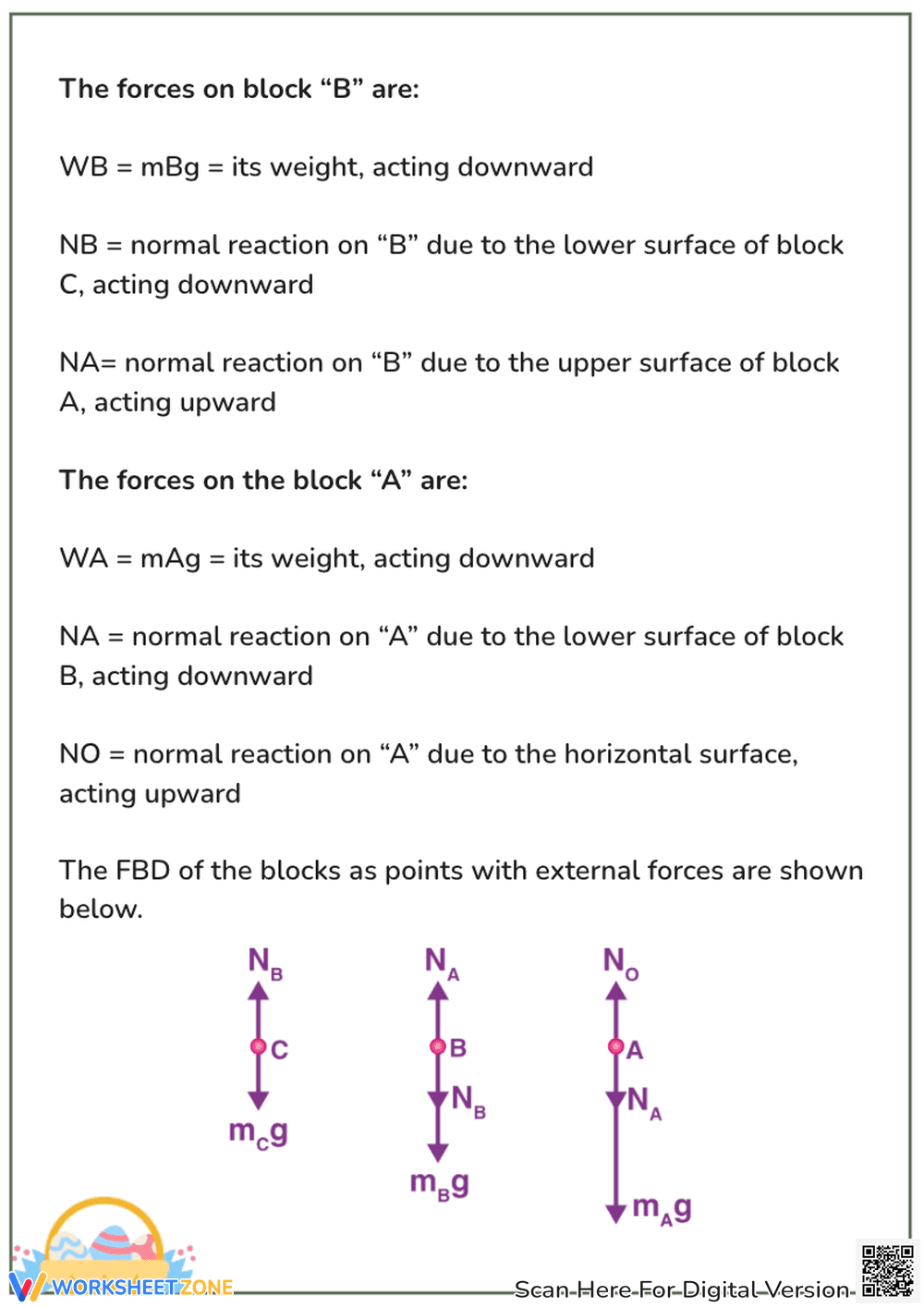

Free Body Diagram Guide | Grade 12 Physics Essential
Paste this activity's link or code into your existing LMS (Google Classroom, Canvas, Teams, Schoology, Moodle, etc.).
Students can open and work on the activity right away, with no student login required.
You'll still be able to track student progress and results from your teacher account.
This Grade 12 physics resource provides a comprehensive walkthrough for constructing free body diagrams in multi-body systems. By examining three stacked blocks, students learn to isolate individual components and identify interaction forces like gravity and normal reaction. It serves as a foundational reference for mastering Newtonian mechanics and equilibrium analysis.
At a Glance
- Grade: 12 · Subject: Physics
- Standard:
HS-PS2-1— Analyze net forces and motion relationships in macroscopic physical systems- Skill Focus: Multi-body Free Body Diagrams
- Format: 3 pages · 1 complex solved example · Answer key included · PDF
- Best For: Physics lecture reference or independent study
- Time: 15–20 minutes
The 3-page PDF contains a detailed visual breakdown of a classic stacked block physics problem. It includes a clear diagram of the physical setup, followed by isolated vector diagrams for each of the three blocks. Each force is labeled with standard notation and accompanied by a text-based explanation of the force's origin and direction, ensuring students understand the relationship between contact surfaces and gravitational pull.
- Guided Practice: The resource begins with a visual representation of the entire system to establish context and identify the three distinct masses.
- Supported Practice: Page two provides the initial decomposition of forces for the top and middle blocks, defining normal reactions and weight vectors.
- Independent Practice: The final page concludes the system analysis with the base block and ground interactions, allowing students to verify their own mental models.
This gradual-release approach ensures students understand the logic behind every vector before moving to complex calculations.
This resource aligns with HS-PS2-1, which requires students to analyze data to support claims about Newton’s Second Law. By identifying all forces acting on a system, students can calculate net force and predict acceleration. Both standard codes can be copied directly into lesson plans, IEP goals, or district curriculum mapping tools.
Use this as a worked example during direct instruction when introducing Newton's Third Law pairs and normal forces. It is also an excellent formative-assessment tool; ask students to predict the FBD for the middle block before revealing the solution page. Expected completion for a thorough review is 15 to 20 minutes.
Designed for Grade 11 and 12 Physics students, particularly those preparing for AP Physics 1 or introductory college mechanics. It pairs naturally with a lab activity involving force sensors or a textbook chapter on static equilibrium and contact forces in vertical systems.
According to the RAND AIRS 2024 report on STEM instructional materials, high-quality worked examples are critical for reducing cognitive load when students encounter complex multi-step physics problems. This resource addresses the specific challenge of identifying internal versus external forces in a system of three interacting masses. By explicitly labeling the normal reaction forces and gravitational components, the worksheet provides the scaffolding necessary for students to transition from conceptual understanding to mathematical modeling. Research from Fisher & Frey (2014) emphasizes that visual representations like these Free Body Diagrams (FBDs) are essential for students to internalize the vector nature of forces. This Grade 12 guide ensures that the standard HS-PS2-1 is met through rigorous, clear, and accurate scientific modeling, making it a reliable tool for both classroom instruction and independent student review.


