


























1 / 2
0
Views
0
Downloads

0.0
0
Save
0 Likes
Share
Introduction to Free Body Diagram
0 Views
0 Downloads
Paste this activity's link or code into your existing LMS (Google Classroom, Canvas, Teams, Schoology, Moodle, etc.).
Students can open and work on the activity right away, with no student login required.
You'll still be able to track student progress and results from your teacher account.
Information
Description
What It Is:
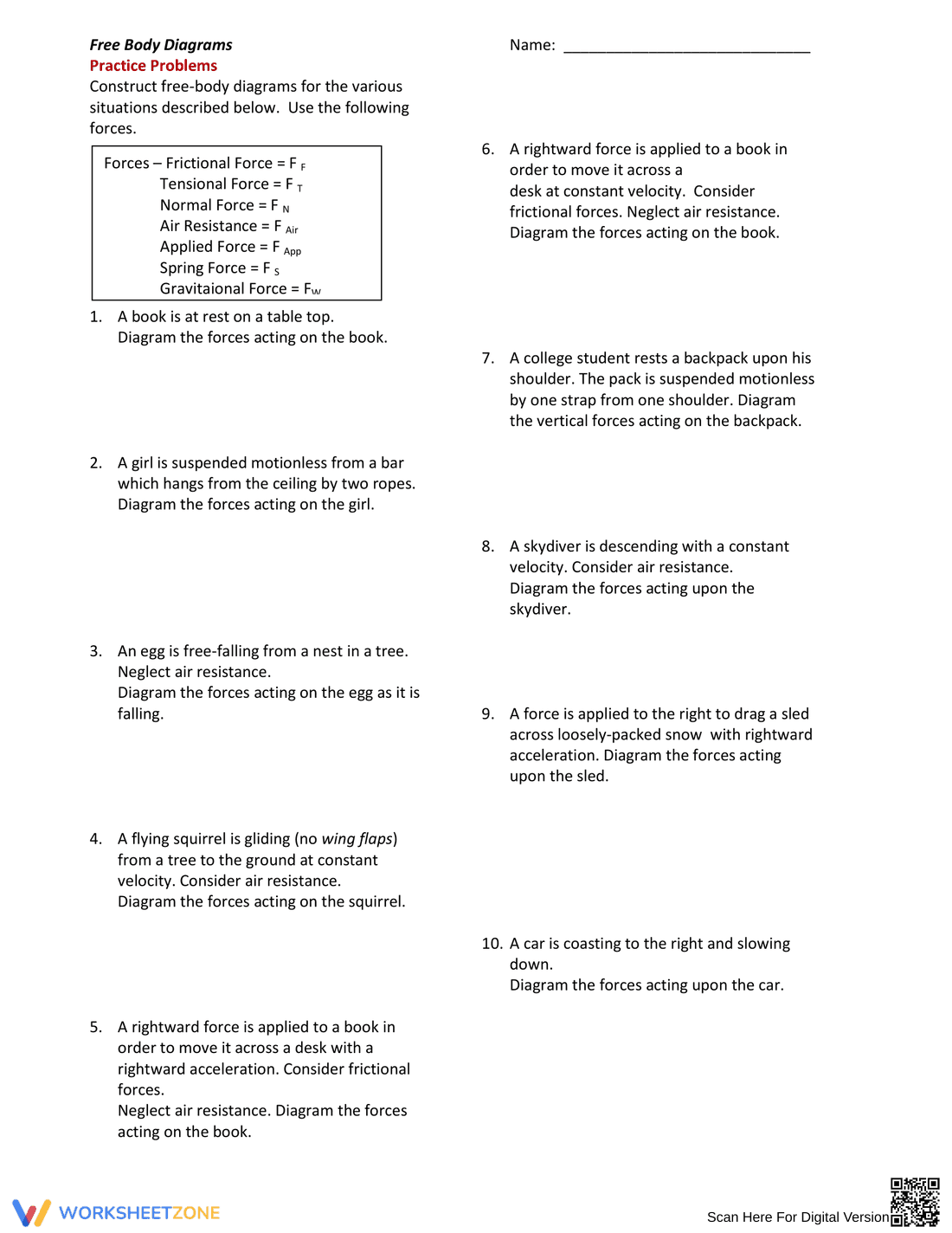
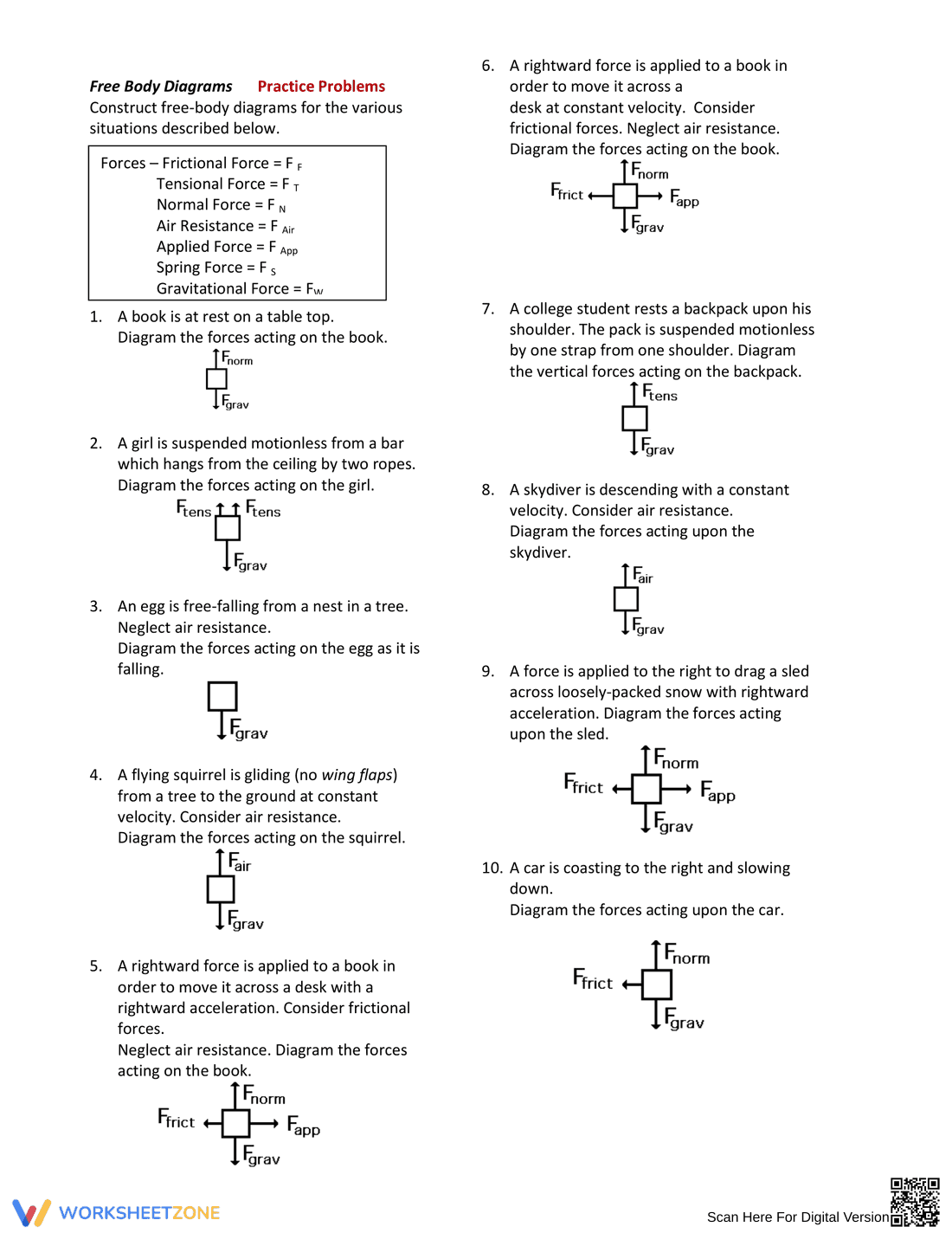
This is a physics worksheet focusing on free-body diagrams. It presents ten different scenarios, such as a book at rest on a table, a girl suspended from a bar, a falling egg, a gliding squirrel, a book being pushed across a desk, a book moving at constant velocity, a student with a backpack, a skydiver, a sled being pulled across snow, and a coasting car. Students are instructed to construct free-body diagrams for each scenario, using the provided list of forces: Frictional Force, Tensional Force, Normal Force, Air Resistance, Applied Force, Spring Force, and Gravitational Force.
Grade Level Suitability:
This worksheet is suitable for high school physics, specifically grades 9-12. It requires an understanding of forces, motion, and the ability to represent these concepts visually through free-body diagrams. The scenarios presented range in complexity, making it appropriate for students learning or practicing these concepts.
Why Use It:
This worksheet provides practical application of physics concepts related to forces. It helps students visualize and analyze the forces acting on objects in various real-world situations. By creating free-body diagrams, students develop a deeper understanding of force interactions and their impact on motion. It reinforces the ability to identify relevant forces and represent them accurately.
How to Use It:
Students should read each scenario carefully and identify all the forces acting on the object described. They should then draw a free-body diagram, representing the object as a point and drawing arrows to represent the magnitude and direction of each force. They should label each force using the provided force notations (e.g., Ff for Frictional Force).
Target Users:
The target users are high school physics students who are learning about forces and motion. It is also suitable for students reviewing these concepts or preparing for physics exams. Teachers can use this worksheet as an in-class activity, homework assignment, or as part of a test.
This is a physics worksheet focusing on free-body diagrams. It presents ten different scenarios, such as a book at rest on a table, a girl suspended from a bar, a falling egg, a gliding squirrel, a book being pushed across a desk, a book moving at constant velocity, a student with a backpack, a skydiver, a sled being pulled across snow, and a coasting car. Students are instructed to construct free-body diagrams for each scenario, using the provided list of forces: Frictional Force, Tensional Force, Normal Force, Air Resistance, Applied Force, Spring Force, and Gravitational Force.
Grade Level Suitability:
This worksheet is suitable for high school physics, specifically grades 9-12. It requires an understanding of forces, motion, and the ability to represent these concepts visually through free-body diagrams. The scenarios presented range in complexity, making it appropriate for students learning or practicing these concepts.
Why Use It:
This worksheet provides practical application of physics concepts related to forces. It helps students visualize and analyze the forces acting on objects in various real-world situations. By creating free-body diagrams, students develop a deeper understanding of force interactions and their impact on motion. It reinforces the ability to identify relevant forces and represent them accurately.
How to Use It:
Students should read each scenario carefully and identify all the forces acting on the object described. They should then draw a free-body diagram, representing the object as a point and drawing arrows to represent the magnitude and direction of each force. They should label each force using the provided force notations (e.g., Ff for Frictional Force).
Target Users:
The target users are high school physics students who are learning about forces and motion. It is also suitable for students reviewing these concepts or preparing for physics exams. Teachers can use this worksheet as an in-class activity, homework assignment, or as part of a test.


