


























0
Views
0
Downloads

0.0
0
Save
0 Likes
Share
Free Body Diagram Examples
0 Views
0 Downloads
Paste this activity's link or code into your existing LMS (Google Classroom, Canvas, Teams, Schoology, Moodle, etc.).
Students can open and work on the activity right away, with no student login required.
You'll still be able to track student progress and results from your teacher account.
Information
Description
What It Is:
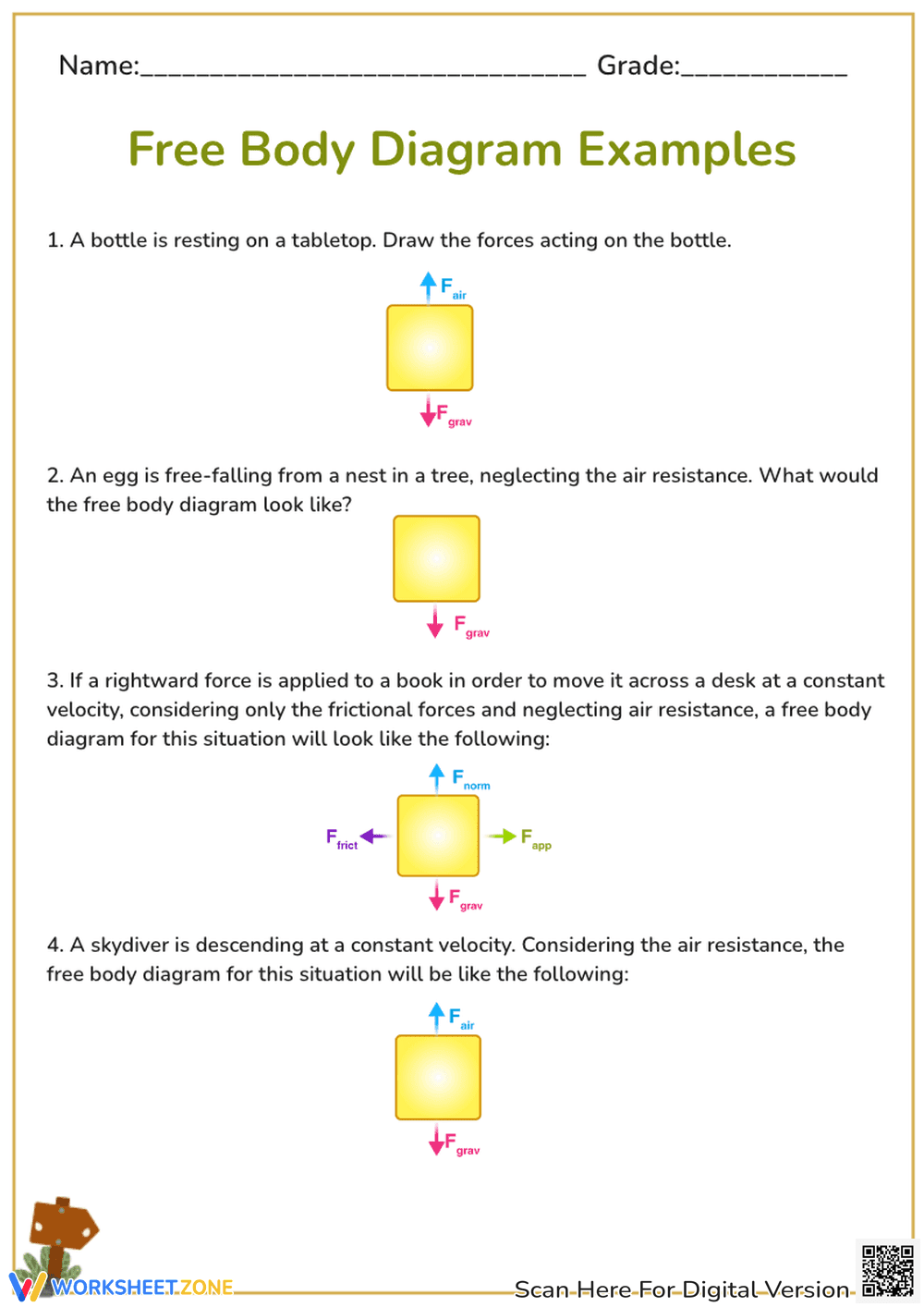
The Free Body Diagram Examples Worksheet helps students learn to identify and represent the forces acting on different objects in motion and at rest. It includes visual examples and guided exercises showing how to label forces such as gravity, tension, friction, and normal force.
Why Use It:
This worksheet reinforces understanding of how free-body diagrams represent physical situations. It helps students apply Newton’s laws of motion by analyzing balanced and unbalanced forces, preparing them for problem-solving in physics and physical science.
How to Use It:
• Review the types of forces (gravity, normal, friction, applied).
• Have students draw arrows for each force acting on the object.
• Discuss how the size and direction of arrows show the magnitude and type of force.
Grade Suitability:
Best suited for Grades 8–11.
• Middle school: Introduces balanced and unbalanced forces.
• High school: Reinforces Newton’s Laws through diagram practice.
Target Users:
Teachers and students studying forces, motion, and Newtonian mechanics in physics or general science.
The Free Body Diagram Examples Worksheet helps students learn to identify and represent the forces acting on different objects in motion and at rest. It includes visual examples and guided exercises showing how to label forces such as gravity, tension, friction, and normal force.
Why Use It:
This worksheet reinforces understanding of how free-body diagrams represent physical situations. It helps students apply Newton’s laws of motion by analyzing balanced and unbalanced forces, preparing them for problem-solving in physics and physical science.
How to Use It:
• Review the types of forces (gravity, normal, friction, applied).
• Have students draw arrows for each force acting on the object.
• Discuss how the size and direction of arrows show the magnitude and type of force.
Grade Suitability:
Best suited for Grades 8–11.
• Middle school: Introduces balanced and unbalanced forces.
• High school: Reinforces Newton’s Laws through diagram practice.
Target Users:
Teachers and students studying forces, motion, and Newtonian mechanics in physics or general science.


