


























Views
Downloads
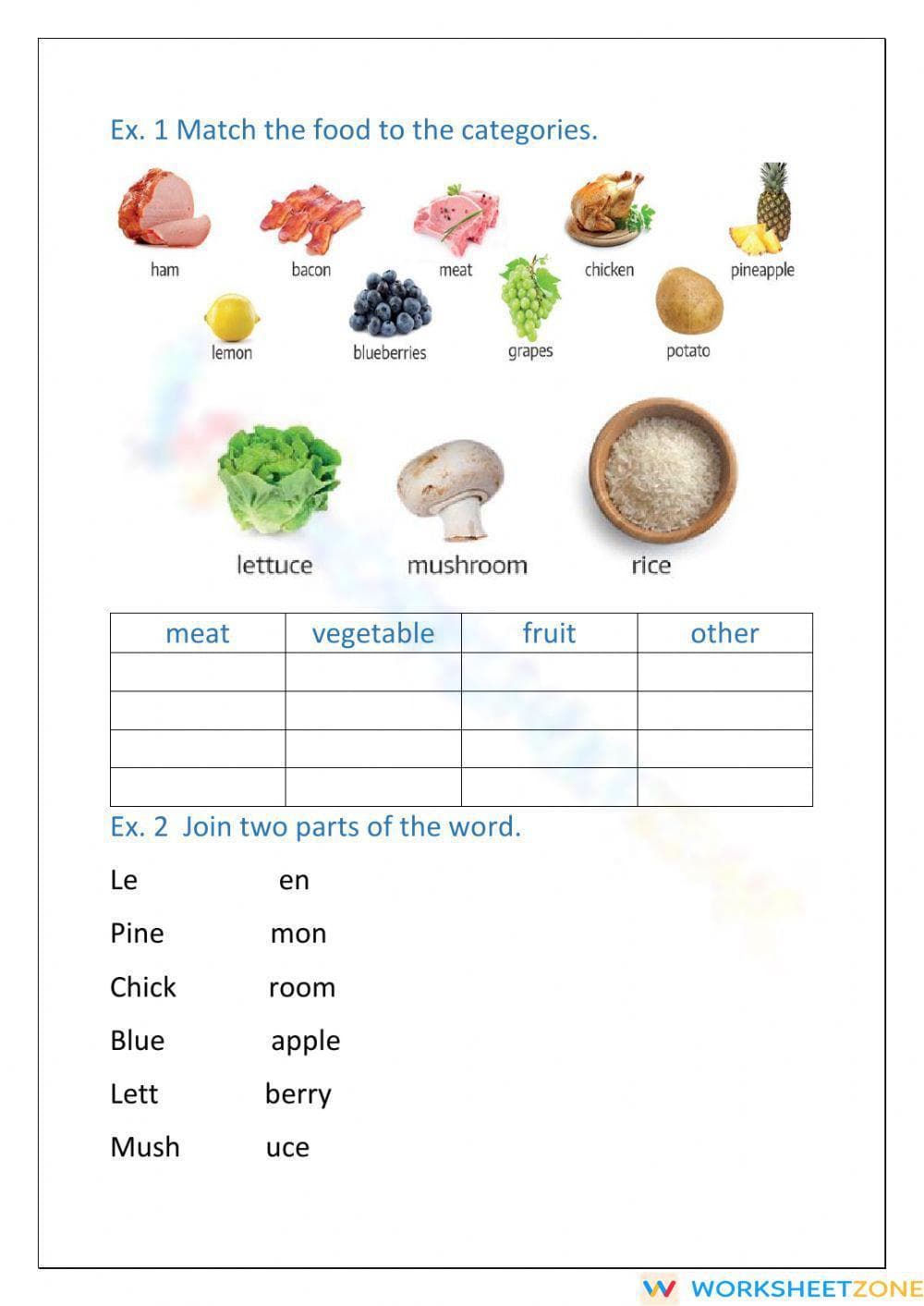


Printable Food Vocabulary and Grammar Worksheet | Grade 5-7
Paste this activity's link or code into your existing LMS (Google Classroom, Canvas, Teams, Schoology, Moodle, etc.).
Students can open and work on the activity right away, with no student login required.
You'll still be able to track student progress and results from your teacher account.
This Essential Food Vocabulary and Grammar Worksheet provides Grade 5-7 students with targeted practice in domain-specific language and linguistic categorization. By engaging with visual prompts and structured grammar exercises, learners solidify their understanding of food-related nouns while mastering the distinction between countable and uncountable structures. Students will improve their communicative precision through these multi-modal tasks.
At a Glance
- Grade: 5-7 · Subject: English Language Arts
- Standard:
CCSS.ELA-LITERACY.L.5.6— Acquire and use domain-specific words to improve academic communicative precision- Skill Focus: Food vocabulary and count/uncount nouns
- Format: 2 pages · 3 problems · Answer key included · PDF
- Best For: Vocabulary enrichment and grammar reinforcement
- Time: 15–25 minutes
This comprehensive 2-page resource features three distinct activity types designed to build linguistic fluency. The first page includes a visual matching task where students categorize diverse food items—ranging from meat and vegetables to fruits—into logical groups. It follows with a word-joining exercise that reinforces spelling and morphology. The second page shifts focus to grammar, challenging students to identify countable and uncountable nouns within the food domain.
Skill Progression
- Guided practice: Students begin by matching illustrated food items to established categories, using visual cues to support vocabulary acquisition and conceptual grouping.
- Supported practice: Learners then transition to morphological awareness by rejoining split word parts, bridging the gap between visual recognition and written spelling.
- Independent practice: The final task requires students to apply abstract grammatical rules to classify nouns as countable or uncountable, demonstrating mastery of English conventions.
This structure follows a gradual-release model, moving from concrete visual identification to complex grammatical application.
Standards Alignment
The primary focus of this worksheet is CCSS.ELA-LITERACY.L.5.6, which requires students to acquire and use accurately grade-appropriate general academic and domain-specific words and phrases. Additionally, the grammar component supports CCSS.ELA-LITERACY.L.5.1 by strengthening the command of standard English conventions regarding noun usage. Both standard codes can be copied directly into lesson plans, IEP goals, or district curriculum mapping tools.
How to Use It
This worksheet is ideal for use during the independent practice portion of a unit on nutrition or basic grammar. Use it after a direct instruction session on count versus noncount nouns to provide immediate formative feedback. Teachers can observe student performance on the classification task to identify specific misconceptions about mass nouns. Completion typically takes 20 minutes in a standard classroom setting.
Who It's For
This resource is designed for middle elementary and early middle school students, including English Language Learners who benefit from visual vocabulary support. It pairs naturally with a food-themed reading passage or an anchor chart detailing the rules for pluralization. The clear layout makes it an excellent choice for a low-prep substitute plan or a homework assignment that reinforces classroom learning.
Academic research highlighted by NAEP and the RAND AIRS 2024 report emphasizes that explicit vocabulary instruction combined with morphological analysis significantly improves literacy outcomes for middle-grade students. This worksheet applies these findings by integrating visual categorization with word-part synthesis, ensuring learners understand structural and grammatical properties. According to Fisher & Frey (2014), the gradual release of responsibility—moving from guided visual matching to independent grammatical reasoning—is essential for internalizing academic language. By targeting CCSS.ELA-LITERACY.L.5.6 through distinct cognitive levels, this resource provides the structured repetition necessary for long-term retention. Educational data from ScienceDirect TpT Analysis indicates that multi-modal worksheets reducing teacher prep time while maintaining high cognitive demand result in consistent student engagement and measurable gains in domain-specific fluency during ELA block instruction. This citation-ready summary highlights the resource’s alignment with evidence-based pedagogical strategies for language acquisition.


