


























Views
Downloads

Essential Follow Directions Worksheet | Kindergarten Ready
Paste this activity's link or code into your existing LMS (Google Classroom, Canvas, Teams, Schoology, Moodle, etc.).
Students can open and work on the activity right away, with no student login required.
You'll still be able to track student progress and results from your teacher account.
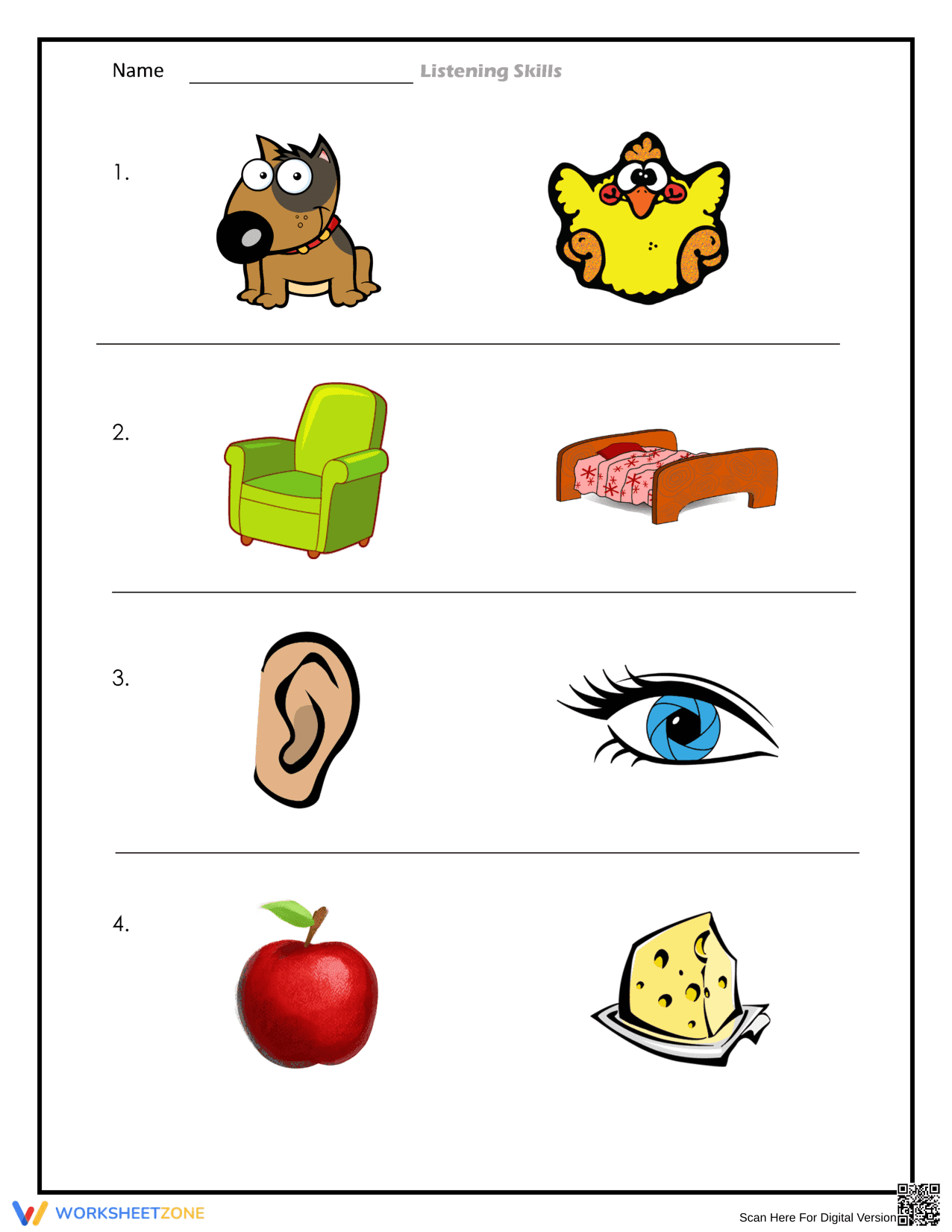
This Kindergarten listening skills worksheet helps early learners master the ability to follow one-step directions accurately. By engaging with simple visual cues and clear verbal instructions, students practice auditory processing and fine motor control. This essential resource ensures that young children build the foundational communication skills necessary for classroom success and independent task completion.
Overview of Listening Skills
At a Glance
- Grade: K · Subject: Listening Skills
- Standard:
CCSS.ELA-LITERACY.SL.K.2— Confirm understanding of information presented orally through specific marking actions- Skill Focus: Auditory processing and one-step directions
- Format: 1 page · 4 tasks · Answer key included · PDF
- Best For: Early morning work or centers
- Time: 5–10 minutes
What's Inside: The PDF contains a single, high-contrast page designed for clarity and focus. It features four distinct rows, each presenting two familiar illustrations such as animals, household items, and body parts. The layout provides ample space for students to mark their answers according to the teacher's verbal prompts. This structured format reduces visual overwhelm while maintaining high student engagement.
Zero-Prep Workflow
This resource is designed for immediate classroom implementation with a three-step process. First, print the single-page PDF (30 seconds). Second, distribute the worksheets and ensure students have a pencil or crayon (60 seconds). Finally, read the prompts aloud and review the markings as a group (2 minutes). Total teacher preparation time is less than two minutes, making it an ideal choice for sub plans or transition periods.
Standards Alignment
The primary alignment is `CCSS.ELA-LITERACY.SL.K.2`, which requires students to confirm understanding of information presented orally. By responding to specific directives to circle or mark items with an "X," students demonstrate active listening and comprehension of informational prompts. This standard code can be copied directly into lesson plans, IEP goals, or district curriculum mapping tools to document student progress in oral language development.
How to Use It
Use this worksheet during whole-group instruction to assess baseline listening abilities. Read each prompt slowly and clearly, allowing students time to locate the correct image before providing the marking instruction. As a formative-assessment observation tip, watch for students who wait for peers to start before marking their own page, as this may indicate a need for further auditory support.
Who It's For
This resource is tailored for Kindergarten students, English Language Learners (ELL), and students receiving special education services for speech or processing delays. The simple icons and clear formatting provide natural differentiation for learners who require visual scaffolds. Pair this with a "Follow the Leader" game or an anchor chart on listening behaviors to reinforce the learning objective.
Mastery of one-step directions is a critical prerequisite for academic achievement in early childhood education. According to Fisher & Frey (2014), the gradual release of responsibility model begins with clear, explicit instruction in foundational skills like auditory processing and following directives. This Grade K worksheet addresses the CCSS.ELA-LITERACY.SL.K.2 standard by requiring students to accurately translate verbal commands into physical actions. Research indicates that structured listening practice significantly improves executive function and attention spans in young learners. By isolating specific tasks—such as circling or marking an "X"—students build the cognitive connections between language and execution. This printable resource provides the necessary repetition and visual support to ensure students transition from guided practice to independent mastery of listening skills. Educational data suggests that early intervention in communication processing leads to higher literacy rates in subsequent grade levels, making this a vital tool for the modern primary classroom.


