




























Views
Downloads

Finding Slope From Two Points Worksheet | Grade 8 Printable

Paste this activity's link or code into your existing LMS (Google Classroom, Canvas, Teams, Schoology, Moodle, etc.).
Students can open and work on the activity right away, with no student login required.
You'll still be able to track student progress and results from your teacher account.
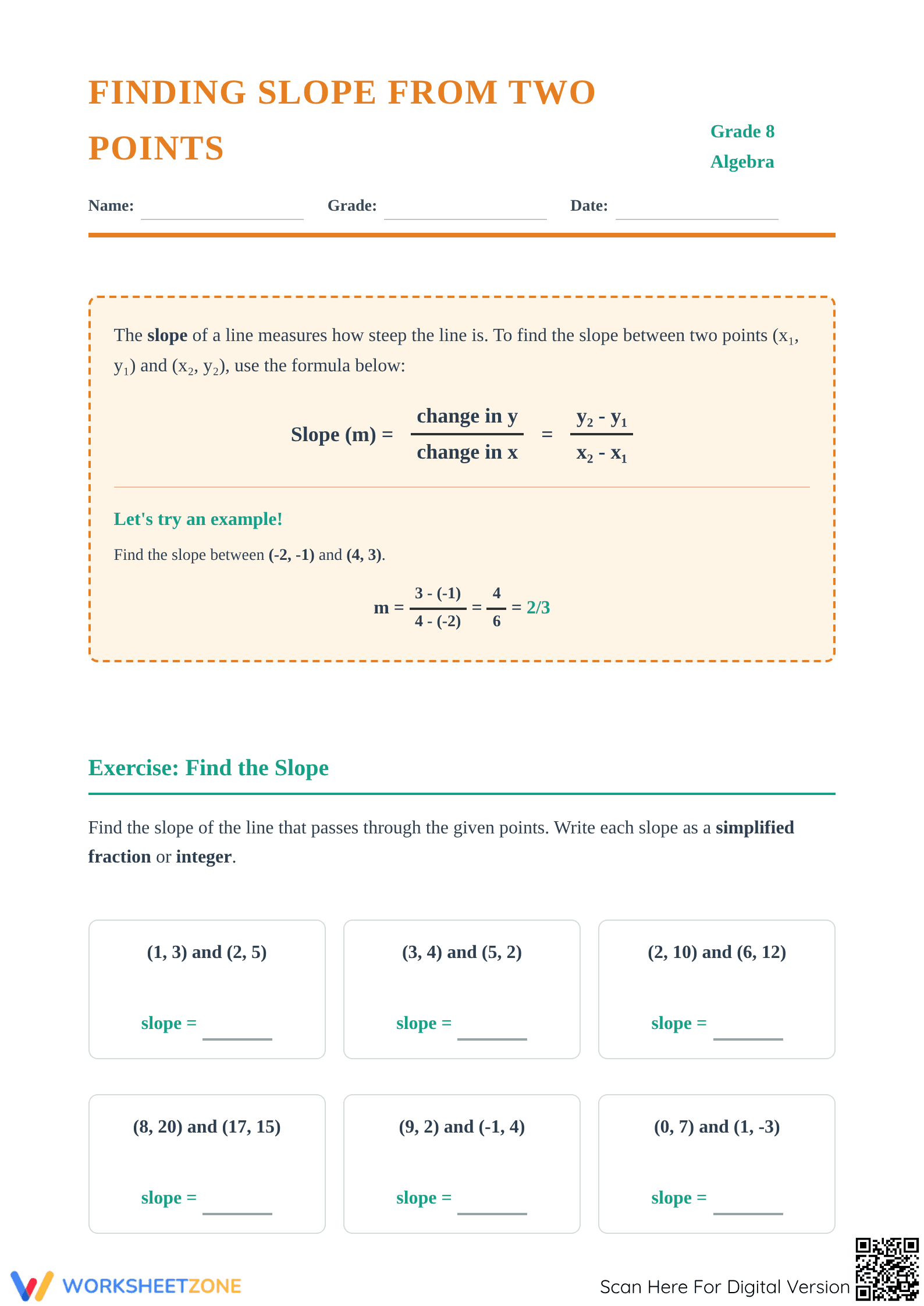
This eighth-grade math worksheet provides targeted practice for calculating the slope of a line using two coordinate points. By applying the slope formula, students will strengthen their algebraic foundation and prepare for graphing linear equations. The resource begins with a clear, worked example to build immediate student confidence.
At a Glance
- Grade: 8 · Subject: Math
- Standard:
CCSS.MATH.CONTENT.8.F.B.4— Determine the rate of change from two points- Skill Focus: Finding slope from two points
- Format: 2 pages · 18 problems · Answer key included · PDF
- Best For: Independent practice
- Time: 15–25 minutes
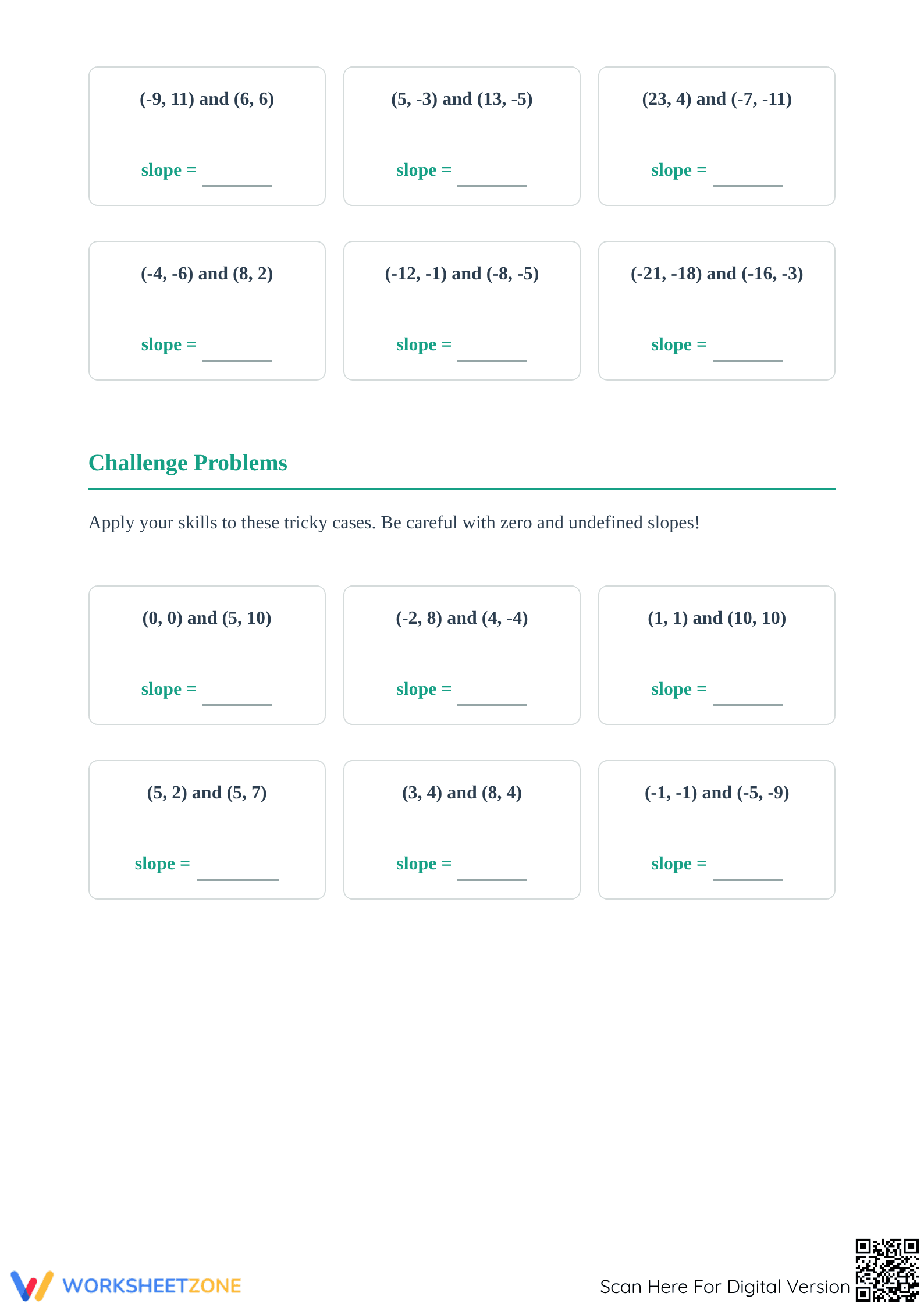
This comprehensive resource features a helpful reference section at the top, complete with the slope formula and a step-by-step worked example. Across two pages, students will tackle 18 total problems. The layout provides ample workspace for students to substitute coordinates into the formula and simplify their fractions. A complete answer key is provided to make grading fast and accurate.
- Guided practice: The worksheet opens with a fully worked example showing exactly how to label coordinates and apply the formula.
- Supported practice: The first 12 problems offer straightforward coordinate pairs, allowing students to build fluency with the standard slope formula.
- Independent practice: The final 6 challenge problems introduce tricky cases, requiring students to carefully identify zero and undefined slopes.
This gradual-release approach ensures students master the basics before encountering edge cases.
Aligned to CCSS.MATH.CONTENT.8.F.B.4, this worksheet requires students to determine the rate of change and initial value of a function from a description of a relationship or from two (x, y) values. It also supports foundational skills for graphing linear equations. Both standard codes can be copied directly into lesson plans, IEP goals, or district curriculum mapping tools.
Deploy this worksheet immediately following your direct instruction on the slope formula. It serves perfectly as an in-class independent assignment or as targeted homework. As a formative assessment tip, watch how students handle negative coordinates in the formula; this is a common area where signs get dropped, providing a great opportunity for real-time correction. Expect students to complete the task in 15 to 25 minutes.
This resource is designed for eighth-grade pre-algebra and algebra students learning linear equations. The built-in formula reference makes it highly accessible for students who need visual scaffolds or IEP accommodations. Pair this practice with a graphing activity so students can visually verify the steepness they just calculated algebraically.
Mastering the ability to determine the rate of change from two points is a critical milestone in middle school algebra. According to EdReports 2024, instructional materials that provide explicit, structured practice with the slope formula significantly improve students' transition to complex linear functions and advanced graphing concepts. This worksheet directly supports CCSS.MATH.CONTENT.8.F.B.4 by isolating the calculation step, reducing cognitive load while students memorize the formula. By progressing from standard integer coordinates to challenge problems involving zero and undefined slopes, the resource builds robust mathematical resilience. Providing a worked example at the top of the page aligns with evidence-based scaffolding strategies, ensuring students can self-correct during independent practice. This targeted approach helps solidify the algebraic reasoning required for high school mathematics and beyond.


