


























Students understand fractional multiplication by utilizing an area model to represent finding a fraction of a whole integer and a fraction of a fraction. Students will:
- draw and shade fractional parts of areas, or use square pieces of paper to represent fractional parts of a whole and fractional parts of a fraction.
- recognize that finding a fraction times a number is equivalent to finding a fraction of a number.
- understand the concept of multiplicative inverse.
- identify patterns in the outcomes of fractional multiplication and begin to generalize an algorithm for multiplying fractions without using a physical model.
- identify patterns in examples and situations that relate the resulting value to the fractional and whole numbers involved in the problems.
- How are relationships represented mathematically?
- How can mathematics help us communicate more effectively?
- How can mathematics help to quantify, compare, depict, and model numbers?
- What does it mean to analyze and estimate numerical quantities?
- What makes a tool and/or strategy suitable for a certain task?
- Equivalent Fractions: Two or more fractions that represent the same amount.
- Factor: A whole number that divides evenly into another whole number.
- Fraction: A number expressible in the form a/b where a is a whole number and b is a positive whole number.
- Numerical Expression: Any combination of numbers and symbols that represent a mathematical relationship.
- Unit Fraction: A fraction with a numerator of one.
- paper
- colored pencils
- index cards with fractions (\(1 \over 2\),\(3 \over 4\),\(2 \over 4\),\(1 \over 3\),\(2 \over 3\),\(1 \over 5\),\(2 \over 5\),\(3 \over 5\)) for small groups
- manipulatives: chips, cubes, or dot stickers
- paper to model paper-folding fractions
- geoboards or dot paper
- copies of Fraction Cards (M-5-2-1_Fraction Cards)
- copies of Station Cards (M-5-2-1_Station Cards)
- copies of Assessment Exit Ticket (M-5-2-1_Assessment Exit Ticket and KEY)
- Observation during the paper-folding task might reveal how well students grasp the concept of multiplying fractions.
- Use the Assessment Exit Ticket to assess students' performance.
Scaffolding, Active Engagement, Modeling, Explicit Instruction, and Formative Assessment
W: The lesson focuses on fractions, multiplication, and representation through physical models.
H: Use paper folding to visually represent fraction multiplication. Point out that the product of two fractions produces a smaller number than the product of two whole numbers.
E: Students practice multiplying fractions using paper-folding and writing related number sentences.
R: To review the method with students, use a large model (e.g., drawing on the board or full-sized sheet of paper) and walk through the steps to generate the matching number sentence.
E: Use the Assessment Exit Ticket to assess student competency.
T: Students who grasp the process may receive Station Cards to practice their skills. Other students may be separated into small groups for additional teaching and guided practice. Use the recommendations in the Extension section to customize the lesson as needed.
O: The lesson aims to help students understand the concept of multiplying fractions by identifying fractional parts of an area. The lesson focuses on appropriate fractions rather than improper or mixed numbers.
Part 1:
"We'll use a paper-folding model and an area model to calculate the product of two fractions. These models enable you to investigate the relationship between two fractions and their product."
"Let's review how to multiply whole numbers. When we multiply whole numbers, we can store the results in an array. For example, the equation 6 × 4 = ___ can be represented as follows:
* * * * * *
* * * * * *
* * * * * *
* * * * * *
"How does the array help us determine the product? What is the product and what does it represent?" (Possible response: We see that there are 6 columns or groups, with each column containing 4 items—or 4 rows. The total can be calculated as 6 + 6 + 6 + 6 = 24, or 6 × 4 = 24.) "Using the commutative property of multiplication, we may prove that 4 × 6 = 24 if we know that 6 × 4 = 24. Remember the commutative property of multiplication, which states that the order of the factors has no effect on the product."
"Create a 3 × 5 array using manipulatives such as chips, cubes, and dot stickers. What's the product? What are your observations on the relationship between the factors and the product?" (Do extra problems if necessary.) "Using the commutative property of multiplication, what would the related multiplication expression be for 3 × 5?" (5 × 3)
"Does anyone have an idea of how we could visually represent the multiplication of two fractions?" Allow students to discuss and share their views and rationales. (Possible responses: Perhaps we might begin with a whole unit and divide it into pieces. Multiplication requires repeated addition for whole numbers; is this true for fractions? If so, we could use repeated fraction pieces.)
"The product of two fractions can be visually represented in the same way that we can represent the product of two whole numbers. We can do this with a paper-folding model. When you multiply two fractions or two whole numbers, you will notice a difference in the relationship between the product and the elements that produced it." Use the paper-folding model to demonstrate how two fractions can be multiplied.
Explain that the piece of paper represents an area, which we will refer to as a whole unit. Use the example of \(1 \over 2\) × \(1 \over 4\). Fold the paper in half horizontally. Open it. Discuss what is represented and shade in \(1 \over 2\). Now, fold the paper in fourths vertically. Open it. Discuss what is represented and shade in \(1 \over 4\) with a different color.
Ask questions like following:
"What do you notice?"
"How many pieces do you have in total?"
"What else do you notice?" (There is an area that is shaded with both colors.)
"What do you think is represented by the area shaded in by both colors?" (The region darkened by both colors represents the product of the two fractions, or one-fourth of a half. "Product" means "multiply," therefore you have the product of two fractions.)
"What is the product here?" (1/8, since 1 out of 8 parts is shaded.)
"Is the relationship between two fractions and their product the same as the relationship between two whole numbers and their product?" (The product of two whole numbers increases, whereas the product of two fractions decreases.) If required, include another example to further clarify this concept.
"I'll give each group a set of index cards. Each index card has a fraction. To represent fractions, each group member should fold two cards using the paper-folding model (using a typical 8.5 × 11 piece of paper), as indicated. Once the product has been calculated, circle or otherwise identify the area represented by the product of the two fractions. Then use a multiplication sentence to represent the problem."
Monitor students' performance while they work in groups. Help students who may not be folding correctly. Visit each group and ask students to explain their ideas and clear any misunderstandings.
Sample questions to ask students while they are working:
"What does the piece of paper represent?" (a whole)
"How do you know how many sections you need?" (look at the denominator)
"How do you know how many sections to shade in?" (look at the numerator)
"What do you notice about the paper and how many parts it has once you start folding?" (the number of parts is increasing)
"What do you notice about the size of each piece?" (product decreases with each fold)
"What do you notice about the relationship of the product to the fractions that produced it?"
"What else do you notice?"
The following questions might be used as exploration for students who demonstrate a strong understanding of the idea.
"Can you come up with two fractions that will give you the product _____?"
"Can you come up with an open-ended multiplication sentence to fit your model?" (The answers will vary. Students should select one fraction and the product \(2 \over 3\) × ___ = \(4 \over 9\))
Once most students have done, ask the following question: "Look at the many models you constructed. Can you find a connection between two fractions and their product?" Allow students to investigate and engage in dialogue. Share your comments on chart paper and search for patterns of understanding. The purpose is for students to see a generalized algorithm for fraction multiplication.
Part 2
To convert the understanding model to an area model, draw a rectangle on the overhead projector, chart paper, or white board. Explain to students that this is the same as the piece of paper we labeled a "whole unit." Take two fractions, \(1 \over 2\) and \(1 \over 4\). Divide the total (by drawing a line through it) into two equal horizontal pieces (\(1 \over 2\)) and shade one of them. Ask students to describe what this means. Then, divide the rectangle vertically into four equal sections and shade one of them. Ask students to discuss what this represents and what they see. To record the procedure, have students tell you which two equations are represented by the area model. Do students see the previously created generalized algorithm? Ask students to describe how the paper-folding model is analogous to the area model.
After students have worked as a group and the class has begun to see a generalization for the multiplication algorithm, have students who demonstrated proficiency rotate to stations, while those who require additional instruction meet as a small group with teacher guidance (see the implementation in the Small Group section, which follow). At each station, alternate having students find the product of two fractions using the area model (this time drawing the representation rather than folding it) and looking at previously made area models, then creating a multiplication sentence to show what each model represents (M-5-2-1_Station Cards).
Encourage students to write the multiplication sentence in two different ways to emphasize the commutative property of multiplication. Allow students to check their work with answers provided at each station. To conclude the lesson, students can be asked the following question. "Were we correct in our thinking when we started to create a generalized algorithm for the multiplication of fractions?" (Possible responses: No. We assumed that multiplying would result in a greater product. The product of two fractions is smaller than the original fraction. Also, we cannot utilize repeated addition as we can with whole numbers because this would result in a larger product. When multiplying fractions, it is always important to consider the whole unit.)
If more assessment is required, students should complete the Assessment Exit Ticket (M-5-2-1_Assessment Exit Ticket and KEY).
Extension:
Routine: Emphasize the right use of vocabulary in lessons and classroom discussions. Allow students to collaborate with partners or small groups on different activities. Use warm-up or review tasks, such as the one below, to reinforce mathematical ideas and assess understanding.
Have a set of fraction cards available (M-5-2-1_Fraction Cards). Holding up two cards at random, ask students to do one of the following activities:
1. Find the product.
2. Write two multiplication statements and the product (commutative property).
3. If possible, identify two different fractions that get the same result as the two cards. If this is not possible, please explain why.
Expansion: Introduce students to fractions and reciprocals. A reciprocal of a fraction is formed by turning it upside down; the numerator becomes the denominator, and the denominator becomes the numerator. For example, 3⁄2 is the reciprocal of \(2 \over 3\). The reciprocal of \(1 \over 4\) is \(4 \over 1\), or 4. An overall comprehension of improper fractions will be required. Another method is to utilize the equation \(1 \over 2\) × 2 = ____, along with a visual illustration. \(1 \over 2\) × \(2 \over 1\) = ____ .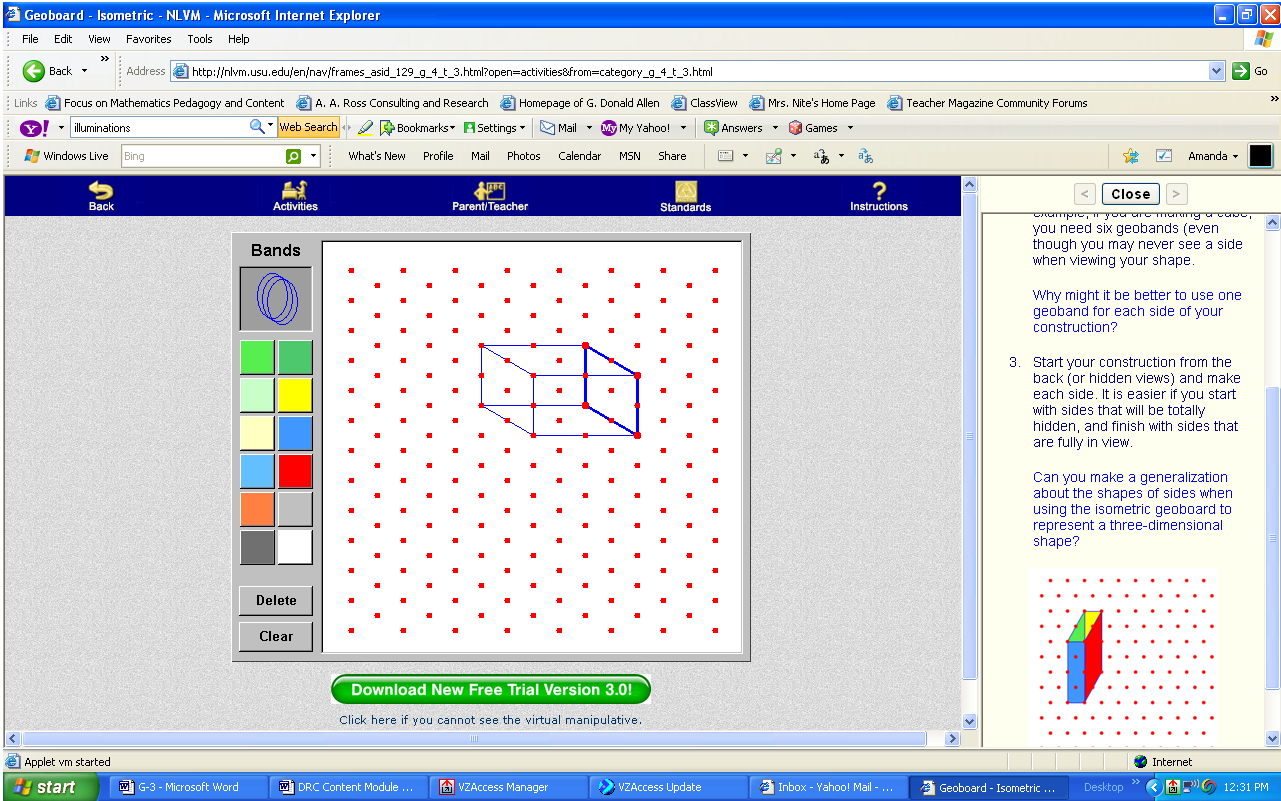
Using the array model can show students that \(1 \over 2\) × \(2 \over 1\). The shaded region shows \(2 \over 2\) = 1.
Use the equation \(3 \over 2\) × \(2 \over 3\)= ___.
Since \(3 \over 2\) = \(1 {1 \over 2} \), and \(1 {1 \over 2} \) of \(2 \over 3\) is the same as 1 of \(2 \over 3\) and \(1 \over 2\) of \(2 \over 3\) , then 1 of \(2 \over 3\) is \(2 \over 3\), and \(1 \over 2\) of \(2 \over 3\) is \(1 \over 3\). So what’s the sum of \(2 \over 3\) and \(1 \over 3\) ? It is 1 whole.
Another way to represent this is with a picture.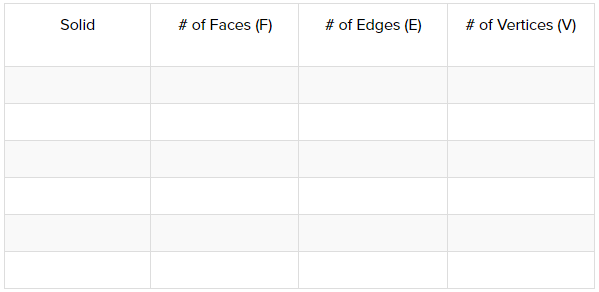
There are 6 pieces in the shaded blue striped section. A whole consists of 6 pieces. So, \(6 \over 6\) = 1 making \(3 \over 2\) × \(2 \over 3\) = 1.
Through exploration, students can learn that a fraction multiplied by its reciprocal equals one. This is known as the multiplicative inverse property. This can be demonstrated using drawings or manipulatives while providing various instances.
Small Group: Based on formative evaluations, small-group instruction can be used to assist students comprehend multiplication and its impact on fractions. Students can practice modeling multiplication sentences with fractions using an alternate manipulative, such as geoboards. If geoboards are not accessible or a different option is selected, students can complete the activity on dot matrix paper. Remind students that folding the paper horizontally and vertically resulted in additional pieces. The denominators' product determined the number of pieces. Model a few paper-folding instances for students to see. Students can use the geoboard with rows of dots to calculate the area required by multiplying the two fractions' denominators.
(\(2 \over 3\) × \(1 \over 4\)=____; Multiplying the denominators 3 and 4 gets 12. To create an area with 12 dots on the geoboard, students can use two rubber bands to draw the same dimensions as the denominators (3 rows × 4 rows of dots). Students can then express the first fraction by looking at the numerator and attaching a different color rubber band (blue) to that number of rows. Using a third color of rubber band (orange), students can express the second fraction by looking at the numerator and placing a rubber band on the number of rows. Students can then determine the product by examining the overlap of the second and third rubber bands (orange and blue).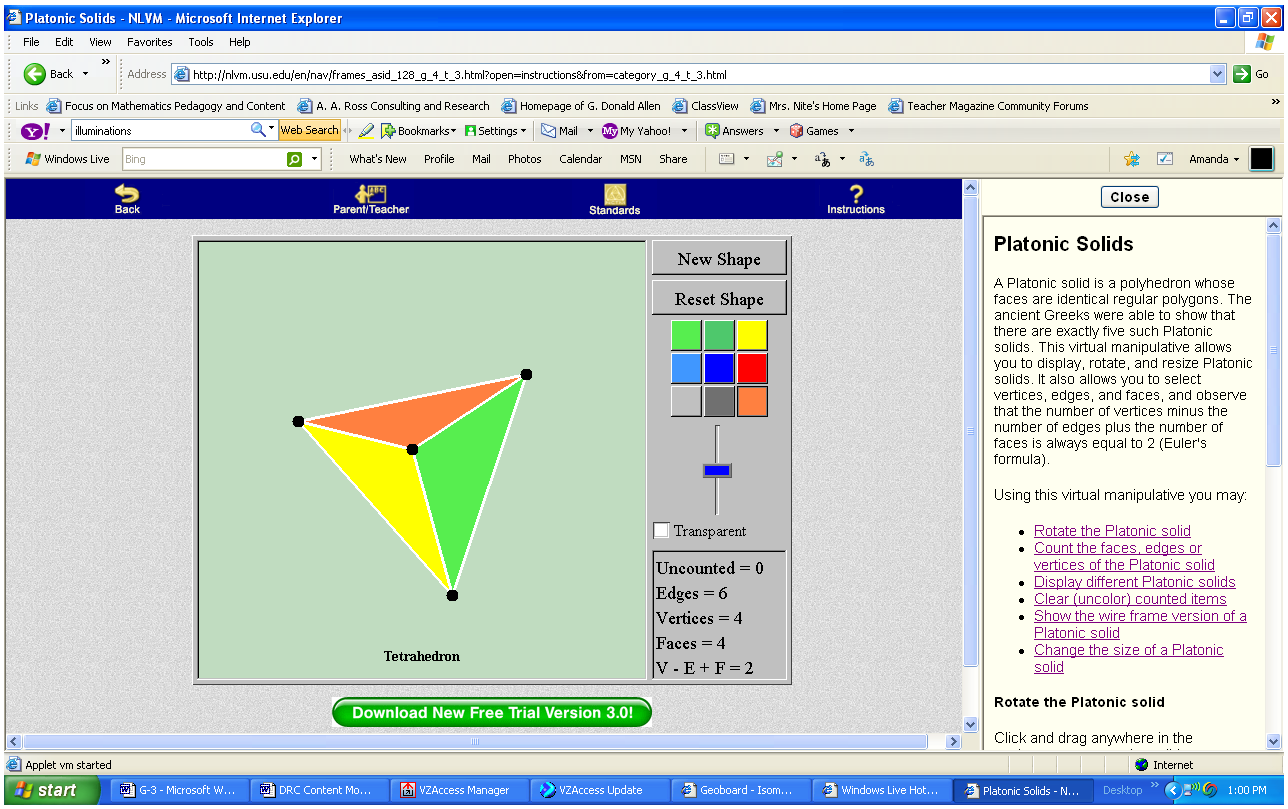
Use two black rubber bands to create a 12-dot area. Blue represents \(2 \over 3\). Orange represents \(1 \over 4\). There are two dots of each colors, so the answer is \(2 \over 12\).
Students can then replicate the technique on dot or graph paper and identify the result. Having students identify the area with fractions and create multiplication sentences can help to improve the algorithm for multiplying fractions using the physical models.
Technology Connection: Have students write multiplication sentences with fractions and model the equations using a spreadsheet tool such as Microsoft Excel. For example, the preceding geoboard example can be recreated using spreadsheet cells and various fill colors.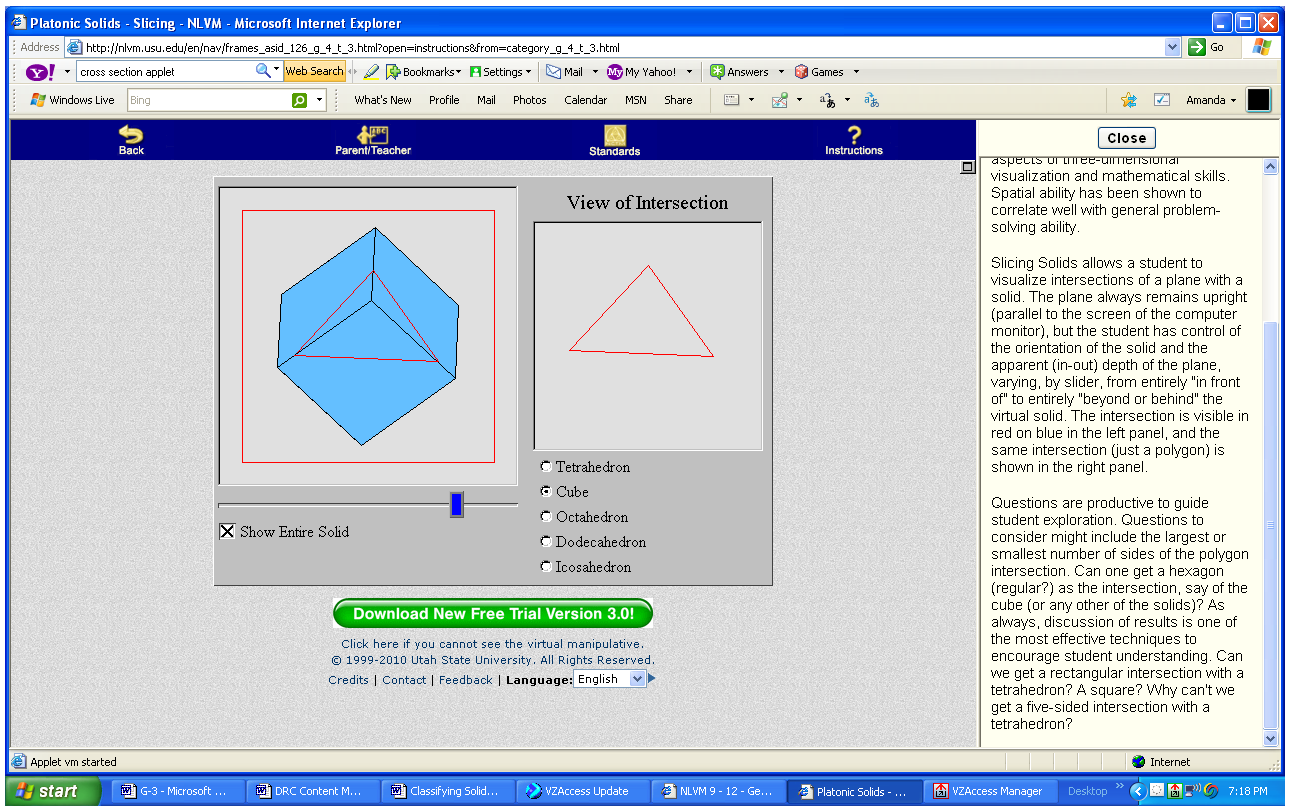
A tool that allows students to create tables could be used instead of a spreadsheet. Graph paper is another alternative. Two fractions can be shaded in, and the product can be calculated by looking at the overlapping colors and total number of pieces. Students can design many models that represent the same product.

Finding Fractional Parts Using an Area Model (M-5-2-1)
Students understand fractional multiplication by utilizing an area model to represent finding a fraction of a whole integer and a fraction of a fraction. Students will:
- draw and shade fractional parts of areas, or use square pieces of paper to represent fractional parts of a whole and fractional parts of a fraction.
- recognize that finding a fraction times a number is equivalent to finding a fraction of a number.
- understand the concept of multiplicative inverse.
- identify patterns in the outcomes of fractional multiplication and begin to generalize an algorithm for multiplying fractions without using a physical model.
- identify patterns in examples and situations that relate the resulting value to the fractional and whole numbers involved in the problems.


