


























Views
Downloads

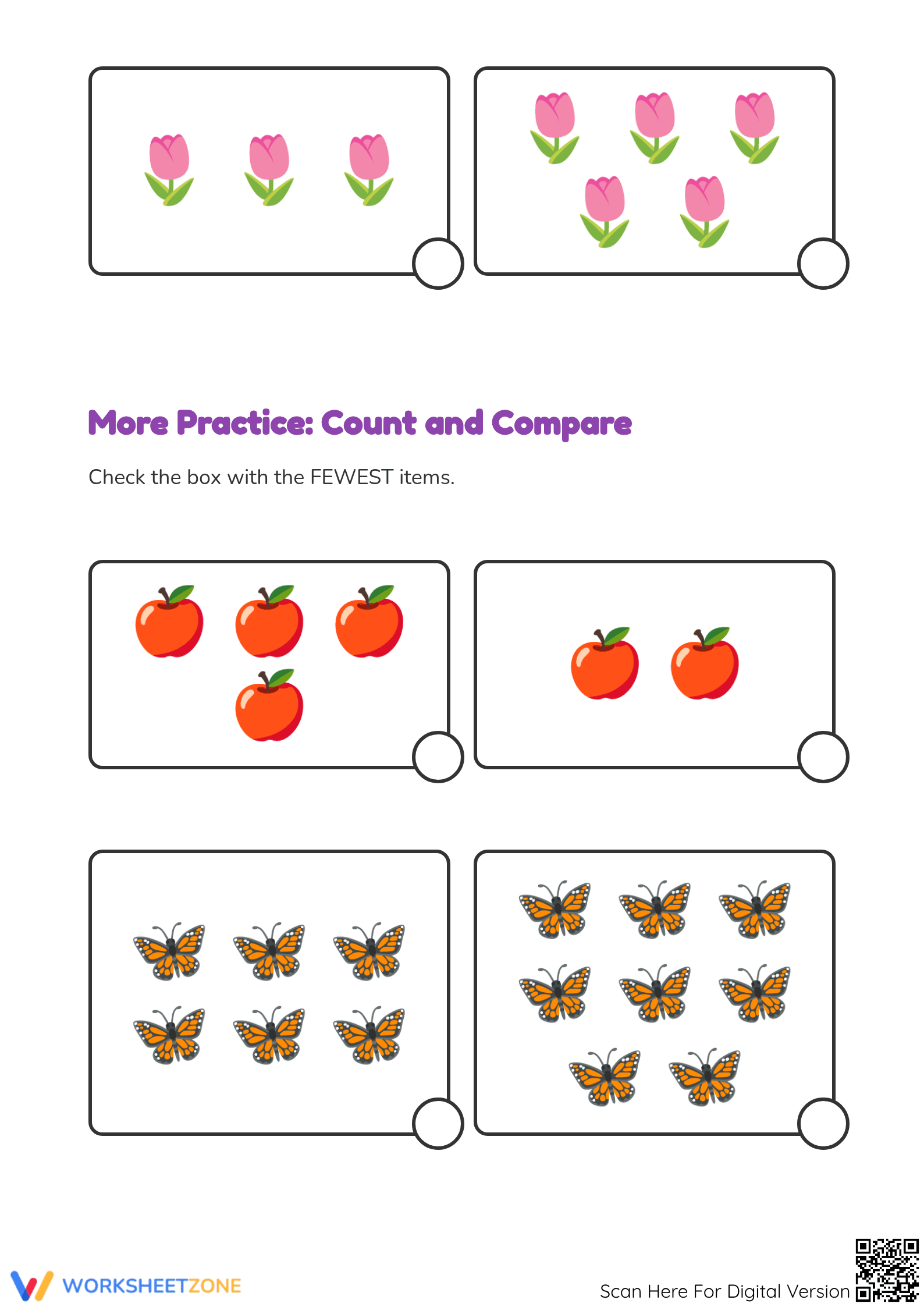



Printable Grade K Fewer Number Comparison Worksheet
Paste this activity's link or code into your existing LMS (Google Classroom, Canvas, Teams, Schoology, Moodle, etc.).
Students can open and work on the activity right away, with no student login required.
You'll still be able to track student progress and results from your teacher account.
This Grade K fewer number comparison worksheet helps young learners master the fundamental concept of quantity by identifying smaller sets of objects. Students examine pairs of illustrated groups—such as apples, bees, and cars—and circle the one containing fewer items. This visual approach builds a strong foundation for future mathematical operations and number sense.
At a Glance
- Grade: K · Subject: Math Comparison
- Standard:
CCSS.MATH.CONTENT.K.CC.C.6— Identify whether the number of objects in one group is less than another- Skill Focus: Identifying groups with fewer items
- Format: 5 pages · 20 problems · Answer key included · PDF
- Best For: Independent practice or morning work
- Time: 5–10 minutes per page
This comprehensive packet includes 5 distinct practice pages, each featuring 4 comparison tasks for a total of 20 practice opportunities. Every page presents clear, child-friendly illustrations in structured frames, ensuring students can easily distinguish between groups. A full answer key is provided, allowing for quick checking or student self-correction during independent work periods.
The zero-prep design allows teachers to implement this activity in under two minutes. First, print the desired number of copies (30 seconds). Second, distribute the worksheets along with crayons or pencils (30 seconds). Third, review the first example together to ensure student understanding of the "fewer" concept (60 seconds). This streamlined workflow makes it an ideal choice for substitute lesson plans or quick math centers.
This resource is rigorously aligned to `CCSS.MATH.CONTENT.K.CC.C.6`. This standard requires students to identify whether the number of objects in one group is greater than, less than, or equal to the number of objects in another group. Both standard codes can be copied directly into lesson plans, IEP goals, or district curriculum mapping tools to demonstrate adherence to state and national requirements.
Use this worksheet during your direct instruction on "less than" concepts or as a formative assessment after a hands-on counting lesson. For a quick observation tip, watch if students use one-to-one matching or if they are beginning to subitize smaller groups. Most Kindergarten students will complete one practice page in approximately 5 to 10 minutes, making it perfect for transition times.
This material is designed for Preschool and Kindergarten students who are developing early numeracy skills. It is particularly effective for learners who benefit from high-contrast visual supports and repetitive practice. Naturally pair this resource with a counting mat or an anchor chart displaying the terms "more" and "fewer" for additional classroom scaffolding and support.
Early mathematics instruction emphasizes the transition from concrete counting to abstract comparison, a critical step in developing algebraic thinking. According to NAEP data, students who demonstrate early mastery of quantity relationships show significantly higher proficiency in first-grade arithmetic. This worksheet facilitates growth by providing structured practice in identifying relative quantities using familiar objects. By focusing on `CCSS.MATH.CONTENT.K.CC.C.6`, the activities align with evidence-based strategies for developing number sense. Fisher & Frey (2014) highlight that such visual comparison tasks bridge the gap between perceptual subitizing and conceptual counting. This practice set ensures students receive the focused repetition necessary to solidify their understanding of fewer numbers, making it a reliable tool for classroom teachers and interventionists. The clear layout reduces cognitive load, allowing students to focus purely on the mathematical comparison at hand while building confidence in their nascent counting abilities.


