


























Views
Downloads

Fears and Phobias Worksheet | Grade 6 Printable Reading
Paste this activity's link or code into your existing LMS (Google Classroom, Canvas, Teams, Schoology, Moodle, etc.).
Students can open and work on the activity right away, with no student login required.
You'll still be able to track student progress and results from your teacher account.
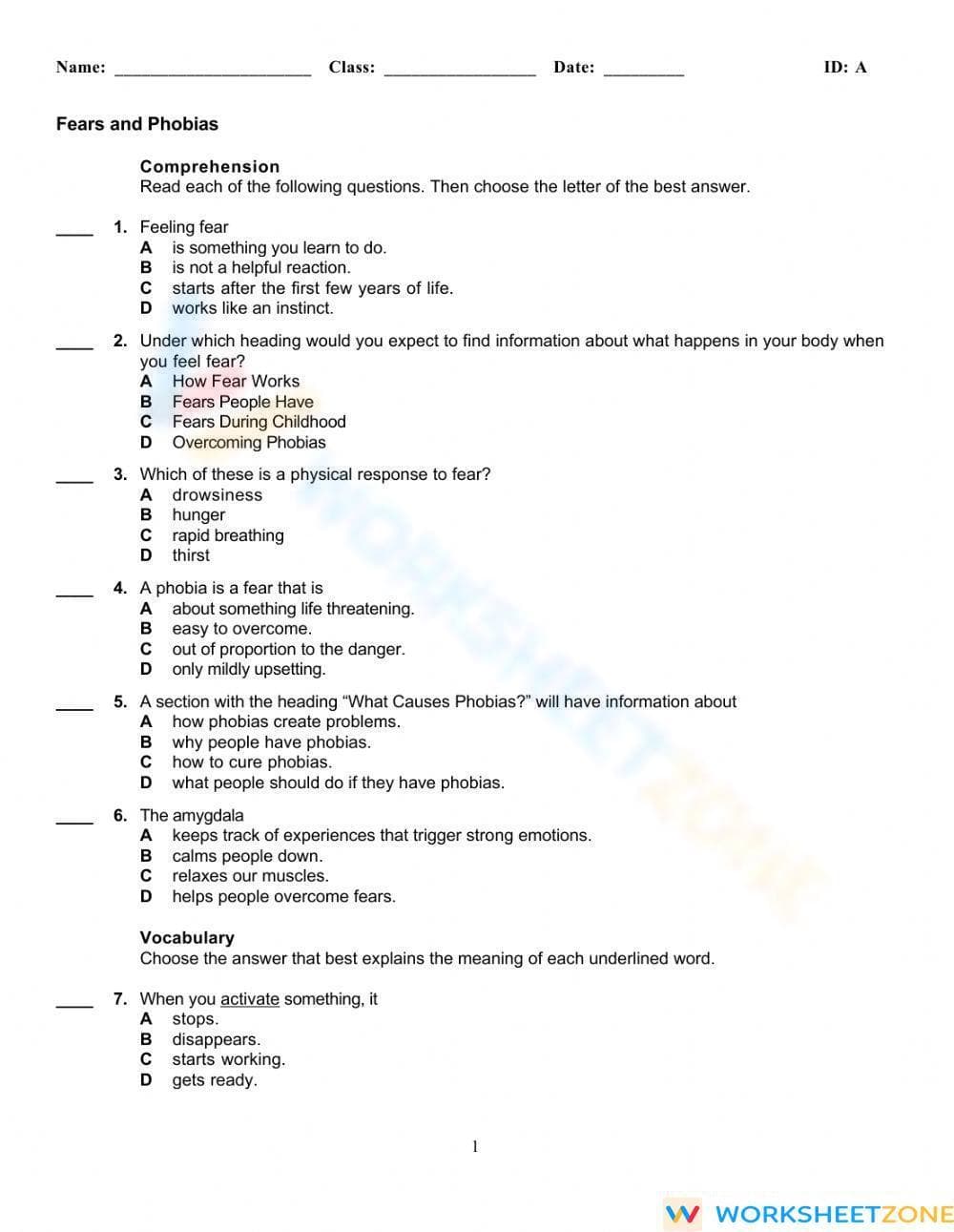
This comprehensive Fears and Phobias reading comprehension worksheet helps middle school students distinguish between normal emotional responses and clinical anxiety disorders. By engaging with informational text, learners analyze the physiological effects of fear and the psychological triggers of phobias. Students develop literacy skills by identifying key details and citing evidence to support their conclusions.
At a Glance
- Grade: 6 · Subject: Literature - Reading Comprehension
- Standard:
RI.6.1— Cite text evidence to support analysis of what the text says explicitly- Skill Focus: Informational Text Analysis
- Format: 2 pages · 12 problems · Answer key included · PDF
- Best For: Middle school reading comprehension practice
- Time: 20–30 minutes
What's Inside
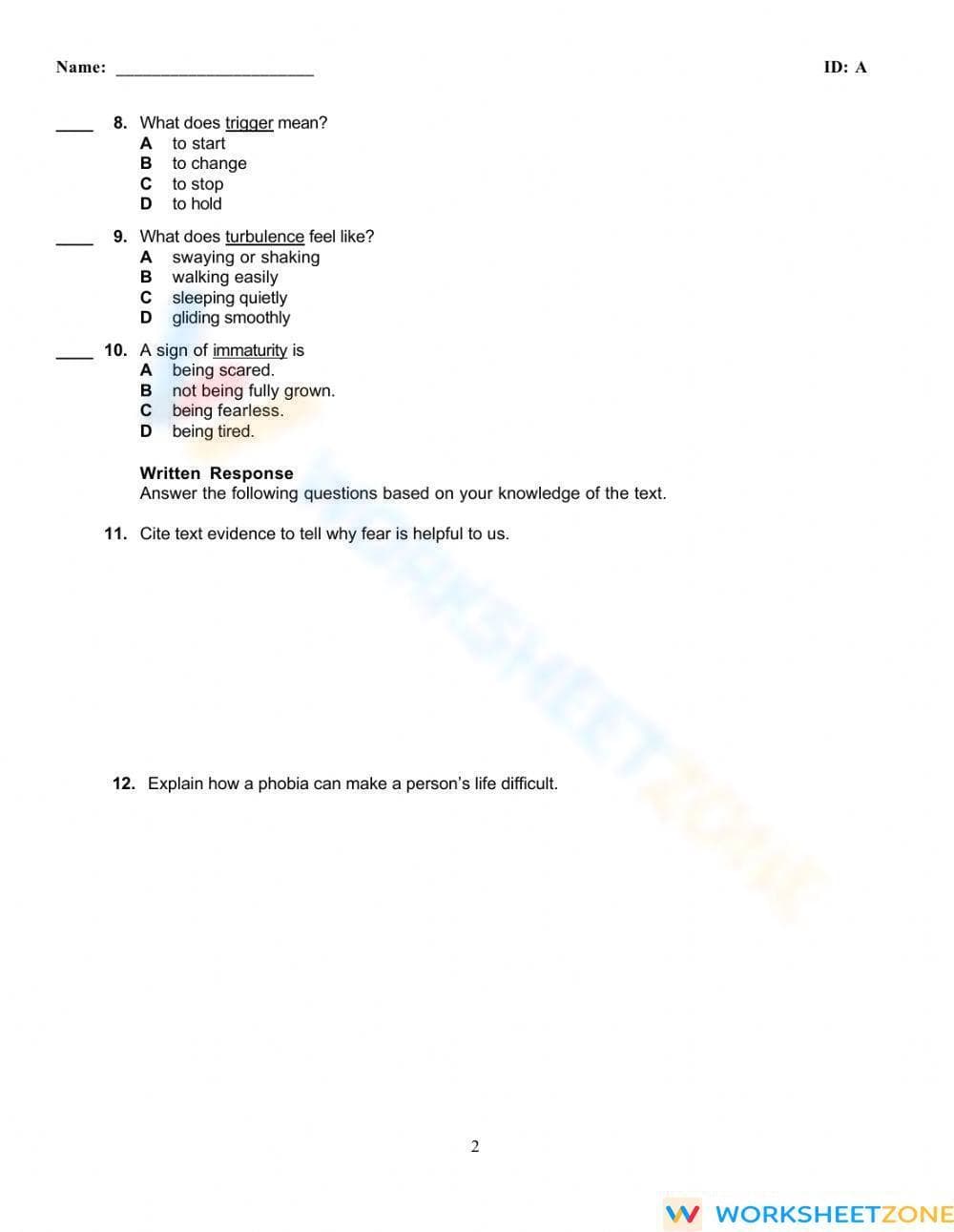
The worksheet package includes two structured pages of informational text analysis. The first page features six multiple-choice comprehension questions focusing on headings and physical responses. The second page extends into vocabulary acquisition and concludes with two written response tasks. A full answer key facilitates quick grading and student self-assessment.
Skill Progression
- Guided practice: Initial multiple-choice questions provide immediate feedback on student understanding of structural elements and primary definitions.
- Supported practice: Vocabulary tasks allow students to apply context clues to complex terms like 'turbulence' and 'trigger' within a structured framework.
- Independent practice: Final written response sections challenge students to synthesize learning by citing specific textual evidence and explaining complex relationships.
This progression follows a gradual-release model, moving from basic recognition to higher-order analysis and evidence-based writing.
Standards Alignment
The primary alignment for this resource is `RI.6.1`, which requires students to cite textual evidence to support analysis of what the text says explicitly as well as inferences drawn from the text. Additionally, it supports `L.6.4.A` by asking students to use context clues to determine the meaning of unknown words. Both standard codes can be copied directly into lesson plans, IEP goals, or district curriculum mapping tools.
How to Use It
Use this worksheet during the independent practice phase after a lesson on informational text structures. Teachers should model how to locate evidence before students work individually. For a formative assessment tip, observe student responses to question 11 to gauge their ability to differentiate between fear types. Expected completion time ranges from 20 to 30 minutes.
Who It's For
Designed for Grade 6 students, this resource also supports Grade 5 advanced learners or Grade 7-8 students requiring remedial reading support. It pairs naturally with a short passage on the nervous system or an anchor chart detailing the gradual release model for evidence-based writing.
Research conducted by Fisher & Frey (2014) emphasizes the importance of scaffolding reading comprehension through a combination of multiple-choice and open-ended questions to build student stamina for complex texts. This Fears and Phobias worksheet applies these principles by requiring students to move beyond surface-level recall into evidence-based justification. By aligning tasks with RI.6.1, the resource ensures that students are practicing the specific cognitive moves required for college and career readiness as defined by national standards. The inclusion of vocabulary-in-context questions further supports the acquisition of Tier 2 academic language, which is a critical predictor of overall reading proficiency in middle school settings. This instructional design allows educators to gather precise data on student mastery of informational text analysis while providing students with the structured practice necessary to become self-regulated readers in an increasingly complex information environment.


