


























Views
Downloads
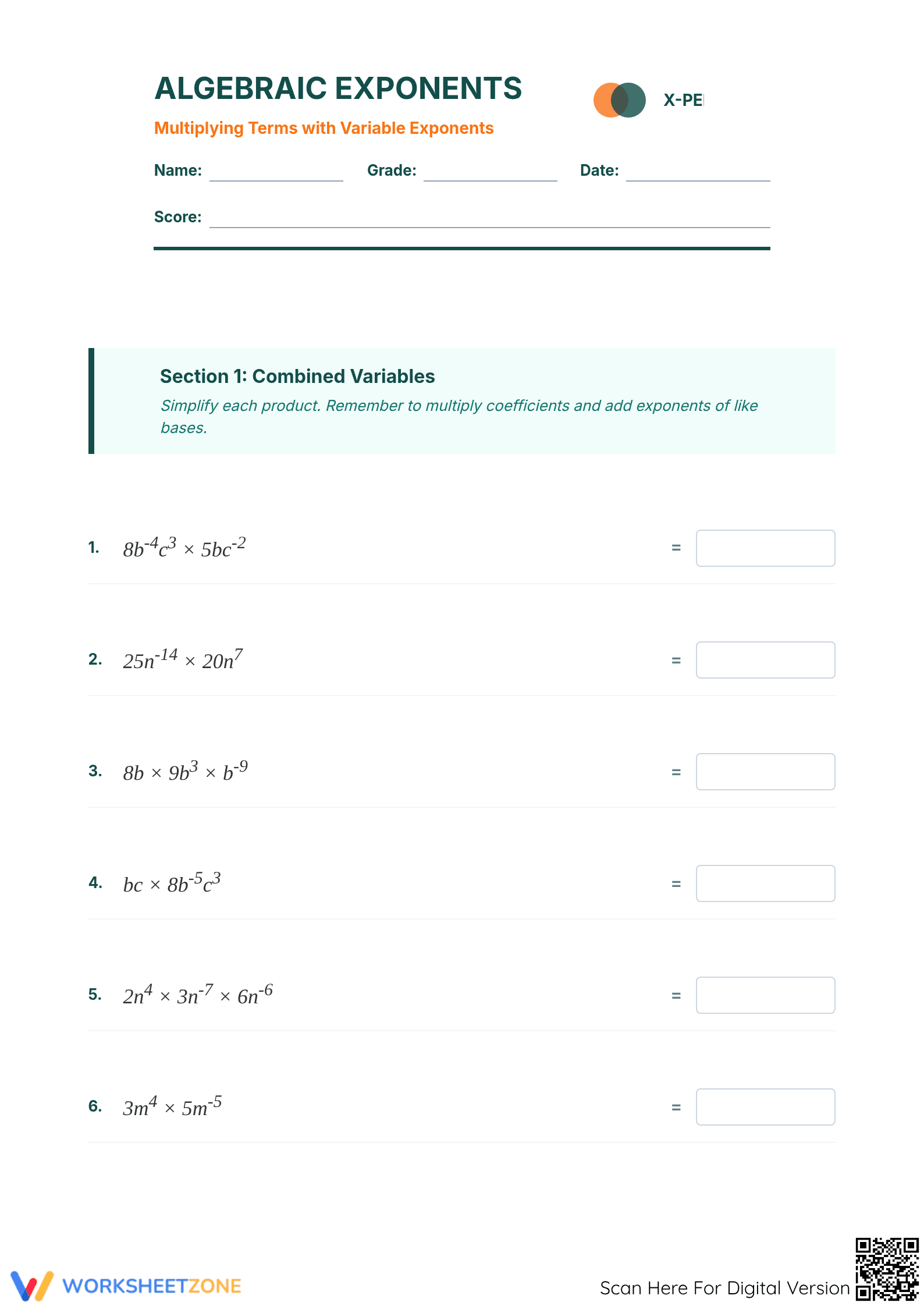
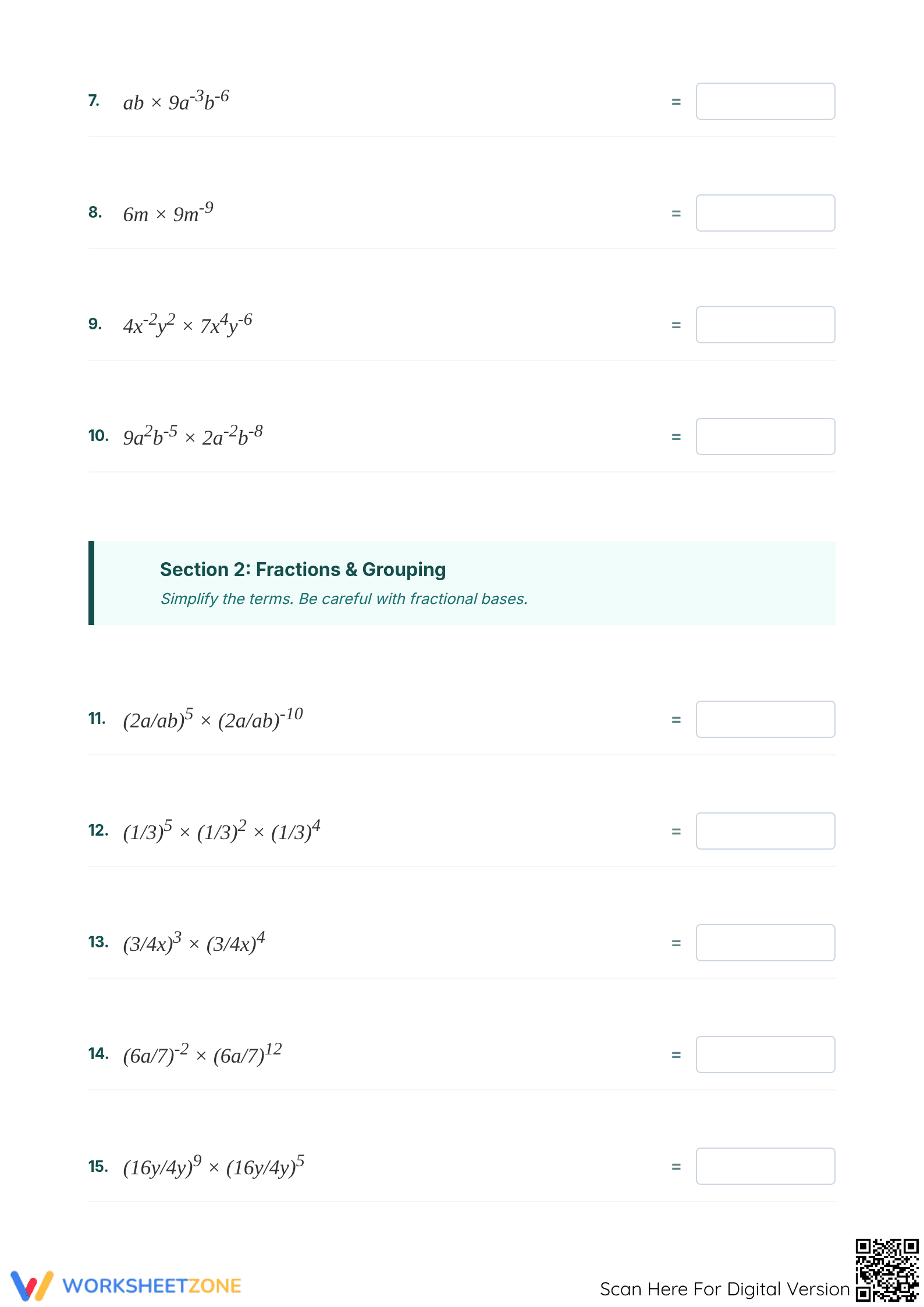
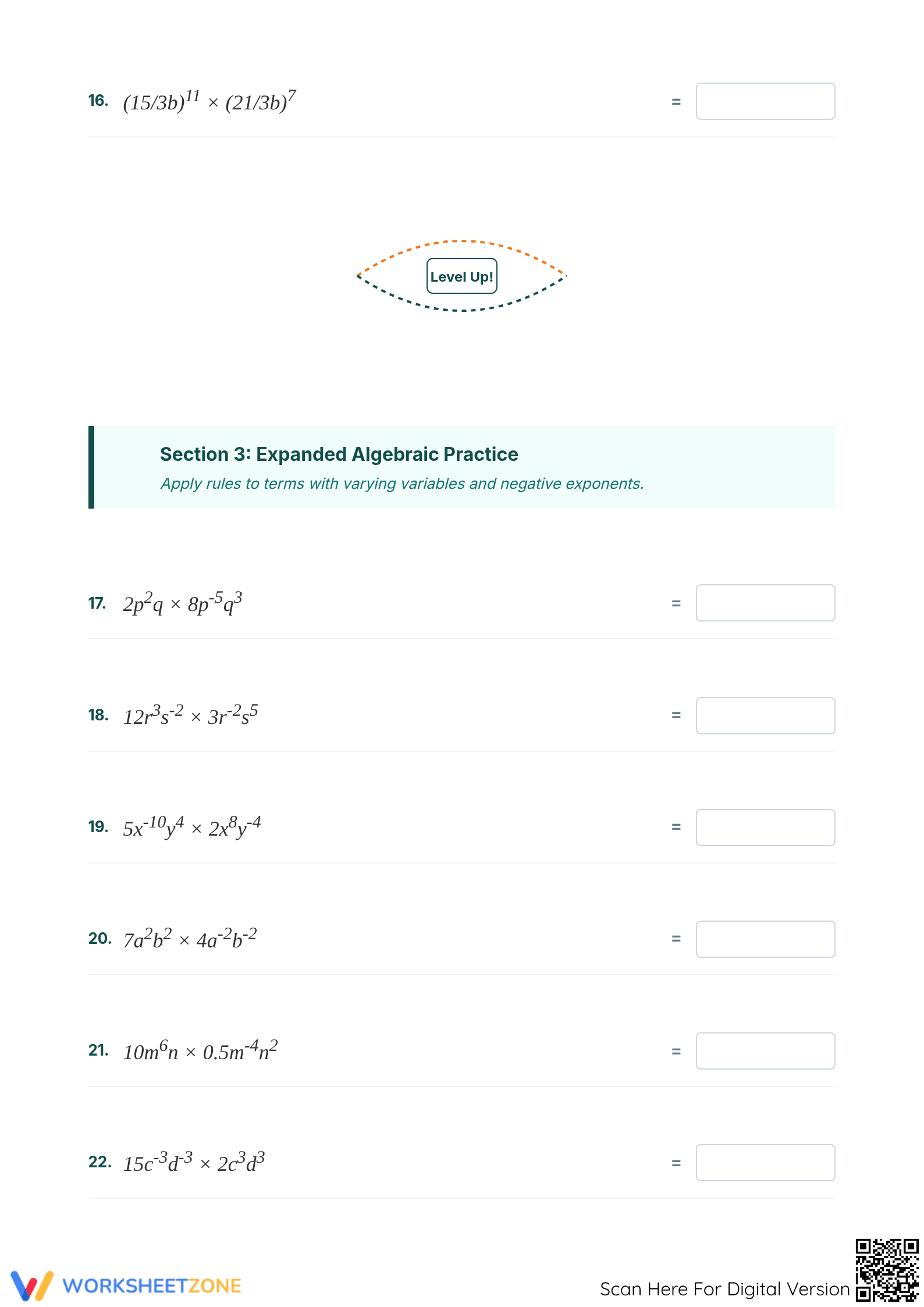
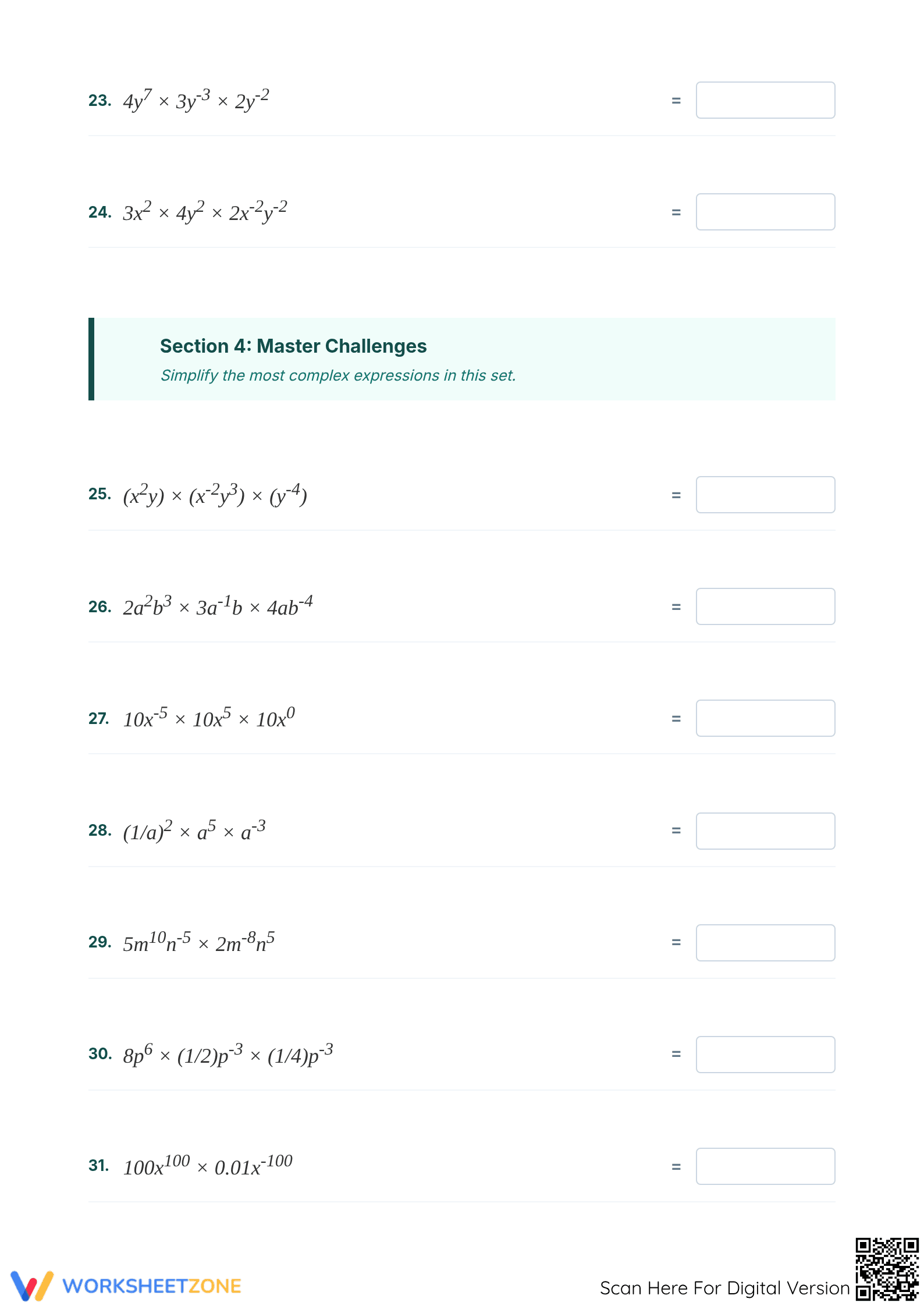


Essential Multiplying Exponents Worksheet | Grade 8 Math
Paste this activity's link or code into your existing LMS (Google Classroom, Canvas, Teams, Schoology, Moodle, etc.).
Students can open and work on the activity right away, with no student login required.
You'll still be able to track student progress and results from your teacher account.
Master the complexities of algebraic exponents with this comprehensive practice set designed for middle and high school mathematicians. This worksheet focuses specifically on the product rule for exponents, requiring students to simplify expressions with multiple variables, negative integers, and fractional bases. By the end of these exercises, learners will demonstrate fluency in combining like bases and calculating coefficients across diverse problem structures.
At a Glance
- Grade: 8 · Subject: Math
- Standard:
CCSS.MATH.CONTENT.8.EE.A.1— Apply the properties of integer exponents to generate equivalent numerical expressions- Skill Focus: Multiplying algebraic terms with variable exponents
- Format: 5 pages · 32 problems · Answer key included · PDF
- Best For: Independent practice or mastery assessment
- Time: 45–60 minutes
This five-page PDF includes 32 carefully sequenced problems divided into four distinct sections: combined variables, fractions and grouping, expanded algebraic practice, and master challenges. Each page provides ample workspace for students to show their thinking. A complete answer key is provided at the end of the document, allowing for immediate feedback and self-correction during the learning process.
- Guided Practice: The first 10 problems focus on basic variable combinations, helping students apply the product rule to simple coefficients and integer exponents.
- Supported Practice: Questions 11 through 24 introduce fractional bases and grouped terms, requiring accuracy while navigating complex algebraic notation.
- Independent Practice: The "Master Challenges" section presents high-order problems with three variables and large exponents to ensure skill transfer.
This structure follows the gradual-release model to ensure students achieve total mastery of exponent properties.
The core of this resource is aligned to CCSS.MATH.CONTENT.8.EE.A.1, which requires students to know and apply the properties of integer exponents to generate equivalent numerical expressions. It also supports higher-level algebraic standards regarding the simplification of rational expressions. Both standard codes can be copied directly into lesson plans, IEP goals, or district curriculum mapping tools.
Use this worksheet as a primary practice set immediately following direct instruction on the product rule for exponents. It serves as an excellent formative assessment tool; teachers can observe student handling of negative exponents in Section 1 to identify common misconceptions before moving to the master challenges. The expected completion time is roughly 50 minutes for a standard class period.
This resource is tailored for 8th-grade math students and Algebra 1 learners who are building their foundation in exponent laws. It is particularly effective for students requiring extra practice with variable manipulation. Pair this worksheet with a visual anchor chart displaying the product rule to support visual learners during the transition to abstract problem-solving.
Effective instruction in algebraic properties requires a balance of procedural fluency and conceptual understanding. According to Fisher & Frey (2014), the gradual release of responsibility—moving from "I do" to "You do"—is essential for students to internalize complex mathematical rules like the product property of exponents. This worksheet facilitates that transition by scaffolding tasks from basic variable multiplication to multi-step challenges involving fractional bases and negative integers. By providing 32 structured problems, the resource ensures that learners receive sufficient repetitions to move the standard CCSS.MATH.CONTENT.8.EE.A.1 from short-term memory to long-term mathematical fluency. Research indicates that students who master exponent properties in middle school demonstrate significantly higher success rates in advanced calculus and STEM-related coursework. This self-contained practice set provides the rigorous evidence needed for progress monitoring and standards-based grading in diverse classroom environments.


